
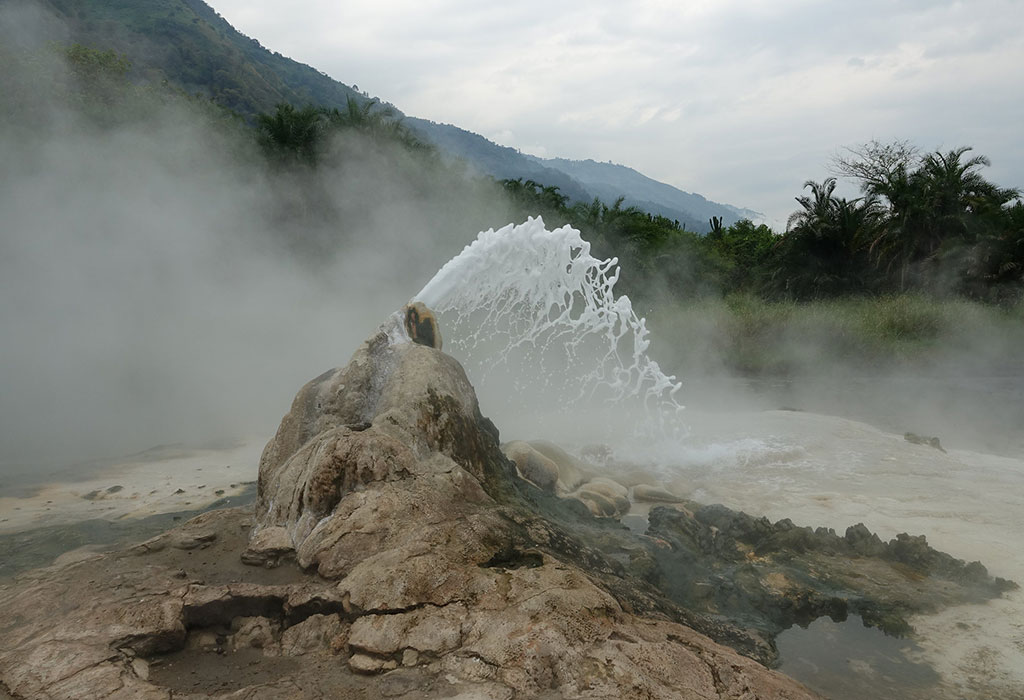
Sempaya Hot Spring represents one of Uganda’s most extraordinary natural phenomena, combining geological marvels with deep cultural significance in the heart of Semuliki National Park. These two remarkable geothermally heated springs, known locally as the Male and Female hot springs, stand as a testament to the powerful forces that shaped the Albertine Rift Valley. Beyond their impressive geological features, including a dramatic geyser that shoots boiling water two meters into the air, the springs hold profound spiritual meaning for the indigenous Bamaga people, who consider them sacred dwelling places of ancestral spirits.
Geographic Setting and Access
The Sempaya Hot Springs are strategically positioned in Bundibugyo District in western Uganda, creating a natural border marker near the Democratic Republic of Congo. This remarkable location places them on the edge of the legendary Rwenzori Mountains, within the geologically active Albertine Rift Valley, where tectonic forces have created some of East Africa’s most spectacular natural features.
Reaching these natural wonders requires a journey through Uganda’s diverse landscapes. Travelers from Kampala can choose between two distinct routes, each offering unique experiences. The shorter route via Mubende provides efficient access, requiring approximately 5 to 6 hours of road travel through Fort Portal. For those seeking a more scenic adventure, the longer route through Masaka, Mbarara, and Kasese offers breathtaking mountain and valley views, though it extends the journey to 7 to 8 hours.
Once within Semuliki National Park, visitors must embark on a guided nature walk through pristine lowland forest to reach the springs. While the path remains relatively flat, the tropical forest environment demands appropriate footwear, as conditions can become wet and muddy, particularly during rainy seasons. This forest trek serves as an introduction to the park’s rich biodiversity and creates anticipation for the geothermal spectacle ahead.
Geological Marvels and Natural Phenomena
The springs’ existence results from fascinating geological processes occurring deep beneath the Earth’s surface. Superheated underground water, subjected to intense geological pressure from the Rift Valley’s tectonic activity, forces its way to the surface, creating these remarkable geothermal features. The water reaches extraordinary temperatures of up to 103°C, sufficiently hot to boil eggs completely within ten minutes, demonstrating the intense heat generated by underground geological forces.
The Female Spring, known locally as Nyasimbi, presents the more dramatic spectacle of the pair. This powerful geyser regularly gushes boiling water up to two meters into the air, creating impressive steam clouds visible from distances of up to two kilometers. The rhythmic eruptions and towering steam create an almost otherworldly atmosphere that captivates visitors and photographers alike.
In contrast, the Male Spring, called Bintente, offers a different but equally mesmerizing experience. Located deeper within the forest, this calm, steaming pool spans approximately twelve meters in diameter, creating a serene hot pool that bubbles gently while maintaining consistently high temperatures. The contrast between the two springs illustrates the diverse ways geothermal energy manifests in natural environments.
Cultural Heritage and Sacred Legends
The springs hold profound spiritual significance for the Bamaga people, who have inhabited this region for generations. According to their rich oral tradition, the springs serve as sacred sites where ancestral spirits continue to reside, watching over their descendants and the surrounding forest.
The compelling legend explaining the springs’ Male and Female designations centers on a tragic love story deeply embedded in local folklore. Biteete and Nyansimbi, a devoted married couple, became separated when Biteete disappeared during a hunting expedition. Village men searching for him discovered only his spear at the location that became the Male Hot Spring. Subsequently, Nyansimbi ventured into the forest seeking her missing husband, but also vanished mysteriously. Searchers found only her clothing at the site that transformed into the Female Hot Spring.
This legend established enduring cultural practices that continue today. Men traditionally visit the Male Spring to make offerings and seek blessings for wealth and prosperity in their endeavors. Women journey to the Female Spring to pray for fertility, healthy pregnancies, and successful childbirth. Annual ceremonies performed at both springs maintain spiritual connections with ancestral gods and preserve cultural traditions across generations.
Visitor Experiences and Activities
The springs offer diverse activities that combine natural wonder with cultural education. The popular egg-boiling demonstration showcases the water’s extreme temperature while providing visitors with a unique dining experience. Watching eggs cook in naturally heated water creates memorable moments and excellent photographic opportunities.
The forest walk to reach the springs doubles as an exceptional nature observation experience. The surrounding lowland forest supports diverse wildlife populations, including red-tailed monkeys and black-and-white colobus monkeys, which frequently appear along the trail. Birdwatchers can spot numerous species unique to this forest ecosystem, making the journey as rewarding as the destination.
Cultural encounters enhance the visit through interactions with the nearby Batwa pygmy community, offering insights into traditional forest lifestyles and indigenous knowledge systems. These encounters provide valuable perspectives on sustainable forest management and cultural preservation.
Planning Your Visit
Optimal visiting conditions occur during Uganda’s dry seasons, from June to September and December to February, when rainfall is minimal and forest paths remain more manageable. In addition, periods offer clearer skies for better photography and more comfortable hiking conditions.
Park entrance fees vary according to visitor categories: foreign non-residents pay $35, foreign residents pay $25, and East African citizens pay UGX 15,000. However, all visitors must be accompanied by trained local guides who provide safety oversight and cultural interpretation.
The Sempaya Hot Springs represent a perfect synthesis of natural wonder and cultural heritage, offering visitors unforgettable experiences that combine geological education, wildlife observation, and cultural immersion in one remarkable destination within Uganda’s diverse landscape.





