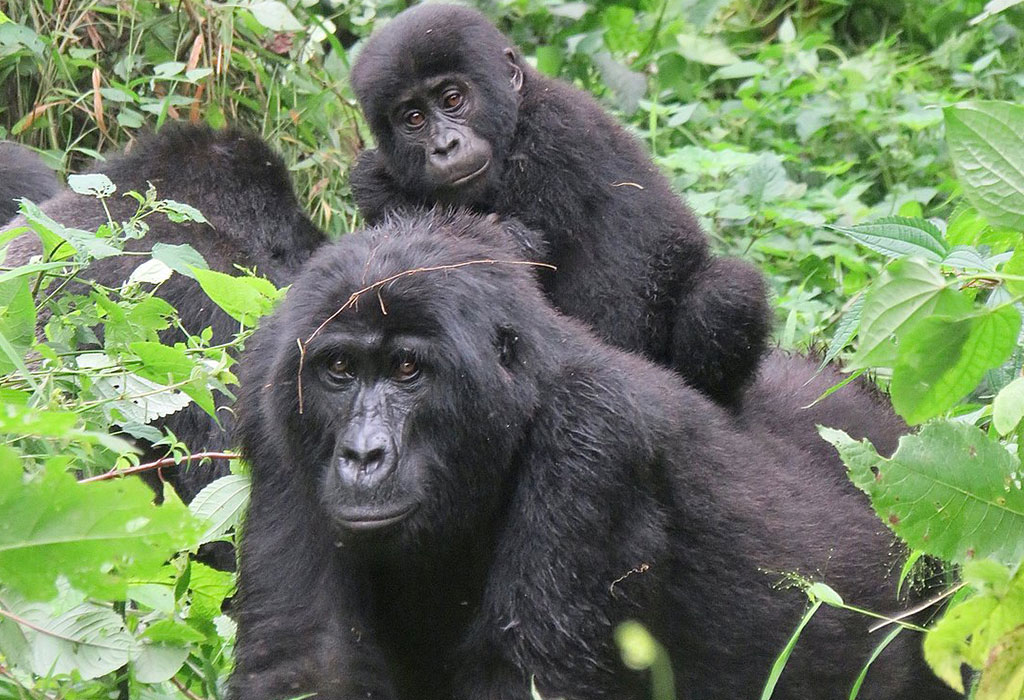
Are Gorilla Safaris in Rwanda Safe? Gorilla safaris in Rwanda are safe. Well-trained and experienced ranger guides lead every trek, and they carry deep knowledge of mountain gorilla behavior. At least two ranger guides accompany each gorilla trekking group. One carries a machete, and the other carries a rifle. Each guide also holds a radio to stay in constant contact with the security team on the ground. If any situation requires backup, help arrives quickly. Following the park’s rules and guidelines makes the entire experience safe and enjoyable for every visitor.
Are Mountain Gorillas Aggressive?
Mountain gorillas look intimidating at first glance. They have large dark bodies, fierce faces, and move by walking on their knuckles. However, they are naturally calm and gentle primates. In reality, they tend to run and hide when something frightens them rather than attack.
When you find the gorillas, they will likely be busy eating leaves and plants. However, they always keep a quiet eye on their visitors. If a gorilla feels provoked, it may thump its chest, pull at grass, or walk on one leg. If this happens, stay calm and do not panic. Wait for your ranger guide to assess the situation, as gorillas sometimes behave this way during internal family disputes or when testing visitors. Always follow the guide’s instructions closely, especially since your time with the gorillas is limited.
Can You Reschedule a Gorilla Permit in Rwanda?
Yes, you can reschedule a Rwanda gorilla permit, but it must be fully paid before the request is considered. To reschedule, write to the Rwanda Development Board’s reservation office and state the new date you wish to move to. Include a brief reason for the change to support your request. Once the board acknowledges your request, they move your permit to the new date, subject to availability. Note that the Rwanda Development Board charges a fee for rescheduling gorilla permits.
Which Gorilla Family is Easiest to Trek?
Rwanda’s Volcanoes National Park is home to 12 habituated gorilla families, including Amahoro, Umubano, Kwitonda, Hirwa, Susa, Sabyinyo, Agashya, Muhoza, and Karisimbi, among others. It is difficult to say which family is the easiest to find, because their location changes daily. A family that was close to the trailhead one day may have moved deep into the forest by the next. Factors such as feeding locations, family conflicts, or the adventurous nature of a particular group all affect where they go.
The best approach is to stay patient, keep fit, and enjoy everything the forest offers along the way. Primate species, colorful butterflies, bird species, sparkling waterfalls, and forest mammals all appear during the hike, keeping the journey interesting before the gorillas are found.
Can You See Gorillas Without a Permit?
No. A gorilla trekking permit from the Rwanda Development Board is required to enter Volcanoes National Park. Think of it as an entry ticket — without it, access to the park is not possible. Each gorilla family allows a maximum of eight visitors per day. With 12 trekking families currently available, Rwanda manages visitor numbers carefully to protect the gorillas and their habitat.
On arrival at the park’s ranger station, visitors present their permits and other identification documents for verification. After a morning briefing, rangers assign each group to a gorilla family. The assignment criteria vary and can be based on age, physical ability, or visitor interests.
When Should You Book a Permit?
Book your gorilla trekking permit at least six months to one year in advance. Permits are limited to eight per gorilla family per day, and demand is consistently high. During peak season, which runs from June to September and December to January, permits sell out very quickly. Even during the low season, availability can be tight. Booking early guarantees your spot and removes the stress of last-minute uncertainty.
How to Book Rwanda Gorilla Permits
Rwanda releases gorilla permits daily. To book, select your preferred dates and the number of permits you need, then contact a trusted tour operator. Our safari consultants check availability directly from the Rwanda Development Board’s permit list. Once availability is confirmed, we strongly advise clients to purchase immediately, as permits go fast. Payment follows a first-come, first-served basis. Visitors can pay in full or in installments of 30% and 70% as per the Rwanda Development Board policy. For permit processing, visitors must provide their full name, nationality, date of birth, and passport expiry date.
How Much Does a Rwanda Gorilla Permit Cost?
A Rwanda gorilla trekking permit costs USD 1,500 for international non-residents, USD 500 for international residents, and USD 200 for East African citizens. The permit covers park entrance fees, ranger guide services, security, gorilla conservation, a trekking certificate, community support, government tax, and one hour with the gorillas. Porter hire and accommodation are not included.
The permit cost is worth every dollar. Mountain gorillas are among the rarest animals on earth, having survived the ice age period that wiped out most of Africa’s forests between 12,000 and 18,000 years ago. By the 1980s, only around 250 mountain gorillas remained. Today, thanks to conservation funding from permit sales and other sources, the global mountain gorilla population has grown to over 1,000.
Best Time to Go Gorilla Trekking in Rwanda
The dry season from June to September and December to February offers the best trekking conditions. Trails are easier to walk, vegetation is thinner, and gorillas are simpler to spot. The rainy season from March to May and October to November brings muddy trails and heavier rain. However, it is a good option for budget travelers, as lodge prices drop and crowds are smaller.
What to Wear and Pack
Wear long-sleeved shirts, waterproof trekking trousers, sturdy waterproof hiking boots, thick socks, gardening gloves, and a waterproof rain jacket. Pack a lightweight backpack, warm layers, a hat, insect repellent, a camera without flash, binoculars, a water bottle, energy snacks, and a first-aid kit. Keep everything lightweight to manage the steep slopes comfortably.
Gorilla Trekking Rules
Are Gorilla Safaris in Rwanda safe? Visitors must wear a clean mask near the gorillas, maintain a distance of at least eight meters, avoid flash photography, stay quiet, refrain from eating or smoking within 200 meters of the gorillas, and avoid spitting near vegetation. Anyone with a communicable illness must stay behind. Only visitors aged 15 and above may participate. Following these rules protects the gorillas and ensures a safe experience for everyone.