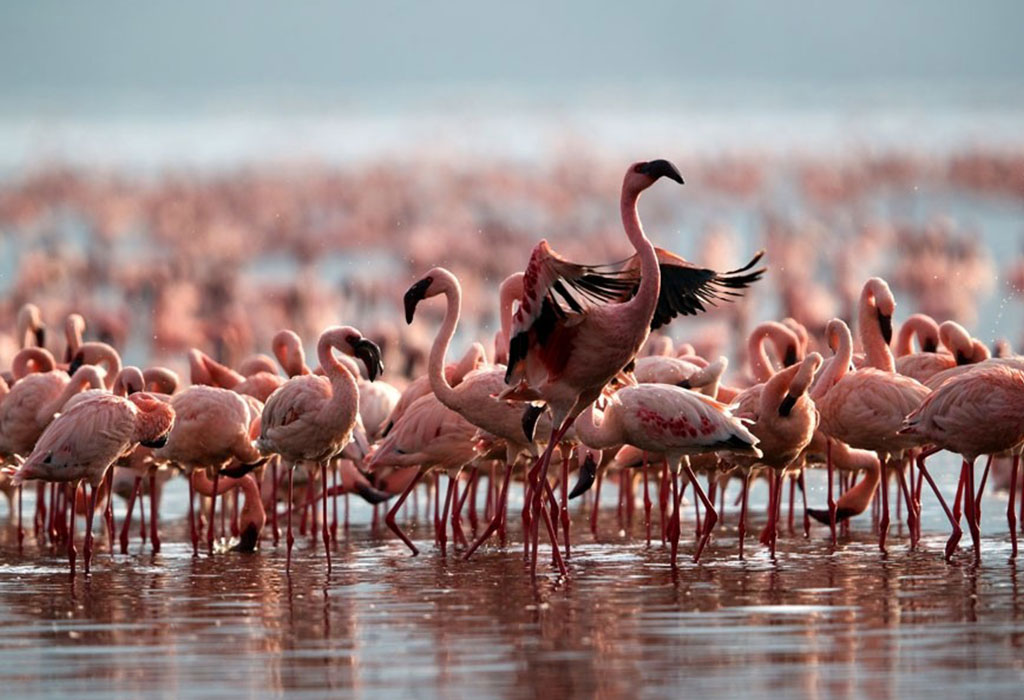
Birding in Lake Nakuru National Park: Lake Nakuru National Park is truly a paradise for birds. In 1960, authorities first designated it a bird sanctuary to protect and conserve the remarkable birdlife thriving around Lake Nakuru. Since then, the park has grown into one of Kenya‘s most famous safari destinations, attracting both local and international visitors. Millions of flamingos have historically gathered along its shores throughout the year. However, the climate keeps changing, and shifting water levels have reduced flamingo numbers from millions to thousands. Even so, these graceful birds still paint the lake’s shores pink every single day.
Lake Nakuru is a soda lake, meaning it contains high levels of blue-green algae. This algae serves as the main food source for flamingos, which is why they flock to the lake in such large numbers. Another bird that feeds on the lake is the great white pelican, which arrives alongside many other wading birds, making the lake a busy and vibrant feeding ground.
Birding in the Park
Birding in Lake Nakuru National Park is one of the most exciting wildlife experiences in East Africa. The park covers about 118 square kilometers and shelters over 450 species of birds, both resident and migratory. Visitors enjoy watching flamingos line the shores throughout the year, creating a stunning pink display that few places in the world can match.
Beyond flamingos, the park is home to several endemic species, including the pelican. It also shelters four threatened bird species — the Madagascar pond-heron, the Pallid Harrier, the Greater Spotted Eagle, and the Grey-crested Helmet-shrike. Birdwatchers travel from across the world specifically to see these rare species.
The best birding happens along the lake’s shores and across the park’s diverse vegetation zones, which include bushy grasslands, acacia woodlands, and euphorbia forests. These different habitats support a wide variety of species. Among them are the African Spoonbill, Black-winged Stilt, Red-capped Lark, Rufous-throated Wryneck, Yellow-billed Stork, Ruppel’s Vulture, Ruppel’s Robin-chat, Black-necked Grebe, Long-tailed Widowbird, Maccoa Duck, Montane White-eye, Grey-headed Gull, Northern Puffback, Pallid Harrier, Gull-billed Tern, Little Grebe, Schalow’s Wheatear, and the Shining Sunbird, among many others.
Best Time for Birding
Visitors can watch birds at any time of day in Lake Nakuru National Park. However, the best time is in the morning, between 6 AM and 11 AM. During these hours, birds leave their nests and fly out to search for food. This makes them easy to spot and enjoy before they scatter across the park. Evenings are also a good time to watch, as birds return to their nests before dark. Still, mornings remain the top choice for birdwatchers because of the high activity levels and soft lighting.
Since the park holds over 450 bird species, visitors cannot see them all in one morning. Therefore, spending at least four days in the park is strongly advisable. This gives birdwatchers enough time to explore different areas and observe a wide range of species without feeling overwhelmed. Alternatively, visitors can identify the specific birds they want to see before arriving and focus their time searching for those.
In terms of months, January and July are particularly special for birding. These are the months just after the rainy seasons. During the rains, food becomes abundant, and vegetation grows thick, which attracts more birds and supports their breeding. As a result, bird numbers peak during these months, giving visitors an even richer experience.
How Birding Works in the Park
Birding in Lake Nakuru National Park mainly takes place along the shores of the lake. Visitors observe birds from inside their vehicles or stand quietly along the shoreline and watch. During game drives, guides drive through the park and stop at key points where birds are active. The park also has several viewpoints, including Lion Hill, Out of Africa Lookout, and Baboon Cliff. Of all these, Baboon Cliff stands out as the best viewpoint for birding. From there, visitors get a wide and elevated view of the lake and the surrounding landscape, making it easier to spot birds in large numbers.
When to Visit
Although birdwatching is available throughout the year, the dry season offers the best overall conditions for visiting Lake Nakuru National Park. The dry months include January, February, June, July, August, September, and December. During this time, vegetation thins out, water sources shrink, and animals gather in more predictable locations. This makes it easier to spot both birds and other wildlife.
Getting to Lake Nakuru National Park
The park sits in central Kenya, northwest of Nairobi, within the Great Rift Valley. Visitors can reach it through three main gates, each via a different route. From Nairobi, the most popular route follows the Nairobi-Nakuru Highway, which takes about three to four hours. This road passes through beautiful landscapes and communities before reaching Nakuru Town, which sits just four kilometers from the park’s main gate.
Travelers can also branch off the highway to reach the Lanet Gate, bypassing Nakuru Town and arriving at a similar time. Visitors coming from the Maasai Mara or Elementaita use the Nderit Gate because of its convenient location along those routes. For those who prefer flying, Naishi Airstrip sits inside the park, so visitors land and immediately begin their safari without passing through any gate.
Other Activities at the Park
Apart from birding, Lake Nakuru National Park offers many other exciting activities. Visitors enjoy boat cruises on the lake, cultural tours among the neighboring Maasai community, guided game drives to spot rhinos, lions, leopards, giraffes, and zebras, rhino tracking at the park’s sanctuary, guided nature walks, and picnics or overnight camping under the stars. Together, these activities make Lake Nakuru National Park a complete and unforgettable safari destination.