

Uganda Big Five Safari – Complete Guide to Seeing Africa’s Big Five
A Uganda Big Five Safari gives travelers the opportunity to search for Africa’s five legendary safari animals—the lion, leopard, African elephant, African buffalo and rhinoceros—while exploring some of Uganda’s most spectacular protected landscapes. Unlike countries where all five species may occur inside a single reserve, completing a Uganda Big Five Safari requires combining national parks containing lions, leopards, elephants and buffaloes with Ziwa Rhino Sanctuary for white rhino tracking. For many travelers, the strongest route combines Uganda Big Five safari experiences with Murchison Falls National Park and Ziwa Rhino Sanctuary before extending toward primate destinations in western and southwestern Uganda.
Introduction to a Uganda Big Five Safari
A Uganda Big Five Safari is not simply about checking five famous animals off a wildlife list. Uganda’s greatest strength is that the Big Five can form the foundation of a much broader safari involving mountain gorillas, chimpanzees, Nile cruises, shoebill searches, tree-climbing lions, primates and spectacular landscapes. This means travelers can combine a traditional African wildlife safari with experiences that are extremely difficult to reproduce in the same journey elsewhere.
Anthill Safaris’ guide to where to see the Big Five in Uganda explains why several destinations need to work together rather than relying on a single national park.
What Are Africa’s Big Five?
Africa’s Big Five are the lion, leopard, African elephant, African buffalo and rhinoceros. These animals became internationally famous during the colonial hunting era, but modern responsible safari tourism has transformed the meaning of the term. Today, the Big Five are primarily associated with wildlife photography, conservation, game viewing and responsible observation rather than trophy hunting.
A modern Big Five safari in Uganda should therefore emphasize protecting wildlife and appreciating natural behavior rather than getting dangerously close to animals or pressuring guides to manufacture sightings.
Why Are They Called the Big Five?
The term “Big Five” originally referred to five African animals considered particularly difficult and dangerous to hunt on foot. Their fame later transferred into photographic safari tourism, where the same animals became symbols of African wildlife conservation.
For today’s traveler, the value of seeing the Big Five should come from observing wild behavior, understanding habitats and supporting conservation. A leopard disappearing into woodland or an elephant herd crossing the savannah can be more meaningful than simply completing a checklist.
What Are the Big Five Animals in Uganda?
Uganda’s Big Five are lion, leopard, African elephant, African buffalo and rhinoceros. Each requires a somewhat different wildlife-viewing strategy, and sightings of wild species can never be guaranteed.
Lion
Lions occur in Murchison Falls National Park, Queen Elizabeth National Park and Kidepo Valley National Park. Queen Elizabeth is particularly famous for the unusual tree-climbing lions found in the Ishasha sector, while Murchison Falls provides extensive northern savannah habitat for conventional lion prides.
Travelers particularly interested in big cats can review the must-see animals in Uganda before deciding how much time to allocate to predator-focused game drives.
Leopard
The leopard is generally the most difficult member of Uganda’s Big Five to see. Leopards occur in several protected landscapes, including Queen Elizabeth, Murchison Falls, Kidepo Valley and Lake Mburo, but their solitary and often nocturnal behavior makes sightings unpredictable.
Travelers should therefore never book a Uganda Big Five Safari based on a guarantee of seeing a leopard. Multiple game drives and an experienced guide can improve the opportunity, but patience remains essential.
African Elephant

African elephants can be encountered in major Uganda wildlife parks including Murchison Falls, Queen Elizabeth and Kidepo Valley. Murchison is particularly impressive because elephants may be observed both during game drives and from boats along the Nile.
Queen Elizabeth also offers excellent elephant habitat, and its Kazinga Channel creates opportunities to watch elephants approaching water during a Queen Elizabeth wildlife safari.
African Buffalo
African buffaloes are widespread across several Ugandan savannah parks and are generally among the more frequently encountered members of the Big Five. Herds occur in Murchison Falls, Queen Elizabeth, Kidepo Valley and Lake Mburo.
Buffaloes should always be observed responsibly because they are powerful wild animals. Visitors should remain inside the safari vehicle unless participating in an officially authorized guided activity.
Rhinoceros
Rhinos require a different approach from the other four Big Five animals. Uganda’s established rhino tourism experience is centered on Ziwa Rhino and Wildlife Ranch in Nakasongola, where visitors can participate in guided white rhino tracking on foot.
The dedicated Ziwa Rhino Sanctuary guide explains why this conservation area is essential for travelers hoping to complete the Big Five in Uganda.
Can You See All the Big Five in Uganda?
Yes. Travelers can potentially see all five Big Five species during one Uganda safari, but they need to combine destinations. Lions, leopards, elephants and buffaloes occur in Uganda’s major savannah parks, while white rhinos are encountered through Ziwa Rhino Sanctuary.
Because wildlife is wild, seeing all five can never be guaranteed. Leopard sightings in particular may require patience. A well-planned Uganda Big Five and primate tour should therefore focus on a rewarding overall safari rather than treating one elusive animal as the sole measure of success.
Where Can You See the Big Five in Uganda?
The most efficient route is usually Ziwa Rhino Sanctuary combined with Murchison Falls National Park. Ziwa provides the rhino encounter, while Murchison supports lions, leopards, elephants and buffaloes. Travelers can then extend south toward Kibale, Queen Elizabeth and Bwindi if they have additional days.
Can You See All Five in One Uganda National Park?
No. Under Uganda’s current wildlife distribution, no single national park provides all five. Rhinos need to be incorporated separately through Ziwa Rhino Sanctuary. This distinction is essential because some generic safari content incorrectly describes Queen Elizabeth or Murchison Falls as containing all five.
Anthill Safaris’ current guide to Uganda’s strongest Big Five route identifies Murchison Falls combined with Ziwa as the most concentrated option for travelers pursuing all five species.
Why Ziwa Rhino Sanctuary Is Essential
Ziwa plays a central role in Uganda’s rhino conservation story and provides travelers with the rhino component missing from the country’s major national parks. Rhino tracking is conducted on foot with trained guides rather than from an ordinary safari vehicle.
This creates a completely different wildlife experience and also allows visitors to understand the conservation effort behind Uganda’s rhino recovery. Travelers heading north from Kampala or Entebbe can incorporate rhino tracking at Ziwa before continuing toward Murchison Falls.
Where Can You See the Other Four?
Lions, leopards, African elephants and African buffaloes occur in several Uganda national parks. Murchison Falls is the strongest choice for concentrating the Big Four within one large savannah ecosystem. Queen Elizabeth adds excellent wildlife diversity and Ishasha’s tree-climbing lions, while Kidepo provides remote wilderness and distinctive dry-country wildlife.
Murchison Falls National Park
Murchison Falls National Park is arguably the most important traditional wildlife destination for a concentrated Uganda Big Five Safari. Lions, leopards, elephants and buffaloes occur within the park, while giraffes, antelopes, hippos, crocodiles and numerous bird species add depth to the wildlife experience.
The park also offers Nile boat safaris and the spectacular falls themselves, which means a Murchison Falls safari contributes far more than simply four Big Five species.
Queen Elizabeth National Park
Queen Elizabeth National Park is another important Big Five destination because lions, leopards, elephants and buffaloes occur across its diverse ecosystems. The park adds the Kazinga Channel, crater landscapes, hippos, abundant birdlife and the Ishasha sector.
It also fits exceptionally well into longer routes involving chimpanzees in Kibale and mountain gorillas in Bwindi, making it one of the strongest parks for travelers building a complete Uganda safari itinerary.
Kidepo Valley National Park
Kidepo Valley National Park provides another opportunity to search for lions, leopards, elephants and buffaloes, but its greatest attraction is its remote northeastern wilderness. Kidepo also supports species rarely encountered elsewhere in Uganda, including cheetahs and ostriches.
For travelers who have enough time, adding Kidepo to a Big Five safari can transform an ordinary wildlife itinerary into a much deeper Uganda expedition.
Why Choose Uganda for a Big Five Safari?
Uganda’s greatest advantage is variety. Travelers can pursue the Big Five while also experiencing mountain gorillas, chimpanzees, shoebills, golden monkeys, tree-climbing lions, the Nile and extraordinary birdlife.
This creates an unusually broad wildlife journey. A visitor may track rhinos on foot at Ziwa, search for lions in Murchison, cruise the Nile, follow chimpanzees through Kibale and then trek mountain gorillas in Bwindi within the same holiday.
Uganda Big Five Safari vs Kenya
Kenya is exceptionally strong for large-scale savannah wildlife, particularly in destinations such as the Maasai Mara, Amboseli and other established reserves. Travelers primarily interested in classic plains wildlife and large concentrations of animals may find Kenya exceptionally rewarding.
Uganda’s advantage is not that it necessarily provides larger concentrations of Big Five wildlife. Its advantage is the ability to combine those animals with mountain gorillas, chimpanzees and specialist primate experiences.
Uganda Big Five Safari vs Tanzania
Tanzania has some of Africa’s most famous Big Five ecosystems, including the Serengeti and Ngorongoro region. It is particularly strong for vast landscapes, major predator populations and large concentrations of plains mammals.
Uganda again differentiates itself through primates. A traveler can combine a Uganda Big Five experience with mountain gorilla trekking before continuing to Tanzania using an Uganda gorilla and Tanzania safari.
What Makes Uganda Different?
Uganda’s wildlife diversity allows a single safari to cross radically different ecosystems. Murchison Falls provides Nile savannah, Kibale provides tropical forest chimpanzees, Queen Elizabeth combines savannah and wetlands, and Bwindi protects mountain gorillas in ancient rainforest.
This means a Uganda Big Five Safari can develop into a gorilla and Big Five safari rather than ending after the fifth iconic mammal is found.
Travelers can also incorporate shoebill birdwatching around Uganda’s wetlands, creating yet another specialist wildlife experience.
Is Uganda Good for First-Time Safari Travelers?
Yes. Uganda works particularly well for first-time safari travelers who want both traditional wildlife and active nature experiences. Game drives and boat safaris can be combined with walking rhino tracking, chimpanzee tracking and gorilla trekking.
The main consideration is itinerary length. A traveler with only three days should concentrate on one wildlife region, while seven to ten days provides a much stronger introduction.
Uganda Big Five Safari for Couples
Couples can combine private game drives, intimate safari lodges and water-based wildlife activities with gorilla trekking or lakeside extensions. A private vehicle provides flexibility for photography and allows couples to travel at their own pace.
Adding Bwindi can transform a conventional Big Five trip into a memorable gorilla and wildlife safari.
Uganda Big Five Safari for Families
Families can enjoy game drives, boat cruises, rhino tracking and lodge-based wildlife viewing. The exact itinerary should consider children’s ages because some activities, including gorilla trekking, have minimum-age requirements.
Families often benefit from spending two nights in major destinations rather than changing accommodation every day.
Uganda Big Five Safari for Solo Travelers
Solo travelers can undertake private Uganda Big Five safaris with their own driver-guide or join selected departures when available. Rhino tracking and primate activities naturally bring travelers together with other participants while the rest of the journey can remain private.
Uganda Big Five Safari for Seniors
Senior travelers can enjoy a Big Five Safari comfortably because most traditional wildlife viewing takes place from safari vehicles or boats. Walking rhino tracking requires some mobility, but the physical demands are generally very different from mountain gorilla trekking.
Travelers who want gorillas as an extension can reduce long road transfers through domestic flights and carefully positioned accommodation.
Uganda Big Five Safari for Photographers
Uganda is particularly rewarding for photographers because the Big Five can be photographed against several different environments. Elephants along the Nile, lions in open savannah, rhinos at Ziwa and tree-climbing lions in Ishasha produce very different photographic opportunities.
Photographers should allow multiple game drives and resist creating an itinerary with a new destination every night. The Uganda photography safari guide provides additional planning ideas.
How Many Days Do You Need?
A focused Uganda Big Five Safari can theoretically be attempted in three or four days using Ziwa and Murchison Falls, but five to seven days provides significantly more wildlife-viewing time. Seven to ten days becomes especially attractive when Queen Elizabeth, chimpanzees or gorillas are included.
Can You See the Big Five in 3 Days?
A three-day route combining Ziwa Rhino Sanctuary with Murchison Falls gives travelers a realistic opportunity to pursue all five species geographically. However, seeing all five cannot be guaranteed because leopards and lions are wild and sightings vary.
Three days should therefore be viewed as a concentrated Big Five attempt rather than a guaranteed checklist.
Is 5 Days Enough?
Yes. Five days allows more time at Murchison Falls and can include Ziwa without rushing the wildlife component. Travelers can undertake rhino tracking, several game drives and a Nile boat safari while allowing additional opportunities for predators.
Five days can also be structured around a broader Uganda wildlife safari holiday depending on whether the traveler prioritizes the Big Five or wants additional activities.
Is 7 Days Better?
For most travelers, yes. Seven days allows a better balance between Big Five wildlife and Uganda’s wider safari diversity. After Ziwa and Murchison Falls, visitors can continue south toward another park or introduce a primate experience.
Anthill Safaris recommends at least a week when travelers want to combine traditional game viewing with major primate experiences on a midrange Uganda safari.
What Is the Best Uganda Big Five Route?
The most efficient concentrated route begins from Entebbe or Kampala and travels north to Ziwa Rhino Sanctuary for white rhino tracking before continuing to Murchison Falls National Park. Murchison then provides the opportunity to search for lions, leopards, elephants and buffaloes while also enjoying giraffes, hippos, crocodiles and Nile scenery.
Travelers with additional days can continue south toward Kibale National Park for chimpanzees, Queen Elizabeth National Park for additional game drives and the Kazinga Channel, and Bwindi for mountain gorillas.
A longer 10-day Gorilla and Big Five Safari demonstrates why Uganda becomes particularly powerful when the traditional Big Five are combined with primates.
Why Book a Uganda Big Five Safari with Anthill Safaris?
Anthill Safaris can design the Uganda Big Five Safari around realistic wildlife distribution rather than advertising all five animals as though they occur in a single national park. The itinerary can begin with Ziwa Rhino Sanctuary and then use Murchison Falls, Queen Elizabeth or Kidepo according to the traveler’s available time and wider interests.
Travelers wanting the highest concentration of Big Five opportunities can prioritize the Murchison Falls and Ziwa combination, while those with more days can expand toward Uganda’s western safari circuit.
Private 4×4 transportation allows travelers to search for wildlife with professional driver-guides who understand animal behavior, productive habitats and realistic game-drive pacing. This flexibility is particularly important when trying to locate elusive species such as leopards.
Anthill Safaris can also coordinate comfortable accommodation around each destination, airport transfers and extensions into Uganda’s primate regions. Travelers wanting the broadest experience can combine the Big Five with Uganda’s primates.
Mountain gorilla enthusiasts can continue toward Bwindi and create one of Africa’s most diverse wildlife journeys. The Big Five and gorilla combination brings together traditional savannah game viewing and one of the world’s rarest great-ape encounters.
Chimpanzee enthusiasts can add Kibale, while birdwatchers can include Mabamba or another productive wetland for shoebill searches. Travelers wanting a longer route can use the framework of a 12-day Best of Uganda Safari to combine wildlife, primates and multiple ecosystems.
Travelers who prefer a more focused wildlife experience can keep the route around Ziwa and Murchison Falls rather than adding distant destinations. This reduces driving and gives more time for game drives, Nile activities and patient predator searches.
Budget-conscious visitors can explore budget Uganda safari options, while travelers wanting greater comfort can use private vehicles, higher-end lodges and domestic aviation where appropriate.
Photography-focused travelers can request additional game drives and slower schedules. A leopard sighting, for example, is much more likely to be enjoyed properly when the itinerary allows time to remain with wildlife rather than forcing the guide to rush toward the next lodge.
Travelers should also remember that a Uganda Big Five Safari remains a wildlife experience, not a guaranteed performance. Lions may be resting deep in vegetation, leopards may remain hidden and elephants may move to a different part of a park. The strongest safari focuses on the complete ecosystem rather than judging success solely on whether all five animals were photographed.
Uganda’s real advantage becomes clear when the Big Five are placed alongside everything else the country offers. Few journeys can combine rhino tracking, lions, elephants, buffaloes and leopards with mountain gorillas, chimpanzees, the Nile, shoebills and some of Africa’s richest primate diversity.
Travelers can begin by reviewing Anthill Safaris’ complete Uganda Big Five Safari guide and then provide their preferred travel dates, number of travelers, number of safari days, accommodation level and priority wildlife experiences.
Anthill Safaris can then determine whether the trip should focus on Ziwa and Murchison Falls, extend into Queen Elizabeth or Kidepo, or become a complete Uganda wildlife and primate safari incorporating gorillas and chimpanzees.
For travelers whose goal is to see Africa’s legendary Big Five while experiencing wildlife far beyond the traditional checklist, Uganda offers an unusually diverse safari. With the correct routing, realistic expectations and patient wildlife viewing, a Uganda Big Five Safari can combine some of Africa’s most famous mammals with the country’s extraordinary primates, waterways, forests and conservation experiences.
Where to See Lions, Leopards, Elephants, Buffaloes and Rhinos in Uganda
Knowing where to see lions, leopards, elephants, buffaloes and rhinos in Uganda is essential when planning a complete Uganda Big Five safari. These five animals are not distributed equally across the country, and no traveler should expect every species to appear during a single game drive. Murchison Falls National Park, Queen Elizabeth National Park and Kidepo Valley National Park provide the strongest opportunities for the four traditional park-based Big Five species—lion, leopard, African elephant and African buffalo—while Ziwa Rhino Sanctuary remains Uganda’s established visitor destination for guided white-rhino tracking. Travelers can begin by reviewing where to see the Big Five in Uganda before building the route.
Where to See the Big Five in Uganda
The most practical Uganda Big Five route has traditionally combined Ziwa Rhino Sanctuary with Murchison Falls National Park. Ziwa provides the confirmed guided rhino-tracking experience, while Murchison supports lions, leopards, elephants and buffaloes. Queen Elizabeth National Park can add further opportunities for the Big Four and is especially valuable for travelers interested in Ishasha’s tree-climbing lions.
Uganda’s rhino distribution is now changing. In March 2026, Uganda Wildlife Authority began reintroducing Southern White Rhinos to a secure sanctuary within Kidepo Valley National Park, with eight rhinos planned for the reintroduction program. Until ordinary tourist rhino-viewing arrangements there are officially confirmed, travelers should continue to treat Ziwa as the established rhino-tracking destination when planning a Uganda Big Five safari.
Lions in Uganda
Lions are among Uganda’s most sought-after safari animals. Uganda Wildlife Authority’s 2026 State of Wildlife Resources reporting places the country’s principal lion populations in Murchison Falls National Park, Queen Elizabeth National Park and Kidepo Valley National Park. Lion numbers remain under conservation pressure, with UWA reporting a national decline in monitored populations from 314 to 291 between the previous and latest assessment periods. For this reason, responsible observation and realistic expectations are essential.
Travelers interested specifically in predators can compare Uganda’s best places to see big cats before selecting a park.
Where Can You See Lions in Uganda?
The three principal national parks for lion safaris are Murchison Falls, Queen Elizabeth and Kidepo Valley. Each provides a different type of lion-viewing experience. Murchison combines lions with expansive northern savannah and the Nile, Queen Elizabeth provides Kasenyi and the famous Ishasha sector, while Kidepo offers remote northeastern wilderness and comparatively low visitor density.
Lions in Murchison Falls
Murchison Falls National Park is one of Uganda’s strongest conventional lion destinations. Lions inhabit the park’s northern savannah, where prey species such as Uganda kob and other antelopes provide an important food base. Early morning game drives are often productive because temperatures are cooler and predators may still be active after the night.
Murchison is especially useful for Big Five travelers because it combines lion habitat with elephants, buffaloes and leopards and lies on the logical safari route from Ziwa. Anthill Safaris consequently places the park at the center of its strongest Uganda Big Five combination.
Lions in Queen Elizabeth National Park
Queen Elizabeth National Park is another major destination for lions. The Kasenyi Plains are particularly important because concentrations of Uganda kob create productive predator habitat. Lions may be found resting in grass, moving between territories or hunting, but their exact location changes constantly.
Travelers can combine predator searches with elephants, buffaloes, hippos, leopards and a Kazinga Channel boat cruise on a Queen Elizabeth National Park safari.
Tree-Climbing Lions of Ishasha
The Ishasha sector in southern Queen Elizabeth National Park is internationally famous for lions that regularly rest in trees. Large fig trees and other suitable trees provide elevated resting positions, although the precise reasons behind the behavior continue to attract different explanations.
Seeing lions in trees is never guaranteed. They may be resting on the ground, hunting or elsewhere within their range on the day of the game drive. Travelers specifically interested in the phenomenon can explore Anthill Safaris’ tree-climbing lions of Ishasha guide.
Lions in Kidepo Valley
Kidepo Valley National Park offers a very different lion safari. Its open semi-arid valleys, rugged mountains and remote location create one of Uganda’s most dramatic predator-viewing environments. Lions occur particularly around wildlife-rich areas such as the Narus Valley, where permanent or relatively reliable water supports prey.
Kidepo is especially attractive to repeat safari travelers and photographers who value wilderness as much as species numbers. It also features among Anthill Safaris’ top Uganda wildlife destinations.
Best Time of Day to Look for Lions
Early morning and late afternoon are generally the strongest times to search for lions. Cooler temperatures encourage more activity, while midday heat often leads lions to rest in shade or long grass.
An early start also gives photographers softer light and better conditions for environmental images. Anthill Safaris discusses the value of dawn game drives among the best moments on a Uganda wildlife safari.
Are Lion Sightings Guaranteed?
No. Lions are wild animals moving through large natural territories. Even in excellent lion habitat, a pride may move several kilometers overnight, disappear into tall vegetation or remain concealed in woodland.
No responsible operator should guarantee a lion sighting. Multiple game drives generally improve the opportunity, but the uncertainty is part of authentic wildlife viewing.
Leopards in Uganda
The leopard is usually the most difficult of Uganda’s park-based Big Five animals to locate. Leopards are solitary, secretive and highly camouflaged. Many are most active from evening through the night and early morning, although they may also be encountered during daylight.
Uganda Wildlife Authority describes the leopard as one of the most secretive large carnivores in the country. Travelers should therefore approach leopard searches with patience rather than expecting them to be as readily visible as elephants or buffaloes.
Where Can You See Leopards?
Queen Elizabeth, Murchison Falls, Kidepo Valley and Lake Mburo all provide leopard habitat. For travelers constructing a Big Five itinerary, Queen Elizabeth and Murchison are particularly useful because they also provide excellent opportunities for other large mammals.
Anthill Safaris’ dedicated guide to where to see leopards in Uganda compares the country’s principal leopard destinations.
Leopards in Murchison Falls
Murchison Falls contains important leopard habitat across savannah, woodland and riverine environments. Leopards can use trees, dense vegetation and rocky areas for concealment and may be encountered around routes where prey is abundant.
A leopard is never an automatic part of a Murchison game drive. Visitors searching for the complete Big Five should allow several game-drive opportunities rather than assuming one morning will reveal every species.
Leopards in Queen Elizabeth National Park
Queen Elizabeth National Park is one of Uganda’s most useful destinations for leopard enthusiasts, but the cats remain elusive. The diversity of habitats provides excellent cover, while prey species occur throughout productive wildlife areas.
Anthill Safaris also highlights Queen Elizabeth for specialist photographic and big-cat experiences. Visitors interested in serious imagery can examine leopard photography and filming in Uganda.
Leopards in Kidepo
Kidepo Valley National Park supports leopards alongside lions, cheetahs and other carnivores. Rocky outcrops, woodland edges and savannah provide suitable habitat, but the park’s vast scale means animals can be widely dispersed.
Kidepo should therefore be chosen for the overall wilderness experience rather than because a traveler expects an easier leopard sighting than elsewhere.
Why Are Leopards Harder to Find?
Leopards usually live alone except during mating or when females are raising cubs. Their spotted coats provide exceptional camouflage, and they can remain almost invisible in woodland, grass or tree cover even when relatively close to a vehicle.
Their secretive behavior is one reason Anthill Safaris describes leopards among Uganda’s more challenging must-see safari animals.
Best Time for Leopard Sightings
Early mornings and late afternoons can provide useful opportunities because these periods overlap with cooler temperatures and increased predator activity. In destinations where officially authorized night drives are offered, nocturnal wildlife viewing may provide additional opportunities.
Travelers should confirm current park activity rules before assuming night drives are available in every protected area.
Leopard Photography Tips
Photographers should prepare camera settings before a leopard appears because sightings can be brief. A telephoto zoom is useful because the animal may remain far from the road, while higher ISO capability can help in dawn, dusk, or shaded woodland conditions.
Never pressure a guide to drive off authorized tracks or disturb a leopard for a photograph. The quality of responsible wildlife observation matters more than obtaining a close portrait.
Elephants in Uganda
African elephants are among Uganda’s most impressive safari animals. UWA identifies major populations across the Kidepo, Murchison-Semliki and Greater Virunga landscapes, while the 2026 wildlife assessment emphasizes the need for continued elephant conservation.
African Savannah Elephants
The elephants most commonly encountered on Uganda’s classic game drives are African savannah elephants. Family groups may include adult females, juveniles and calves, while mature bulls may travel independently or form temporary associations.
Watching social behavior is often more rewarding than simply approaching the closest animal.
Where Can You See Elephants?
Murchison Falls, Queen Elizabeth and Kidepo Valley are among the country’s strongest elephant destinations. Elephants also occur in other parts of Uganda, but these three parks fit most naturally into traditional Big Five itineraries.
Visitors can compare them using Anthill Safaris’ Uganda Big Five safari locations.
Elephants in Murchison Falls
Murchison Falls provides excellent elephant habitat. UWA’s current park information reports more than 900 elephants from an aerial survey, alongside large buffalo and Uganda kob populations.
Elephants can be encountered during northern-bank game drives and may also appear along the Victoria Nile, creating opportunities to observe them from a boat.
Elephants in Queen Elizabeth
Queen Elizabeth National Park supports elephants across savannah, woodland and wetland habitats. They may appear during game drives, around crater landscapes or near the Kazinga Channel.
Because the park combines elephants with lions, buffaloes, leopards and large concentrations of hippos, it is an important extension to a Uganda Big Five and primate safari.
Elephants in Kidepo
Kidepo’s elephants move through expansive valleys and can create spectacular photographic scenes against distant mountain ranges. Water availability influences their movements, particularly during drier periods.
UWA currently identifies Kidepo as supporting large numbers of elephants, buffaloes and lions.
Elephant Viewing from Safari Vehicles
Safari vehicles provide a controlled way to observe elephant families while maintaining appropriate distance. Drivers should give elephants right of way and avoid blocking movement corridors between family members.
If an elephant changes direction, displays agitation or approaches the vehicle, visitors should remain quiet and follow the driver-guide’s instructions.
Elephant Viewing from Boat Cruises
Uganda offers particularly memorable elephant viewing from water. Along the Nile in Murchison Falls National Park and the Kazinga Channel in Queen Elizabeth National Park, elephants may approach the shoreline to drink or feed.
A boat provides a completely different photographic perspective and forms part of many Uganda wildlife safari holidays.
Responsible Elephant Encounters
Responsible elephant viewing requires patience and space. Vehicles should never intentionally surround a herd, separate a mother from a calf or continually move forward when an elephant clearly wants room.
Wild animals should be observed on their terms. This is particularly important with elephants because their sophisticated social behavior allows them to communicate discomfort long before a situation becomes dangerous.
African Buffaloes
African buffaloes are one of the more frequently encountered Big Five species in Uganda’s savannah parks. They can occur in large herds, small groups or as older solitary bulls.
Murchison Falls, Queen Elizabeth and Kidepo Valley are all strong buffalo destinations. Their widespread presence makes them a major component of the Uganda Big Five experience.
Where Can You See Buffaloes?
Buffaloes occur in many Ugandan protected areas, including Murchison Falls, Queen Elizabeth, Kidepo and Lake Mburo. Travelers concentrating on the Big Five generally encounter them in Murchison or Queen Elizabeth because those parks also support lions, leopards and elephants.
Buffalo Herds in Murchison Falls
Murchison Falls supports very large buffalo populations. UWA currently reports more than 10,000 buffaloes in the park, making them one of its most numerous conspicuous large mammals.
Large herds can produce impressive photographs and are also ecologically important prey and grazing animals within the savannah system.
Buffaloes in Queen Elizabeth
Queen Elizabeth National Park provides excellent buffalo habitat across grassland, woodland and areas around permanent water. Buffaloes may be encountered during almost any game-drive route, although their location varies seasonally.
Travelers interested in a broader wildlife experience can include Queen Elizabeth within a multi-park Uganda Big Five safari.
Buffaloes Around the Kazinga Channel
The Kazinga Channel is especially useful for watching buffaloes without relying entirely on road-based game drives. Individuals and groups frequently use shoreline areas to drink, graze or rest near water.
Boat passengers may see buffaloes alongside hippos, crocodiles, elephants and abundant birds during the same excursion.
Buffalo Behavior and Safety
African buffaloes are powerful and potentially dangerous animals. Solitary older bulls can be particularly unpredictable, while a herd may defend calves or respond strongly when surprised at close range.
Visitors should never leave a safari vehicle near buffaloes unless participating in an authorized activity with a trained ranger. Photographs should always be taken from the safe position instructed by the guide.
Rhinos in Uganda
Uganda’s rhino conservation story has changed substantially in recent years. The country’s original wild rhino populations were eliminated through poaching and insecurity by the early 1980s. Rhino recovery began in 2005 with the breeding program at Ziwa, and Uganda has now begun restoring Southern White Rhinos to protected areas including Ajai Wildlife Reserve and Kidepo Valley National Park. UWA reported 61 rhinos nationally when the Kidepo reintroduction began in March 2026.
Where Can You See Rhinos in Uganda?
For travelers specifically seeking an established guided rhino-tracking activity, Ziwa Rhino Sanctuary remains the clearest option. Southern White Rhinos have now also been translocated to Ajai Wildlife Reserve and Kidepo Valley National Park as part of Uganda’s national restoration strategy, but routine tourist tracking at these newer restoration sites should not be assumed until officially confirmed.
This distinction is important when using older articles about rhino tracking tours in Uganda.
Ziwa Rhino Sanctuary
Ziwa Rhino and Wildlife Ranch lies in Nakasongola District and developed Uganda’s first successful modern white-rhino breeding program. It remains a practical stop on the road between Kampala or Entebbe and Murchison Falls National Park.
Visitors can join trained guides for rhino tracking at Ziwa, learning about conservation, behavior and the history of Uganda’s rhino recovery.
Southern White Rhinos
The rhinos involved in Uganda’s current restoration program are Southern White Rhinos. Despite the name, white rhinos are not actually white; the common name is traditionally associated with interpretations of their wide, square grazing mouth.
They are primarily grazers and frequently spend time in open grassland, making ranger-led tracking possible under controlled conditions.
What Happened to Uganda’s Original Rhino Population?
Uganda historically supported both black rhinos and the northern white rhino form. Severe poaching combined with insecurity during the 1970s and early 1980s caused rhinos to disappear from the country’s wild protected areas. UWA records the last rhino in Kidepo Valley as having been killed in Narus Valley in 1983.
Rhino Reintroduction in Uganda
Uganda’s modern rhino recovery began with Ziwa in 2005. Successful breeding subsequently allowed the country to move toward the longer-term objective of restoring rhinos to areas of their historical range.
Four Southern White Rhinos were moved to Ajai Wildlife Reserve in late 2025, and in March 2026 UWA began moving rhinos into a secure sanctuary in Kidepo Valley National Park. The Kidepo phase began with two animals and is planned to involve eight.
This makes Uganda’s rhino story increasingly important to travelers interested in conservation as well as wildlife photography.
What Is Rhino Tracking Like?
At Ziwa, tracking begins with ranger guidance and may involve a short vehicle transfer followed by walking through grassland and acacia habitat. Rangers interpret footprints, dung, feeding signs and recent rhino movements before approaching the animals at a controlled distance.
The experience is more immersive than viewing rhinos from a vehicle and forms the centerpiece of Anthill Safaris’ Ziwa rhino tracking experience.
Is Rhino Tracking Done on Foot?
Yes. The established rhino-tracking experience at Ziwa is conducted principally on foot under ranger supervision, although a vehicle may sometimes be used to reach the general area where the rhinos are located.
Visitors should never attempt to walk toward rhinos independently. The ranger determines the approach, viewing position and safe distance.
How Long Does Rhino Tracking Take?
The duration varies according to the rhinos’ location, weather and the pace of the group. Travelers should generally allow approximately one to several hours for the complete activity rather than treating it as a fixed short walk.
Anthill Safaris’ current tracking guidance describes experiences that may extend to around two or more hours when the rhinos require additional searching. Visitors using Ziwa en route to Murchison should therefore leave enough time in the day’s schedule.
Is Rhino Tracking Safe?
Rhino tracking is managed by trained guides who understand the animals and determine how visitors should approach. However, rhinos remain extremely large wild animals, so the activity cannot be treated casually.
Visitors should remain quiet, stay with the ranger and immediately follow instructions if an animal moves or changes behavior. Guided tracking is fundamentally different from independent walking near wildlife.
Conservation at Ziwa
Ziwa has played a central role in rebuilding Uganda’s rhino population after extinction in the wild. Breeding success there created the foundation for recent reintroductions elsewhere in the country.
The sanctuary therefore deserves to be viewed as much more than a place to complete a Big Five checklist. Travelers undertaking a Ziwa rhino day trip can learn directly about Uganda’s conservation recovery.
Can You See Black Rhinos in Uganda?
Uganda does not currently have an established tourist population of black rhinos. The modern restoration and visitor-tracking program is centered on Southern White Rhinos. Travelers should therefore be cautious when older safari material lists black rhinos among animals currently available to visitors.
Black rhinos form an important part of Uganda’s historical wildlife story, but they should not presently be advertised as a species travelers can expect to see on a Uganda safari.
Completing Your Uganda Big Five Checklist
The most straightforward way to pursue all five remains to begin at Ziwa Rhino Sanctuary and then continue to Murchison Falls National Park. This gives travelers the established white-rhino tracking experience followed by opportunities to search for lions, leopards, elephants and buffaloes.
A focused 3-day Murchison Falls and Ziwa safari can provide an opportunity to pursue the full Big Five, but it cannot guarantee that every animal will be found. Leopards in particular remain unpredictable.
Travelers with more time can add Queen Elizabeth National Park. This increases opportunities for lions, leopards, elephants and buffaloes while adding the Kazinga Channel and Ishasha’s tree-climbing lions.
A longer 10-day Uganda safari can combine Ziwa, Murchison, Kibale, Queen Elizabeth and Bwindi, turning the Big Five search into a much broader wildlife and primate experience.
Travelers wanting even greater depth can use a 12-day Uganda wildlife journey to allow more game-drive time and reduce the pressure to locate all major species during a single outing.
Families can also complete the Big Five route when activities are matched appropriately to children’s ages. Anthill Safaris’ Uganda family safari guide explains how rhino tracking, game drives and boat safaris can be incorporated without overloading younger travelers.
One of Uganda’s strongest advantages is that completing the Big Five does not have to end the safari. Travelers can continue into Kibale for chimpanzees, Bwindi for mountain gorillas or Mabamba for shoebills. A Big Five and primate safari therefore delivers considerably more biodiversity than a simple five-animal checklist.
Travelers whose ultimate goal is mountain gorillas can also combine gorilla trekking with the Uganda Big Five, moving from open savannah into the rainforests of southwestern Uganda.
The strongest wildlife itinerary is one that allows enough time for nature to remain unpredictable. Multiple early-morning and late-afternoon game drives provide better opportunities than rushing through a park in search of one final animal.
Anthill Safaris can organize private 4×4 transportation, Ziwa rhino tracking, national park game drives, boat cruises, accommodation and primate extensions. Travelers can compare available Uganda safari options according to the number of days available.
Visitors planning around the rapidly changing rhino-conservation situation should also request current information before assuming that Kidepo or Ajai offers the same visitor experience as Ziwa. Conservation reintroduction and publicly bookable rhino tracking are not automatically the same thing.
For the latest broad planning guidance, travelers can review Anthill Safaris’ Uganda Safari FAQs and then decide whether Murchison, Queen Elizabeth, Kidepo or a combination of several parks best suits their wildlife priorities.
Ultimately, seeing lions, leopards, elephants, buffaloes and rhinos in Uganda requires patience, accurate routing and realistic expectations. Lions may be found in Murchison, Queen Elizabeth or Kidepo; leopards require persistence; elephants and buffaloes occur across several major savannah parks; and Ziwa remains the established location for a dedicated rhino-tracking experience.
By combining these destinations intelligently, a complete Uganda Big Five route can provide far more than five famous animals. It becomes an exploration of Uganda’s savannahs, rivers, conservation programs and extraordinary wildlife diversity, with the option to continue toward gorillas, chimpanzees and many of Africa’s most memorable primate experiences.
Best Places for a Uganda Big Five Safari
The best places for a Uganda Big Five Safari are Murchison Falls National Park, Ziwa Rhino Sanctuary, Queen Elizabeth National Park and Kidepo Valley National Park. Each destination contributes something different to the experience. Murchison Falls provides one of Uganda’s strongest combinations of lions, leopards, elephants and buffaloes, while Ziwa remains the country’s established destination for guided white-rhino tracking. Queen Elizabeth National Park adds exceptional wildlife diversity, the Kazinga Channel and the famous tree-climbing lions of Ishasha, while Kidepo Valley National Park offers big game in one of Uganda’s most remote wilderness settings. Travelers can compare these Uganda Big Five safari locations before deciding which parks belong in their itinerary.
Best Uganda Big Five Safari Destinations
Choosing the best Uganda Big Five safari destinations should depend on available time, wildlife priorities and the broader route rather than simply selecting the park with the longest species list. For travelers whose main objective is pursuing all five animals efficiently, Murchison Falls combined with Ziwa is particularly logical. Visitors who want the Big Five alongside gorillas and chimpanzees may benefit from including Queen Elizabeth, while Kidepo is particularly attractive to experienced safari travelers who value remote landscapes and lower visitor density.
Anthill Safaris’ guide to the strongest Big Five combination in Uganda explains why geography is just as important as wildlife distribution when planning the route.
Murchison Falls National Park
Murchison Falls National Park is one of the most important destinations on a Uganda Big Five Safari. Its extensive savannah, woodland and Nile habitats support lions, leopards, African elephants and African buffaloes. Travelers can also see giraffes, Uganda kobs, hartebeests, waterbucks, hippos, Nile crocodiles and a wide variety of birds.
The park becomes even more valuable because Ziwa Rhino Sanctuary lies naturally along the road route between Kampala or Entebbe and Murchison Falls. This makes a Murchison Falls and Ziwa Big Five Safari one of the most efficient ways to pursue the complete Big Five in Uganda.
Why Murchison Is Excellent for Big Five Safaris
Murchison combines several advantages in one destination. Its northern savannah provides relatively open wildlife-viewing conditions, the Victoria Nile attracts animals toward permanent water, and the park supports four of the traditional Big Five species. Instead of relying only on vehicle-based game drives, travelers can also observe wildlife during a Nile boat safari.
This creates a more complete safari experience than merely driving from one animal sighting to another. The waterfall, river, wildlife and varied landscapes give Murchison an identity beyond the Big Five checklist.
Buligi Game Tracks
The Buligi area in northern Murchison Falls is one of the park’s important game-drive regions. Open savannah and woodland create opportunities to search for lions, elephants, buffaloes, giraffes, antelopes and other wildlife.
Early morning drives are especially valuable because temperatures are cooler and predators may still be active. Visitors should allow sufficient time rather than rushing through the area in pursuit of a predetermined checklist. Anthill Safaris includes this style of exploration among Uganda’s best national park game drives.
Lions of Murchison Falls
Lions are one of Murchison Falls National Park’s major attractions. They occur within the northern savannah where populations of Uganda kob and other prey animals provide suitable hunting opportunities.
Lion sightings remain unpredictable. A pride may be clearly visible on an open track one morning and completely hidden in grass or woodland the following day. Multiple game drives generally provide a stronger opportunity than relying on a single excursion.
Leopards
Leopards are present in Murchison Falls but are considerably more difficult to find than elephants or buffaloes. Their solitary behavior, excellent camouflage and tendency to use dense vegetation make them among the most elusive animals on a Uganda Big Five Safari.
Travelers should therefore view a leopard sighting as an exceptional encounter rather than something an operator can guarantee. Anthill Safaris’ Murchison Big Four guide emphasizes this distinction between species presence and sighting probability.
Elephant Herds
Murchison Falls is one of Uganda’s strongest elephant destinations. Family groups can be observed moving across the savannah, feeding in woodland or approaching the Nile to drink.
Elephant viewing can be particularly rewarding because visitors may encounter the animals from both safari vehicles and boats. Watching a herd approach the river provides a completely different perspective from observing the same species on an open game-drive track.
Buffalo Herds

African buffaloes are widespread in Murchison Falls and can form impressive herds. They are generally easier to locate than lions or leopards and may be encountered across grassland as well as close to water.
Buffaloes contribute greatly to Murchison’s classic African safari character and provide excellent photography opportunities when large groups cross open landscapes.
Nile Wildlife
The Victoria Nile dramatically expands Murchison Falls National Park’s wildlife experience. Hippos and Nile crocodiles live in the river, while elephants, buffaloes, antelopes and numerous bird species use its banks.
This combination of river and savannah is one reason Murchison ranks among Uganda’s top wildlife safari destinations.
Murchison Falls Boat Cruise
A boat cruise on the Victoria Nile should be considered an essential component of a Murchison Falls safari rather than an optional extra. It allows travelers to watch wildlife without remaining inside a safari vehicle and provides an excellent opportunity to photograph animals approaching the water.
Depending on the chosen route, cruises may focus on the falls or the Nile delta. Both experiences add birdlife, aquatic wildlife and landscape photography to a Uganda Big Five Safari.
Hippos and Nile Crocodiles
Hippos are among the most characteristic animals of the Victoria Nile, while large Nile crocodiles may be seen resting on banks or moving through the water. These species are not part of the traditional Big Five, but they demonstrate why a safari should never be reduced to five animals.
Many travelers ultimately remember their Nile encounters as strongly as their lion or rhino sightings.
Giraffes and Antelopes
Murchison Falls is also one of Uganda’s leading giraffe destinations. Giraffes frequently appear across the northern savannah alongside Uganda kobs, hartebeests, waterbucks and other herbivores.
This diversity gives game drives greater depth and makes Murchison particularly suitable for first-time safari visitors interested in seeing a broad range of large African mammals.
Combining Murchison Falls and Ziwa
Combining Murchison Falls and Ziwa Rhino Sanctuary is one of the most logical routes in Ugandan safari planning. Ziwa lies north of Kampala on the overland route toward Murchison, meaning travelers can undertake guided rhino tracking before continuing to the national park for the remaining four traditional Big Five species.
This geographical advantage is why Anthill Safaris identifies the Ziwa and Murchison Big Five route as Uganda’s strongest concentrated Big Five combination.
A three- or four-day journey can potentially incorporate rhino tracking, game drives, Murchison Falls and a Nile boat cruise. However, seeing every Big Five species is never guaranteed because lions and particularly leopards may remain hidden.
Ziwa Rhino Sanctuary
Ziwa Rhino Sanctuary in Nakasongola District has played a central role in Uganda’s modern rhino conservation story. The sanctuary became the foundation of the country’s Southern White Rhino breeding and recovery program after rhinos had disappeared from Uganda’s wild protected areas.
For safari travelers, the established Ziwa Rhino Sanctuary experience provides the country’s best-known guided rhino-tracking activity.
Why Ziwa Matters to a Uganda Big Five Safari
Ziwa matters because the traditional Uganda Big Five route cannot historically be completed by relying solely on Murchison Falls or Queen Elizabeth National Park. The sanctuary supplies the rhino component while lying conveniently on the main overland route to Murchison Falls.
Uganda’s rhino geography is evolving following recent reintroductions into protected areas, but travelers specifically seeking an established, bookable rhino-tracking experience should continue to confirm Ziwa as the principal visitor option for their dates.
Rhino Tracking
Rhino tracking at Ziwa is generally undertaken on foot with trained ranger-guides. Rangers locate the animals and position visitors at a safe viewing distance while interpreting rhino behavior and conservation.
This activity creates a completely different experience from observing elephants, lions or buffaloes from a safari vehicle. Travelers can learn more through Anthill Safaris’ Ziwa rhino tracking guide.
Wildlife Beyond Rhinos
Ziwa should not be viewed solely as a place where travelers arrive, photograph a rhino and leave. The wider sanctuary supports additional mammals, reptiles and birdlife, making the broader ecosystem valuable in its own right.
Visitors who allow more time can therefore combine rhino tracking with slower nature observation rather than treating the sanctuary simply as a checklist stop.
Birdwatching at Ziwa
Ziwa’s woodland, grassland and wetland environments create opportunities for birdwatching. Travelers interested in birds can use the sanctuary as an additional birding location before continuing toward Murchison Falls.
This is particularly valuable for travelers whose interests extend beyond traditional large mammals. Anthill Safaris can combine Ziwa with a wider Uganda birdwatching safari.
Shoebill Opportunities
Ziwa’s wetland habitats have historically been associated with shoebill excursions, although travelers should confirm whether a dedicated shoebill activity is currently operating for their dates rather than assuming every older itinerary remains unchanged.
Visitors whose primary goal is seeing a shoebill may also consider Mabamba Wetland, which is one of Uganda’s established specialist locations for shoebill birdwatching.
Ziwa to Murchison Falls
The route from Ziwa north toward Murchison Falls is one of the reasons the sanctuary works so well within a Big Five itinerary. Travelers do not need to make a major detour away from the principal northern safari circuit.
A morning rhino experience can be followed by continuation toward Murchison, although the exact daily program should allow sufficient time for tracking rather than forcing visitors to rush.
Queen Elizabeth National Park

Queen Elizabeth National Park is one of Uganda’s most diverse wildlife destinations and an excellent addition to a broader Uganda Big Five Safari. The park supports lions, leopards, elephants and African buffaloes while adding hippos, antelopes, primates, crater landscapes and extraordinary birdlife.
Its location between Kibale and Bwindi also makes a Queen Elizabeth National Park safari particularly useful for travelers combining the Big Five with chimpanzees and mountain gorillas.
Big Four Wildlife in Queen Elizabeth
Queen Elizabeth contains four of the traditional Big Five: lions, leopards, elephants and buffaloes. Rhinos are not part of the conventional wildlife-viewing experience in the park, so travelers pursuing the complete Big Five still need an appropriate rhino component elsewhere.
Queen Elizabeth’s advantage is therefore not completing the five within one park but providing exceptional diversity and multiple ways to observe wildlife.
Kasenyi Plains
The Kasenyi Plains are one of Queen Elizabeth’s principal game-drive areas. Large numbers of Uganda kob provide prey for lions, making the plains particularly important for predator searches.
Early morning game drives can also reveal elephants, buffaloes and numerous smaller mammals. Travelers should remain flexible because predator movements are never predictable.
Mweya Peninsula
The Mweya Peninsula occupies a strategic area overlooking the Kazinga Channel and surrounding landscapes. Its location makes it an important base for game drives and boat activities while providing easy access to different habitats.
Travelers can combine Mweya-area wildlife with other Queen Elizabeth safari activities during a two- or three-night stay.
Kazinga Channel
The Kazinga Channel connects Lakes George and Edward and forms one of Queen Elizabeth National Park’s defining wildlife features. Hippos occur in impressive numbers, while elephants, buffaloes and other animals may approach the shoreline.
Birdlife is also exceptional, making the channel one of Uganda’s strongest mixed wildlife and birdwatching experiences.
Ishasha Sector
Ishasha lies in southern Queen Elizabeth National Park and offers a quieter savannah environment than the park’s more heavily visited northern regions. It is also strategically located for travelers continuing toward Bwindi Impenetrable National Park.
This makes Ishasha particularly valuable for visitors building a Uganda Big Five Safari into a longer gorilla itinerary.
Tree-Climbing Lions
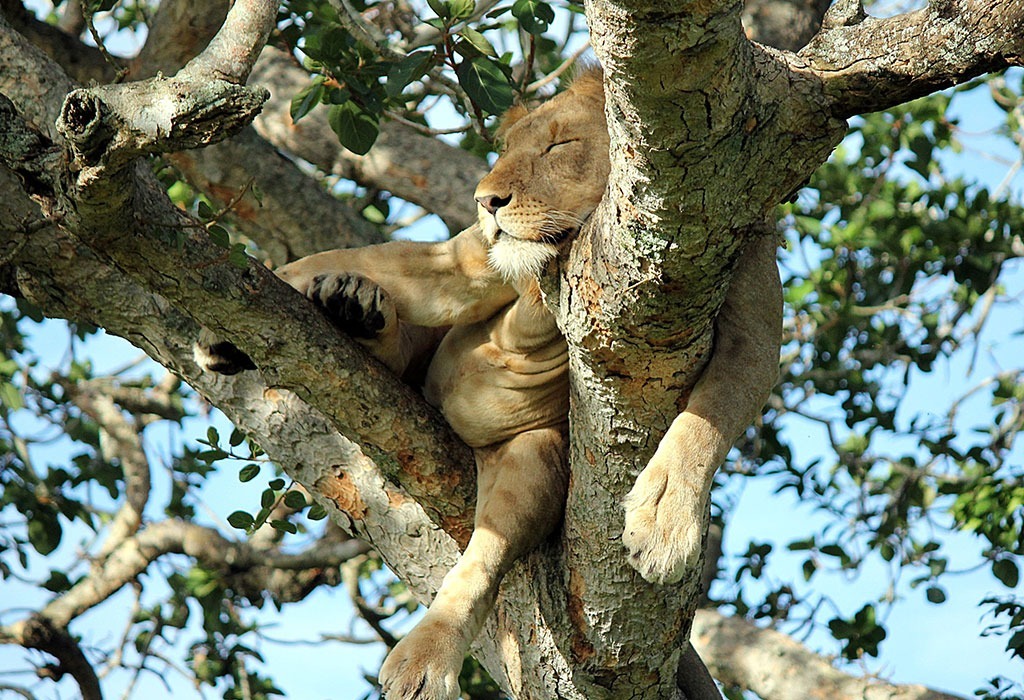
The tree-climbing lions of Ishasha are one of Uganda’s signature predator experiences. Entire individuals or groups may be observed resting in large fig and acacia trees, particularly during suitable conditions.
However, the lions do not remain in trees permanently and sightings cannot be guaranteed. Travelers specifically interested in the behavior can explore the Ishasha tree-climbing lion experience.
Leopard Opportunities
Leopards occur in Queen Elizabeth National Park but are significantly harder to locate than elephants or buffaloes. Dense vegetation, solitary behavior and nocturnal activity often make them the most challenging Big Five animal in the park.
Allowing several game drives improves the opportunity but never guarantees a sighting.
Elephants and Buffaloes
Elephants and buffaloes occur widely within Queen Elizabeth’s varied habitats. Both species may be observed on game drives, while the Kazinga Channel provides an additional opportunity to see them close to water.
This gives Queen Elizabeth a particularly strong advantage for photographers who want different perspectives on the same species.
Kazinga Channel Boat Safari

A Kazinga Channel boat safari is one of Queen Elizabeth National Park’s essential experiences. Travelers can watch hippos and crocodiles while searching shorelines for elephants, buffaloes and waterbirds.
This activity adds significant variety to a Queen Elizabeth wildlife itinerary and is especially useful after several hours of game driving.
Kidepo Valley National Park
Kidepo Valley National Park lies in northeastern Uganda and delivers the country’s most remote classic savannah safari. Its huge open valleys, mountain backdrops and relatively low visitor density create an atmosphere fundamentally different from Murchison Falls and Queen Elizabeth.
Travelers can explore the complete Kidepo Valley National Park guide before deciding whether the longer journey is worthwhile.
Why Consider Kidepo?
Kidepo should be considered by travelers who value wilderness, predators, unusual species, and photography. Historically, it has supported lions, leopards, elephants and buffaloes alongside cheetahs, ostriches and several dry-country species difficult to find elsewhere in Uganda.
Its appeal is therefore much broader than simply trying to complete the Big Five.
Big Game in Kidepo
Kidepo’s Narus Valley is one of its principal wildlife areas because reliable water attracts herbivores and predators, particularly during drier periods. Game drives may reveal elephants, buffaloes, giraffes, lions, antelopes and other mammals.

Anthill Safaris’ Kidepo wildlife experience highlights this combination of large mammals and distinctive northeastern species.
Lions
Lions are one of Kidepo’s major predator attractions. Open landscapes can provide excellent viewing opportunities when animals are located, while rocky formations and mountain backdrops make encounters especially photogenic.
As in every other Uganda park, sightings remain dependent on animal movement and cannot be guaranteed.
Elephants
Elephants move through Kidepo’s valleys and can gather around permanent water during dry conditions. Family herds against the park’s mountain scenery can produce some of Uganda’s most distinctive elephant photographs.
Buffaloes
Kidepo is particularly renowned for buffalo herds. Groups can be substantial, especially where water and grazing conditions are favorable.
The scale of these herds contributes strongly to Kidepo’s classic big-game character and is one reason it features among Anthill Safaris’ Kidepo Big Five safari options.
Remote Safari Experience
The sense of isolation is perhaps Kidepo’s greatest attraction. Vehicles may encounter wildlife without the concentration of safari traffic found in more famous East African destinations.
For photographers and repeat safari travelers, this remoteness can be more valuable than simply maximizing the number of species seen each day.
Is Kidepo Worth the Additional Travel?
For travelers with enough time, yes. Kidepo is particularly worthwhile for photographers, repeat Africa visitors, wilderness enthusiasts and travelers hoping to see cheetahs and other northeastern species.
The main disadvantage is distance. Visitors who have only five to seven days and also want gorillas may achieve a more efficient itinerary by remaining within Uganda’s northern and western circuits.
Longer travelers can connect Kidepo with Murchison through an 8-day Kidepo and Murchison safari.
Which Destination Is Best?
There is no single best Uganda Big Five safari destination for every traveler. Murchison is generally strongest for a concentrated conventional Big Five route when combined with Ziwa. Queen Elizabeth is especially strong for activity diversity and for travelers continuing to gorillas. Kidepo is the strongest choice for remote wilderness and unusual northeastern wildlife.
Murchison vs Queen Elizabeth
Murchison Falls is generally the stronger option for travelers whose primary objective is a concentrated Big Five attempt because Ziwa lies naturally on the route from Kampala or Entebbe. Murchison also offers giraffes, extensive northern savannah and the Victoria Nile.
Queen Elizabeth has the advantage for travelers heading toward Kibale or Bwindi. Its Kazinga Channel, Ishasha and varied game-drive areas make it one of the country’s strongest all-round destinations.
Travelers can compare both within Anthill Safaris’ guide to the best parks for Uganda Big Five sightings.
Murchison vs Kidepo
Murchison is easier to integrate into most Uganda itineraries and combines efficiently with Ziwa. It also provides both game drives and Nile wildlife viewing.
Kidepo requires significantly more travel but rewards visitors with remoteness, spectacular landscapes, cheetahs, ostriches and a less conventional safari atmosphere.
Queen Elizabeth vs Kidepo
Queen Elizabeth is the more practical park for first-time visitors combining wildlife with gorillas and chimpanzees. Kidepo is better for travelers who prioritize wilderness, photography and unusual dry-country wildlife.
Neither destination is universally better; the correct choice depends on the rest of the route.
Best Park for First-Time Visitors
Murchison Falls is arguably the strongest first-time choice for travelers primarily pursuing the Big Five because it combines four of the species with a logical Ziwa extension. Queen Elizabeth may be the better first-time choice when mountain gorillas and chimpanzees are also priorities.
Travelers unsure which route fits can begin with Anthill Safaris’ Uganda safari holiday options.
Best Park for Lions
Both Murchison Falls and Queen Elizabeth provide strong lion opportunities. Queen Elizabeth has the added attraction of Ishasha’s tree-climbing lions, while Murchison offers extensive open savannah and works particularly well within the concentrated Big Five route.
Best Park for Leopards
No Ugandan park can promise easy leopard viewing. Queen Elizabeth and Murchison are both strong choices, while Kidepo also supports leopards. Multiple game drives, patience, and experienced guiding remain more important than simply choosing one park.
Best Park for Elephants
Murchison Falls and Queen Elizabeth are particularly strong choices. Murchison allows elephants to be observed in open savannah and along the Nile, while Queen Elizabeth adds the Kazinga Channel. Kidepo offers outstanding elephant photography against dramatic mountain landscapes.
Best Park for Buffalo
Murchison Falls and Kidepo are particularly impressive for buffalo herds. Queen Elizabeth also offers excellent buffalo viewing, especially around water and during Kazinga Channel cruises.
Best Destination for Rhinos
For an established visitor rhino-tracking experience, Ziwa Rhino Sanctuary remains the clearest choice. Uganda’s 2026 rhino restoration program has expanded rhino presence into additional protected areas, including Kidepo, but travelers should separately verify whether tourist rhino viewing is officially available there for their dates.
Visitors can arrange the established experience through Anthill Safaris’ Ziwa rhino tracking safari.
Best Combination for Seeing All Five
For travelers who want the most practical established route for pursuing all five animals, Ziwa Rhino Sanctuary combined with Murchison Falls National Park remains the strongest starting point. Ziwa provides guided Southern White Rhino tracking, while Murchison offers opportunities to search for lions, leopards, elephants and buffaloes.
This combination can be completed within a relatively short northern Uganda safari, although no responsible operator can guarantee that every free-ranging species will be seen. Leopards in particular can remain hidden even during several game drives.
Travelers with five to seven days can add more time in Murchison or extend toward another destination. Those with ten days or more can continue south toward Kibale, Queen Elizabeth and Bwindi, creating a much richer complete Uganda safari.
Travelers interested in mountain gorillas can add a gorilla and wildlife safari, while visitors primarily focused on Uganda’s famous mammals can spend additional time in Murchison, Queen Elizabeth or Kidepo.
Photographers should consider spending more nights in fewer destinations rather than attempting to move between all three major wildlife parks. Better photographs normally come from repeated sunrise and late-afternoon game drives rather than constantly changing lodges.
Families and senior travelers may also prefer the Murchison and Ziwa route because it can provide Big Five opportunities without the same level of long-distance travel required to include Kidepo. Private transportation makes it easier to control the pace of the journey.
Repeat safari travelers may make the opposite choice and prioritize Kidepo precisely because of the additional effort required. The remote valleys, predators, buffalo herds and unusual species create a very different experience from Uganda’s more frequently visited western parks.
Ultimately, the best places for a Uganda Big Five Safari should be chosen according to the traveler’s complete goals. Murchison Falls is the strongest concentrated Big Five base, Ziwa provides the established rhino-tracking component, Queen Elizabeth adds exceptional wildlife diversity and tree-climbing lions, while Kidepo provides remote wilderness and some of Uganda’s most distinctive big-game scenery.
Anthill Safaris can combine these destinations within a private Uganda Big Five safari itinerary based on travel dates, number of days, preferred accommodation, wildlife interests and whether the journey should also include gorillas, chimpanzees or birdwatching.
For travelers whose priority is maximizing the opportunity to pursue all five efficiently, Anthill Safaris can begin with Murchison Falls and Ziwa. Visitors seeking broader wildlife diversity can add Queen Elizabeth, while those with additional time can extend into the remote wilderness of Kidepo.
The result is not simply a five-animal checklist. A well-designed Uganda Big Five Safari can combine rhino conservation, Nile wildlife, savannah predators, tree-climbing lions, huge buffalo herds, elephants, giraffes, birds and some of Africa’s most dramatic landscapes. Start planning with Anthill Safaris and build the route around the Uganda Big Five destinations that genuinely suit your available time and preferred safari style.
Uganda Big Five Safari Itineraries – 3, 5, 7, 10 and 14 Days
The best Uganda Big Five Safari itineraries range from a concentrated three-day Ziwa Rhino Sanctuary and Murchison Falls adventure to a complete fourteen-day journey combining rhinos, savannah wildlife, chimpanzees, tree-climbing lions and mountain gorillas. The right itinerary depends on how much time travelers have and whether seeing Africa’s Big Five is the main objective or part of a broader Uganda wildlife experience. A short itinerary can focus on where to see the Big Five in Uganda, while longer journeys can add Kibale, Queen Elizabeth National Park and Bwindi.
Best Uganda Big Five Safari Itineraries
The most geographically efficient Uganda Big Five Safari normally begins with guided rhino tracking at Ziwa and continues north to Murchison Falls National Park. Murchison provides opportunities to search for lions, leopards, elephants and buffaloes while also adding giraffes, hippos, Nile crocodiles and a boat safari. Travelers with additional days can expand this core route into a complete Uganda Big Five Safari involving primates and other national parks.
No itinerary should promise that all five animals will be seen. Rhinos can be tracked under managed conditions at Ziwa, but lions and particularly leopards remain free-ranging wildlife whose locations change constantly. Longer itineraries create additional viewing opportunities but never turn wild animal encounters into guarantees.
3-Day Uganda Big Five Safari
A three-day Uganda Big Five Safari is the shortest practical route for travelers who want to pursue all five species. It normally combines Ziwa Rhino Sanctuary with Murchison Falls National Park, allowing visitors to track Southern White Rhinos and then search for lions, leopards, elephants and buffaloes on game drives.
Day 1 – Entebbe/Kampala to Ziwa Rhino Tracking and Murchison Falls
Depart Entebbe or Kampala early and travel north toward Ziwa Rhino Sanctuary. Meet trained guides for the established Ziwa Rhino Sanctuary experience, walking through suitable habitat in search of Southern White Rhinos while learning about Uganda’s rhino conservation story.
After tracking, continue toward Murchison Falls National Park. Depending on arrival time and the day’s logistics, travelers can proceed to their lodge, enjoy the surrounding scenery or include a suitable park activity.
Day 2 – Murchison Falls Game Drive and Nile Boat Safari
Begin before or around sunrise with a game drive across Murchison’s productive northern savannah. Search for lions, elephants, buffaloes, giraffes, Uganda kobs, hartebeests and other mammals. Leopards may occur within the park but are considerably harder to locate.
Later, enjoy a boat safari on the Victoria Nile. Hippos and Nile crocodiles are characteristic river residents, while elephants, buffaloes and other mammals may approach the shoreline. Travelers researching the park can use Anthill Safaris’ Murchison Big Five Safari guide to understand why the park is such a strong match with Ziwa.
Day 3 – Morning Wildlife Viewing and Return to Entebbe
A final early wildlife drive can provide another opportunity to search for species missed the previous day before beginning the return journey toward Kampala or Entebbe.
Three days gives travelers a realistic opportunity to pursue the Big Five geographically, but seeing a leopard—or any particular free-ranging animal—cannot be guaranteed. Travelers should therefore judge the safari by the overall wildlife experience rather than whether every box on a five-animal checklist is completed.
5-Day Uganda Big Five Safari
A five-day Uganda Big Five Safari provides considerably better pacing. Instead of moving directly through Ziwa and rushing Murchison, travelers can spend meaningful time in both areas and undertake multiple wildlife activities. Five days is an excellent choice for travelers primarily interested in the Big Five who do not yet want to add gorilla or chimpanzee trekking.
Day 1 – Entebbe to Ziwa
Travel north from Entebbe or Kampala toward Ziwa. Complete guided rhino tracking and spend more time learning about Uganda’s rhino restoration program than would normally be possible on a hurried transfer day.
The experience can be planned through Anthill Safaris’ Ziwa rhino tracking guidance, with accommodation selected according to the broader route.
Day 2 – Ziwa to Murchison Falls
Continue to Murchison Falls National Park at a relaxed pace. Depending on entry route and timing, travelers may visit a falls viewpoint or undertake introductory wildlife viewing before reaching the lodge.
This less hurried structure allows photographers, families and senior travelers to experience the route without trying to combine several major activities in one day.
Day 3 – Murchison Wildlife Safari
Spend the morning exploring Murchison’s northern game tracks. Search for lions, elephants, buffaloes, giraffes and antelopes while remaining alert for leopards. An experienced driver-guide can use recent wildlife information, tracks and prey concentrations to choose productive areas.
The safari should still remain flexible. Even the best guide cannot control wild animal movements. Anthill Safaris’ guided game-drive experiences are designed around this natural unpredictability.
Day 4 – Game Drive and Nile Experience
Use another morning game drive to explore areas not covered the previous day before enjoying a Nile boat safari. This additional wildlife time substantially improves the experience compared with trying to complete the park in a single day.
Photographers can concentrate on behavioral opportunities rather than immediately leaving every sighting in search of the next species.
Day 5 – Return to Entebbe
After breakfast, begin the journey toward Entebbe or Kampala. The five-day route provides an excellent introduction to Uganda’s savannah wildlife, rhino conservation and Nile ecosystem without creating excessive transfer pressure.
7-Day Uganda Big Five Safari
A seven-day Uganda Big Five Safari can move beyond the concentrated northern circuit and add Queen Elizabeth National Park. This provides additional opportunities for lions, leopards, elephants and buffaloes while introducing the Kazinga Channel and Ishasha’s famous tree-climbing lions.
A practical route can begin with Ziwa and Murchison before continuing toward Queen Elizabeth according to road and domestic-flight planning. Travelers can compare the destination through Anthill Safaris’ Queen Elizabeth Safari guide.
The advantage of seven days is not simply another chance to complete the Big Five. It introduces two major savannah ecosystems. Murchison is defined by the Victoria Nile and northern grasslands, while Queen Elizabeth combines savannah, crater landscapes, wetlands, the Kazinga Channel and Ishasha.
Travelers particularly interested in lions can include time searching for Ishasha’s tree-climbing lions, while remembering that seeing lions resting in trees is never guaranteed.
10-Day Uganda Big Five and Gorilla Safari
A 10-Day Uganda Big Five and Gorilla Safari is one of the strongest complete wildlife journeys in Uganda. It can combine Ziwa Rhino Sanctuary, Murchison Falls, Kibale National Park, Queen Elizabeth National Park and Bwindi Impenetrable National Park, taking travelers from open savannah into tropical forest.
Anthill Safaris has a dedicated 10-Day Gorilla and Big Five Safari that provides a useful framework for travelers seeking exactly this combination.
The journey can begin with rhino tracking at Ziwa and continue into Murchison for game drives and a Nile boat safari. From northern Uganda, travelers move toward the western circuit and Kibale, where the forest changes the character of the safari completely.
Kibale can provide chimpanzee trekking before the journey continues through Queen Elizabeth National Park. Travelers interested in adding this primate experience can review the Kibale National Park guide.
Queen Elizabeth adds further opportunities for lions, elephants, buffaloes and leopards before the route continues toward Bwindi. Mountain gorilla trekking then becomes the finale to a journey that has already included rhinos, the Nile, savannah wildlife and chimpanzees.
This contrast is why Uganda’s Big Five route differs so substantially from an ordinary five-animal safari. Travelers can move from tracking rhinos on foot to watching elephants beside the Nile and ultimately enter rainforest to encounter mountain gorillas.
12-Day Uganda Big Five, Gorilla and Chimpanzee Safari
Twelve days allows travelers to experience the same major ecosystems at a more relaxed pace. Ziwa, Murchison Falls, Kibale, Queen Elizabeth and Bwindi can all be included while giving each major destination more than a hurried overnight stop.
Kibale should receive enough time for chimpanzee trekking and potentially Bigodi Wetland Sanctuary. Travelers can study Anthill Safaris’ best chimpanzee trekking in Uganda guidance when deciding how much time to allocate to the forest.
Additional time in Queen Elizabeth can provide repeated game drives and a Kazinga Channel cruise rather than forcing travelers immediately toward Bwindi. This is particularly valuable for photographers attempting to locate leopards or photograph lions in favorable light.
Bwindi can then receive two or three nights, allowing visitors to arrive calmly before gorilla trekking and rest afterward. Those interested in the complete experience can review the Uganda Gorilla Safari guide.
14-Day Complete Uganda Wildlife Safari
A fourteen-day Uganda Big Five Safari provides enough time to build a comprehensive wildlife and primate itinerary without turning every day into a long-distance transfer. A strong route can include Ziwa Rhino Sanctuary, Murchison Falls, Kibale, Queen Elizabeth, Ishasha, Bwindi and either Lake Bunyonyi or Lake Mburo.
The opening days concentrate on rhinos and the savannah wildlife of Murchison. The middle of the journey adds chimpanzees and Queen Elizabeth, while the southern portion introduces tree-climbing lions, mountain gorillas and a slower lake or savannah extension.
Lake Bunyonyi works particularly well for post-gorilla relaxation, while Lake Mburo can break the return journey toward Entebbe and add zebras, impalas, walking safaris and other activities. Travelers can compare these options through the current Best Safari Destinations in Uganda guide.
Fourteen days is especially suitable for photographers, couples, honeymooners and travelers who prefer two- or three-night stays rather than packing every morning.
Uganda Big Five and Gorilla Safari
A Uganda Big Five and Gorilla Safari deserves particular attention because it represents one of Uganda’s strongest competitive advantages as an African destination. Traditional Big Five wildlife can be experienced in many African countries, but relatively few itineraries allow travelers to combine it so naturally with mountain gorillas.

The journey typically uses Ziwa for rhinos and one or more savannah parks for lions, leopards, elephants and buffaloes before continuing toward Bwindi. Anthill Safaris explains the concept in detail in its guide to combining gorillas and the Big Five.
A shorter version can combine Queen Elizabeth and Bwindi, though travelers would need to add Ziwa elsewhere if completing the traditional Big Five is essential. Anthill Safaris’ 5-Day Uganda Gorilla and Game Safari demonstrates the strong geographical relationship between Bwindi and Queen Elizabeth.
Uganda Big Five and Chimpanzee Safari

Travelers more interested in chimpanzees than gorillas can combine Ziwa and Murchison with Kibale National Park. Queen Elizabeth may be inserted between Kibale and the broader western circuit depending on available days.
This safari combines traditional game drives with a forest experience where visitors track chimpanzees on foot. The contrast between the two environments gives the itinerary greater depth than a wildlife-only journey.
Uganda Big Five and Shoebill Safari
Birdwatchers can add a shoebill search to the Uganda Big Five route. Mabamba Wetland near Entebbe is one of Uganda’s most practical specialist destinations and can be incorporated at the beginning or end of the journey.
Travelers can plan the experience using Anthill Safaris’ Shoebill Bird Watching Uganda guide. Murchison’s Nile and delta habitats can also add exceptional birding to the route.
Uganda Big Five Photography Safari
A photography-focused Uganda Big Five Safari should use fewer destinations and spend longer in each one. Photographers benefit from repeated sunrise and late-afternoon game drives, allowing them to wait for behavior and favorable light rather than simply collecting species.
Murchison is particularly rewarding for elephants, giraffes and Nile landscapes, while Queen Elizabeth offers lions, the Kazinga Channel and Ishasha. Photographers adding gorillas should choose equipment suitable for low forest light. Anthill Safaris’ Uganda photography safari destinations can help shape the route.
Uganda Big Five Safari for Couples

Couples often benefit from a private 4×4 safari that allows flexible stops and a slower pace. A seven- to ten-day itinerary can combine Ziwa and Murchison with Queen Elizabeth or Bwindi, while higher-end lodges create private evenings between activities.
Lake Bunyonyi or another scenic destination can be added after gorilla trekking to prevent the entire journey from becoming a sequence of early starts and long transfers.
Uganda Big Five Honeymoon Safari
A honeymoon safari can combine the Big Five with mountain gorillas and romantic forest or savannah lodges. Instead of maximizing the number of parks, honeymooners should normally prioritize accommodation quality, privacy and enough time to enjoy each property.
Travelers interested in premium accommodation can explore Anthill Safaris’ Luxury Safari Experiences in Uganda.
Family Big Five Safari
A Uganda Big Five Safari works well for families because game drives and boat cruises can be enjoyed across a wide range of ages. The itinerary should reduce excessively long transfer days and include accommodations suitable for children.
Families planning a wider journey can use the Family Safaris in Uganda guide to compare activities and park choices. If gorilla trekking is included, the minimum participation age and current permit rules must be considered.
Luxury Uganda Big Five Safari
A luxury Uganda Big Five Safari can combine premium lodges, private vehicles, high-quality guiding and domestic flights where they improve the route. Luxury should increase comfort and efficiency rather than simply adding expensive accommodation to an unrealistic itinerary.
Travelers can review Anthill Safaris’ luxury Uganda safari planning and choose where domestic flights genuinely save useful safari time.
Midrange Uganda Big Five Safari
Midrange travel provides an excellent balance for many visitors. Comfortable ensuite lodges, private transportation and well-planned meals can be combined with the same national parks and wildlife activities used on higher-priced safaris.
Anthill Safaris’ Mid-Range Uganda Safari guide explains why seven- to fourteen-day road journeys can provide especially strong value.
Budget Uganda Big Five Safari
A budget Uganda Big Five Safari reduces accommodation and transportation costs without changing the fundamental wildlife objective. Travelers can use simpler lodges and road transportation while retaining professionally guided park activities and rhino tracking.
Budget options can be compared through Anthill Safaris’ Uganda budget safari options. Travelers should compare inclusions carefully rather than selecting a package solely because it has the lowest headline price.
Private Uganda Big Five Safari
A private Uganda Big Five Safari gives travelers their own vehicle and driver-guide for most of the journey. This is particularly valuable for photographers, couples, families and travelers with specialist wildlife interests.
The guide can adjust game-drive pacing around actual wildlife conditions rather than following a rigid large-group schedule. A private safari cannot guarantee sightings, but it can provide more flexibility when sightings occur.
Fly-In Big Five Safari
Domestic flights can reduce long overland journeys, especially when travelers want to combine distant parks within a limited number of days. Murchison Falls can be included in a flying itinerary, while domestic aviation can also connect travelers toward western or southwestern Uganda.
Anthill Safaris’ Fly-In Safari to Murchison Falls describes how flying can increase the amount of time available for game drives and Nile activities.
Travelers wanting a fully private aviation experience can also explore Private Flying Safaris in Uganda, especially when comfort and time efficiency are higher priorities than overland sightseeing.
Which Itinerary Should You Choose?
Choose three days if time is extremely limited and the main objective is a concentrated Ziwa and Murchison Big Five attempt. Choose five days if you want more relaxed wildlife viewing and additional opportunities to search for lions and leopards.
Seven days is stronger when Queen Elizabeth National Park is important. Ten days is one of the best choices for travelers who want the Big Five plus mountain gorillas and chimpanzees, while twelve days creates better pacing for photography and deeper primate experiences.
Fourteen days is ideal for travelers who want a complete Uganda wildlife safari rather than a checklist-focused trip. It provides time for rhinos, Murchison Falls, chimpanzees, Queen Elizabeth, Ishasha, mountain gorillas and a relaxing Lake Bunyonyi or Lake Mburo extension.
Travelers who remain unsure can first compare the country’s leading locations through Anthill Safaris’ Uganda Big Five Safari Locations guide.
Custom Uganda Big Five Safaris with Anthill Safaris
Anthill Safaris can customize a Uganda Big Five Safari around the traveler’s dates, available days, accommodation preference and wildlife priorities. The itinerary should begin with realistic routing rather than forcing every visitor into the same fixed package.
Travelers interested primarily in the traditional Big Five may be advised to concentrate on Ziwa and Murchison. Visitors wanting gorillas can continue southwest, while birdwatchers can add Mabamba or other productive habitats.
Those wanting chimpanzees can incorporate Kibale, and travelers interested in tree-climbing lions can give Queen Elizabeth and Ishasha additional time. Longer wildlife enthusiasts can extend farther toward Kidepo when the available days justify the additional travel.
Anthill Safaris can arrange private 4×4 transportation, professional driver-guides, accommodation, airport transfers, game drives, boat safaris and relevant wildlife activities. Gorilla and chimpanzee permits can also be coordinated when primate experiences form part of the journey.
The planning process should also consider travel pace. A ten-day itinerary with fewer, longer stays may provide a stronger safari than a ten-day itinerary that changes lodges almost every night.
Photographers can request additional game-drive time, families can reduce long driving days, couples can prioritize scenic accommodation, and senior travelers can incorporate domestic aviation where appropriate.
Travelers beginning their research can also review Anthill Safaris’ Uganda Safari FAQs for broader information about transportation, accommodation, costs and itinerary design.
A short Uganda Big Five Safari is possible, but additional days dramatically expand what the country can offer. The difference between three and ten days is not merely seven more nights; it is the difference between a concentrated wildlife search and a journey spanning rhino conservation, the Nile, chimpanzee forest, savannah predators and mountain gorillas.
This diversity is why Uganda works particularly well for travelers who want more than a standard Big Five checklist. Traditional African wildlife remains central to the journey, but it can be combined with experiences that define Uganda as one of Africa’s most varied safari destinations.
To start planning, travelers can send Anthill Safaris their preferred travel dates, number of travelers, number of available safari days, accommodation category and priority wildlife experiences. Anthill Safaris can then recommend whether a 3-day, 5-day, 7-day, 10-day, 12-day or 14-day Uganda Big Five Safari provides the strongest match for the available time and interests.
Uganda Big Five Safari Cost, Best Time, Accommodation and Planning
The cost of a Uganda Big Five Safari depends on the number of safari days, accommodation category, group size, private vehicle requirements, park fees, rhino tracking, boat safaris and whether mountain gorilla or chimpanzee permits are included. There is therefore no single correct price for every traveler. A short safari combining Ziwa Rhino Sanctuary and Murchison Falls costs substantially less than a ten- or fourteen-day private journey incorporating Kibale, Queen Elizabeth National Park and Bwindi. Travelers should compare the complete inclusions of a Uganda Big Five Safari rather than selecting a package only because it has the lowest advertised price.
How Much Does a Uganda Big Five Safari Cost?
A short road-based Uganda Big Five Safari can begin in the lower budget range when travelers use simple accommodation and share major trip costs among several people. Longer private journeys increase considerably because the vehicle, fuel, accommodation, park entries and guiding are required for more days.
Anthill Safaris currently estimates that a typical seven- to ten-day midrange Uganda safari may cost approximately USD 2,500 to USD 4,000 per person, excluding international flights, although an actual Big Five quotation must be calculated around specific dates and inclusions.
What Determines the Safari Price?
The biggest price factors are trip duration, number of travelers sharing the vehicle, accommodation standard and activities. Gorilla trekking, chimpanzee trekking and domestic flights can significantly increase the final amount, while a simple Ziwa and Murchison road safari has a much more concentrated cost structure.
Safari Vehicle
A private 4×4 safari vehicle is one of the largest components of a Uganda Big Five Safari. The vehicle is required not only for transfers but also for game drives through Murchison Falls, Queen Elizabeth and other wildlife destinations.
A private vehicle usually costs more per person for one or two travelers because the fixed transport expense is shared among fewer people. Families and small groups often achieve better per-person value while retaining private safari flexibility.
Fuel
Uganda itineraries can cover considerable distances. Fuel costs therefore increase when combining Entebbe, Ziwa, Murchison Falls, Kibale, Queen Elizabeth and Bwindi. Adding Kidepo creates even greater travel distances unless domestic flights are used.
The strongest itinerary minimizes unnecessary backtracking. Anthill Safaris’ guide to Uganda Big Five safari locations helps travelers understand how park geography affects both travel time and cost.
Park Entrance Fees
National park entrance fees are normally charged according to the applicable Uganda Wildlife Authority visitor category and length of stay. A well-designed safari quotation should state clearly whether park entrance fees are included.
Travelers should not compare safari prices without checking this detail because one quotation may include the relevant conservation fees while another displays them separately.
Rhino Tracking
Guided Southern White Rhino tracking at Ziwa is a separate safari activity and should be included in the budget when completing the established Uganda Big Five route. Ziwa remains the country’s best-established visitor destination for guided rhino tracking.

Travelers can review the Ziwa rhino tracking experience before deciding how it fits into the route toward Murchison Falls.
Game Drives
Game-drive costs depend on the park, vehicle arrangements and whether additional ranger or specialist-guiding services are included. Most private Uganda safaris use the same tour vehicle for both inter-park transport and game drives.
Photography-focused travelers may want additional drives rather than simply one morning excursion in each park. More time usually produces better wildlife opportunities than continually changing destinations.
Boat Safaris
Boat safaris are among the most worthwhile additions to a Uganda Big Five itinerary. Murchison Falls provides Victoria Nile experiences, while Queen Elizabeth National Park offers the Kazinga Channel.
These activities add hippos, crocodiles, waterbirds and opportunities to observe elephants or buffaloes near water. They are an important part of a complete Uganda wildlife safari.
Accommodation
Accommodation has a major influence on the final safari price. Uganda offers simple camps and lodges, comfortable midrange properties and high-end safari lodges with premium locations, service and facilities.
Paying more for accommodation does not guarantee more wildlife, but a well-located lodge can reduce transfer time and provide easier access to early-morning game drives.
Meals
Many safari lodges operate on full-board arrangements because travelers spend most of the trip in remote national parks. A quotation should state whether breakfast, lunch and dinner are included and whether drinks are charged separately.
Travelers with dietary requirements should communicate them before booking so lodges can prepare appropriately.
Professional Driver-Guide
A professional driver-guide is one of the most valuable components of a private Uganda Big Five Safari. The guide handles long-distance driving, navigation, park logistics and wildlife interpretation while helping determine productive areas for game drives.
Experienced guiding matters particularly when searching for elusive species such as lions and leopards. Travelers can learn more about the overall structure of a Uganda Big Five wildlife experience before comparing packages.
Gorilla Permits When Included
If a Big Five Safari is extended to Bwindi or Mgahinga, the gorilla permit becomes a major additional cost. Uganda’s standard 2026 gorilla trekking permit is USD 800 for foreign non-residents, with separate tariffs for foreign residents, Rest of Africa visitors and East African Community citizens.
Travelers combining these experiences can explore Anthill Safaris’ Big Five and gorilla safari planning before calculating the full trip budget.
Chimpanzee Permits When Included
Kibale National Park chimpanzee trekking creates another permit cost when added to a Big Five itinerary. For 2026, the standard Kibale chimpanzee tracking tariff for foreign non-residents is USD 250 per person, with different eligible resident and regional categories.
Travelers interested in primates can compare the options through Anthill Safaris’ chimpanzee trekking in Uganda guide.
Budget Uganda Big Five Safari Cost
A budget Uganda Big Five Safari uses simpler lodges, road transportation and a focused itinerary. Short trips to Ziwa and Murchison can provide much better value than attempting to combine several distant parks.
For context, Anthill Safaris currently lists some four-day Murchison budget arrangements in approximately the USD 912 to USD 1,100 per-person range, depending on circumstances and inclusions. Travelers should obtain a current date-specific quotation rather than treating this as a fixed Big Five price.
Visitors can explore broader budget Uganda safari options when accommodation simplicity matters more than luxury facilities.
Midrange Uganda Big Five Safari Cost
Midrange safaris are often the best balance for travelers seeking comfortable ensuite rooms, reliable meals and good locations without paying premium lodge rates. As a broad Anthill Safaris benchmark, seven- to ten-day midrange Uganda journeys commonly fall around USD 2,500 to USD 4,000 per person.
The actual Big Five Safari cost can fall below or above that range depending on vehicle occupancy, permits and selected activities.
Luxury Uganda Big Five Safari Cost
Luxury safari costs vary much more widely. Premium lodges, private guiding, upgraded rooms, charter or scheduled domestic aviation, private boat activities and extended stays can significantly increase the budget.
The aim of a luxury Uganda safari should be better comfort, service and itinerary efficiency rather than simply selecting the most expensive room available.
Private vs Group Safari Costs
A private safari costs more per person when only one or two travelers share the vehicle, but it provides considerably greater control over departure times, photography stops and game-drive pace. Small groups reduce per-person transport costs because fixed vehicle and fuel expenses are shared.
Group departures may be cheaper where available, but travelers should compare group size, accommodation and included activities carefully.
What Is Included?
A properly structured Uganda Big Five Safari package commonly includes private ground transportation, fuel, professional driver-guide services, accommodation, specified meals, park entrance fees and the wildlife activities stated in the itinerary.
Rhino tracking, boat cruises, gorilla permits and chimpanzee permits should only be treated as included when they are explicitly listed in the quotation. Anthill Safaris’ Uganda Safari FAQs provide additional guidance on typical safari inclusions.
What Is Usually Excluded?
International flights, visas, travel insurance, personal drinks, optional activities, personal purchases, laundry at some properties and gratuities are commonly excluded unless specifically stated otherwise. Domestic flights may also be separate when the basic quotation is road-based.
Best Time for a Uganda Big Five Safari
Uganda’s Big Five destinations can be visited throughout the year, but June through September and December through February are the most popular periods for traditional game viewing because conditions are generally drier.
The wetter periods of March through May and October into November should not automatically be avoided. Landscapes become green, birding can be excellent and there may be fewer visitors. Anthill Safaris’ current guidance on the best months for game viewing in Uganda explains these seasonal tradeoffs.
Can You See the Big Five Year-Round?
Yes, the principal Big Five species do not simply disappear during Uganda’s wet seasons. Lions, leopards, elephants and buffaloes remain in their national-park ecosystems throughout the year, while guided rhino tracking at Ziwa depends on current sanctuary operations rather than a narrow annual viewing season.
Season changes visibility and access more than it changes the fundamental presence of wildlife.
June to September
June through September is one of Uganda’s main dry-season safari periods. Roads and game tracks are generally more manageable, grass can become shorter in some areas and wildlife may become increasingly associated with permanent water.
This is also a busy tourism period, so popular lodges and private safari vehicles should be reserved well ahead.
December to February
December through February provides another relatively dry period and is an excellent time for a Uganda Big Five Safari. These months work particularly well for travelers combining wildlife with mountain gorilla trekking because forest conditions may also be comparatively manageable.
March to May
March through May generally brings wetter conditions. Heavy rainfall can create muddy tracks and slower road travel, but landscapes become exceptionally green and dramatic.
Travelers who do not mind rain can benefit from lower visitor numbers in some destinations and strong opportunities for landscape and bird photography.
October and November
October and November are another wetter or transitional period across much of Uganda. Rainfall patterns vary from year to year, so travelers should prepare for both sunny periods and heavy showers.
These months can be appealing to photographers and visitors who prefer greener scenery to the dusty appearance of the late dry season.
Dry-Season Wildlife Viewing
Dry-season wildlife viewing is often considered easier because vegetation may thin and animals increasingly depend on permanent rivers and waterholes. This can improve observation around the Victoria Nile, Kazinga Channel and other water sources.
It should not be interpreted as a guarantee that lions or leopards will be easier on every particular day.
Wet-Season Wildlife Viewing
Wet-season game drives offer lush landscapes, dramatic skies and excellent opportunities to photograph animals against green backgrounds. Wildlife may spread more widely when temporary water becomes available, meaning guides sometimes need to search broader areas.
Rain can also create difficult tracks, making a capable 4×4 especially valuable.
Best Time for Lions
Lions can be seen throughout the year. The most important factor is usually time of day rather than month. Early morning and late afternoon provide cooler temperatures when lions are more likely to be active.
Queen Elizabeth, Murchison Falls and Kidepo remain the principal destinations. Travelers can compare them using Anthill Safaris’ Uganda big-cat safari guide.
Best Time for Leopards
Leopards also occur year-round and remain difficult to find in every season. Dawn, dusk and other cooler periods can provide useful opportunities, but patience and repeated game drives matter more than selecting one supposedly perfect month.
Best Time for Elephants
Elephants can be observed throughout the year. Dry periods may increase activity around permanent water sources, while wet-season landscapes provide green feeding areas and attractive photography.
Murchison Falls is particularly rewarding because elephants can potentially be observed both during game drives and from the Nile.
Best Time for Buffaloes
Buffaloes remain present year-round. Large herds may gather around productive grazing and water areas, while seasonal rainfall changes their movements across the parks.
Murchison, Queen Elizabeth and Kidepo all provide strong opportunities for buffalo viewing.
Best Time for Rhino Tracking
Ziwa rhino tracking can generally be planned throughout the year when the activity is operational. Drier conditions can make walking more comfortable, while wetter months provide greener landscapes.
Travelers should confirm activity availability through the current Ziwa Rhino Sanctuary information when booking.
Best Time for Photography
The dry season often provides easier access, warm golden grass and concentrated wildlife around water. The wet season offers greener scenery, dramatic skies and lower dust levels.
There is therefore no universal best photography season. Travelers should select dates according to the visual style they prefer. Anthill Safaris’ Uganda photography safari guide provides further planning advice.
Best Time for Birdwatching
Uganda is a year-round birding destination, and wet periods can be particularly rewarding because breeding activity, vegetation and insect abundance increase. Seasonal migrants add further interest at different times.
Travelers focused heavily on birds should build the itinerary around habitats and target species. The Uganda birding safari guide provides specialist guidance.
Uganda Big Five Safari Accommodation
Accommodation choices range from simple camps to premium wilderness lodges. The correct lodge should be selected according to location, game-drive access and total itinerary rather than amenities alone.
Where to Stay Near Ziwa
Travelers can stay within or around the Ziwa area when the itinerary allows a slower rhino experience. Anthill Safaris currently identifies Amuka Lodge among accommodation options associated with the sanctuary area.
Many shorter Big Five itineraries instead track rhinos during the transfer and continue toward Murchison Falls the same day.
Where to Stay in Murchison Falls
Murchison Falls offers the widest range of accommodation on the core Big Five route. Options range from simple camps to comfortable midrange properties and high-end lodges overlooking the Nile.
Travelers can compare current properties through Anthill Safaris’ top lodges in Murchison Falls. Location matters because staying in the wrong section can add substantial driving before an early game drive.
Where to Stay in Queen Elizabeth
Queen Elizabeth has accommodation around several different areas, including Mweya, Kyambura and Ishasha. The best property depends on which activities are most important.
Travelers prioritizing northern game drives and the Kazinga Channel may choose differently from visitors whose main objective is Ishasha. Anthill Safaris’ guide to where to stay around Queen Elizabeth National Park compares the main options.
Where to Stay in Kidepo
Kidepo has fewer accommodation options than Murchison or Queen Elizabeth, but choices span high-end lodges, comfortable camps and simpler facilities. Because of the park’s remoteness, accommodation should be secured before building the transport plan.
Travelers can review current Kidepo Valley accommodation before deciding whether to drive or fly.
Budget Lodges
Budget lodges typically provide simpler rooms or tents, basic meals and fewer luxury facilities while still giving travelers a practical base for wildlife activities. They are particularly suitable for guests who prefer to spend money on safari experiences rather than premium rooms.
Midrange Lodges
Midrange lodges generally offer ensuite accommodation, hot showers, comfortable beds and quality meals in convenient safari locations. This category is particularly popular on seven- to fourteen-day road safaris because it balances comfort with total trip cost.
Travelers can compare this travel style through Anthill Safaris’ midrange Uganda safari guide.
Luxury Lodges
Luxury lodges emphasize service, room quality, privacy, architecture, views and often exceptional locations. In Murchison Falls, premium properties may overlook the Nile, while Kidepo lodges can provide expansive views over the remote savannah.
Anthill Safaris also highlights selected properties in its top eco-lodges in Uganda guide.
Staying Inside vs Outside National Parks
Staying inside or very close to a national park can reduce early-morning transfer time and may create a stronger wilderness atmosphere. Accommodation farther outside can sometimes provide better value or different lodge styles.
The decision should be based on the actual activity schedule. Saving money on a distant lodge is less attractive if travelers lose valuable dawn wildlife-viewing time driving to the gate.
Practical Planning
Good preparation improves comfort and allows travelers to concentrate on wildlife rather than equipment problems. A Big Five safari does not require technical expedition gear, but heat, dust, rain and long days in a vehicle should all influence packing.
What Should You Pack?
Pack lightweight neutral clothing, comfortable closed shoes, a hat, sunglasses, sunscreen, insect repellent, a light rain jacket, personal medication, binoculars and suitable camera equipment. A small daypack is useful for carrying water and electronics during daily activities.
Travelers combining wildlife with gorilla trekking should also review the more specialized gorilla trekking packing list.
What Should You Wear on Game Drives?
Lightweight neutral-colored clothing works well. Long trousers and long sleeves provide sun and insect protection, particularly during early morning and evening activities.
A light fleece or jacket can be useful for dawn game drives when moving in an open-roof vehicle before temperatures rise.
Binoculars
Binoculars dramatically improve a Big Five Safari because animals do not always remain close to the vehicle. They are also invaluable for birds and distant predator observations.
Anthill Safaris’ current birding guidance recommends practical binocular sizes such as 8×42 or 10×42 for wildlife and bird observation. The Uganda birdwatching parks guide provides further equipment suggestions.
Camera Equipment
A versatile telephoto zoom is useful for lions, leopards and distant wildlife, while a wider lens can capture elephants, buffalo herds and landscapes. Travelers should carry spare batteries, memory cards and basic dust or rain protection.
Photography-focused guests should understand their camera controls before the safari begins because wildlife encounters can develop quickly.
Sun Protection
Uganda’s equatorial sun can be strong even when temperatures feel comfortable. A wide-brimmed hat, quality sunglasses and high-protection sunscreen should remain accessible during game drives and rhino tracking.
Travelers should also carry drinking water and hydrate regularly during long wildlife days.
Rain Protection
A lightweight waterproof jacket is useful throughout the year because tropical rainfall can occur outside the traditionally wetter months. Camera equipment should be protected using waterproof covers or dry bags.
Visitors traveling during March–May or October–November should prepare more carefully for muddy tracks and repeated rainfall.
How Far in Advance Should You Book?
For ordinary Big Five wildlife safaris without primate permits, several months of planning normally provides better lodge and vehicle availability. Peak periods such as June through September and December through February should be reserved earlier, particularly for popular lodges.
Anthill Safaris currently recommends booking peak-season Uganda safaris roughly six months to a year in advance where specific dates and accommodation are important. Travelers adding gorilla trekking should secure permits early because availability is limited.
A short Murchison Falls safari from Entebbe can sometimes be arranged with less notice, but last-minute availability should never be assumed during peak travel periods.
Planning with Anthill Safaris
Anthill Safaris can calculate the Uganda Big Five Safari cost around the traveler’s exact dates, group size, number of days and accommodation preference instead of providing a misleading one-price-fits-all package.
Travelers primarily interested in completing the established Big Five route can concentrate on Ziwa and Murchison Falls. The Murchison Falls and Ziwa combination remains the strongest starting point for a concentrated itinerary.
Visitors with additional time can include Queen Elizabeth National Park for more game drives, the Kazinga Channel and Ishasha. Travelers who value remoteness can consider Kidepo Valley National Park, although the additional distance must be reflected in the price and schedule.
Travelers interested in primates can transform the wildlife journey into a Uganda Big Five and primate safari, adding chimpanzees in Kibale and mountain gorillas in Bwindi.
Those with ten days can consider the dedicated 10-Day Gorilla and Big Five Safari, while travelers with additional time can slow the itinerary and spend more nights in the major parks.
Accommodation should then be selected around the wildlife plan rather than the other way around. A well-located midrange lodge may provide a better practical safari than a more expensive property requiring an additional hour of driving to reach productive game tracks each morning.
Photographers can request additional dawn and late-afternoon drives, while birdwatchers can add slower habitat-focused excursions. Couples may prioritize private lodges and scenic locations, and families may benefit from shorter transfer days and properties with appropriate room configurations.
Travelers interested in Murchison accommodation can compare Murchison fly-in and lodge options, while Queen Elizabeth visitors can review wildlife-focused Queen Elizabeth lodges.
Those planning Kidepo should secure accommodation and transport particularly early because the destination has fewer lodge choices and requires significantly more logistical planning than Uganda’s western parks. Anthill Safaris’ Kidepo lodge guide can help compare the main categories.
The cheapest safari is not necessarily the best-value safari. An itinerary that saves money by reducing game-drive time, using poorly located accommodation or rushing between parks may provide much less wildlife experience despite the lower price.
The strongest Uganda Big Five Safari budget allocates money to the things that directly affect the journey: a reliable safari vehicle, experienced driver-guide, appropriate accommodation, conservation fees and enough time in each wildlife destination.
Similarly, the best time for a Uganda Big Five Safari depends on the traveler’s priorities. Dry-season visitors benefit from generally easier roads and potentially more concentrated wildlife around permanent water, while wet-season travelers gain greener scenery, birdlife and often quieter parks.
No season guarantees lions, leopards or any other wild animal. The best approach is to select suitable parks, allow sufficient game-drive time and accept that wildlife movements remain part of the unpredictability that makes safari travel authentic.
Travelers can begin by reviewing Anthill Safaris’ best safari destinations in Uganda and deciding whether their Big Five journey should remain wildlife-focused or expand into gorillas, chimpanzees, birdwatching and other Uganda highlights.
To receive an accurate quotation, send Anthill Safaris your preferred travel dates, number of travelers, number of safari days, accommodation category, approximate budget and priority wildlife experiences. Anthill Safaris can then calculate the cost, recommend the strongest travel period and match Ziwa, Murchison Falls, Queen Elizabeth, Kidepo or Uganda’s primate destinations to the time and budget available.
Uganda Big Five Safari FAQs, Conservation and Why Travel with Anthill Safaris
A Uganda Big Five Safari combines the search for lions, leopards, African elephants, African buffaloes and rhinoceroses with some of East Africa’s most varied wildlife landscapes. Unlike destinations where all five may occur within a single reserve, Uganda’s established Big Five safari traditionally combines Ziwa Rhino Sanctuary with national parks such as Murchison Falls, Queen Elizabeth and Kidepo Valley. Travelers can use this Uganda Big Five Safari guide to understand how the destinations, wildlife experiences and conservation stories fit together.
The Uganda Big Five Safari is also different because it can easily develop into a much broader African journey. Mountain gorillas, chimpanzees, shoebills, Nile boat safaris, tree-climbing lions and exceptional birdlife can all be incorporated when travelers have enough time. The following Uganda Big Five Safari FAQs answer the questions travelers commonly ask before choosing an itinerary.
Uganda Big Five Safari FAQs
1. What Are the Big Five Animals in Uganda?
The Big Five animals are the lion, leopard, African elephant, African buffalo and rhinoceros. The term originated during the historical hunting era but is now primarily associated with photographic safaris, conservation and responsible wildlife observation.
Travelers can explore where to see the Big Five in Uganda before deciding which national parks should be included.
2. Does Uganda Have the Big Five?
Yes. Uganda has all five Big Five species, but they are not concentrated in one conventional tourism area. Lions, leopards, elephants and buffaloes occur in several national parks, while Southern White Rhinos are part of Uganda’s recovering rhino population.
Ziwa Rhino Sanctuary remains the country’s established guided rhino-tracking destination, while Uganda’s 2026 conservation program has also restored Southern White Rhinos to additional protected landscapes including Kidepo Valley National Park.
3. Can You See All Five in Uganda?
Yes, travelers can potentially see all five during one Uganda Big Five Safari. The most established visitor route combines rhino tracking at Ziwa with Murchison Falls National Park, where travelers can search for lions, leopards, elephants and buffaloes.
However, seeing all five can never be guaranteed. Leopards are especially secretive, and lions can also move well away from commonly used game tracks. A Uganda Big Five Safari itinerary should therefore provide enough wildlife-viewing time rather than promise a checklist.
4. Can You See the Big Five in One National Park?
Historically, the answer for Uganda tourism has been no because rhino tracking had to be added through Ziwa. Uganda’s wildlife distribution is now changing following the 2026 restoration of Southern White Rhinos to Kidepo Valley National Park.
Travelers should nevertheless distinguish between conservation reintroduction and an established tourist rhino-tracking product. For travelers currently booking a guided rhino encounter, Ziwa remains the clearest established option. Anthill Safaris can confirm the latest arrangements before building a complete Uganda Big Five Safari.
5. Where Are Uganda’s Rhinos?
Ziwa Rhino Sanctuary in Nakasongola has played the central role in Uganda’s modern rhino recovery and remains the country’s best-known location for guided tourist rhino tracking. Uganda has also begun restoring rhinos to protected areas from which they disappeared decades ago, including Ajai Wildlife Reserve and Kidepo Valley National Park.
Travelers primarily interested in seeing rhinos can review the dedicated Ziwa Rhino Sanctuary guide.
6. Does Murchison Falls Have the Other Four?
Yes. Murchison Falls National Park supports lions, leopards, African elephants and African buffaloes. This makes the park particularly important for a concentrated Uganda Big Five Safari because Ziwa lies naturally along the overland route between Kampala or Entebbe and Murchison Falls.
The park also provides giraffes, Uganda kobs, hartebeests, hippos, Nile crocodiles and exceptional birdlife, making a Murchison Falls Big Five Safari much richer than a five-animal checklist.
7. Which Big Five Live in Queen Elizabeth National Park?
Queen Elizabeth National Park supports lions, leopards, African elephants and African buffaloes. Rhinos are not part of the park’s standard wildlife-viewing experience.
The park’s advantage lies in its exceptional habitat diversity. Travelers can combine game drives with the Kazinga Channel, Ishasha’s tree-climbing lions, crater scenery, hippos and prolific birdlife during a Queen Elizabeth National Park safari.
8. Does Kidepo Have the Big Five?
Kidepo Valley National Park has historically been an important destination for lions, leopards, elephants and buffaloes. Uganda Wildlife Authority began reintroducing Southern White Rhinos to a secure sanctuary within Kidepo in March 2026, meaning the park’s Big Five conservation profile has changed significantly.
Travelers should not automatically assume that established tourist rhino tracking operates there in the same way it does at Ziwa. Current visitor arrangements should be reconfirmed. Anthill Safaris explains the park’s wider wildlife appeal in its Kidepo Big Five Safari guide.
9. Where Can You See Lions in Uganda?
Uganda’s principal lion destinations are Murchison Falls National Park, Queen Elizabeth National Park and Kidepo Valley National Park. Queen Elizabeth is particularly famous for the tree-climbing lions of Ishasha, while Murchison and Kidepo offer impressive conventional savannah lion habitat.
Early morning and late afternoon game drives usually provide better conditions for searching for lions because temperatures are cooler. Travelers can explore Anthill Safaris’ guide to where to see big cats in Uganda.
10. Where Can You See Leopards in Uganda?
Leopards occur in Murchison Falls, Queen Elizabeth, Kidepo Valley and Lake Mburo national parks, among other suitable habitats. They are generally the hardest member of Uganda’s Big Five to locate because they are solitary, secretive and exceptionally well camouflaged.
Multiple game drives improve the opportunity but never guarantee a sighting. Travelers specifically interested in this species can read about leopard viewing in Uganda.
11. Where Can You See Elephants and Buffaloes?
Murchison Falls, Queen Elizabeth and Kidepo Valley are all excellent destinations for elephants and buffaloes. Murchison is especially useful because both species may be observed on game drives and around the Victoria Nile.
Queen Elizabeth offers similar diversity around the Kazinga Channel, while Kidepo can produce spectacular environmental photographs of elephants and buffalo herds against remote mountain scenery. Travelers can compare these areas through the best safari destinations in Uganda.
12. Can You See Tree-Climbing Lions?
Yes. The Ishasha sector of Queen Elizabeth National Park is Uganda’s best-known destination for tree-climbing lions. These lions sometimes rest in large trees during the day, creating one of Uganda’s most distinctive predator encounters.
They are not permanently in trees, so no operator should promise that visitors will see the behavior on a particular game drive. Travelers can learn more through Anthill Safaris’ Tree-Climbing Lions of Ishasha guide.
13. Which Is the Hardest Big Five Animal to See?
The leopard is usually the hardest Big Five species to find on a Uganda safari. Its solitary lifestyle, nocturnal tendencies and camouflage allow it to disappear even in productive leopard habitat.
A strong Uganda Big Five Safari should therefore allow repeated wildlife drives rather than scheduling only one game drive before moving to the next destination.
14. Are Big Five Sightings Guaranteed?
No. Lions, leopards, elephants and buffaloes are free-ranging wild animals, and their locations change continuously. Even during an excellent safari, one elusive species may remain unseen.
Rhino tracking at Ziwa is more structured because guides monitor the animals’ movements, but wildlife encounters should still be approached respectfully and never treated like a staged attraction. Anthill Safaris’ Uganda Safari FAQs provide broader guidance about realistic safari expectations.
15. How Many Days Do You Need for a Uganda Big Five Safari?
Three days is the shortest concentrated itinerary for Ziwa and Murchison Falls, while five days gives travelers more wildlife-viewing time. Seven days can include another major park, while ten to fourteen days creates enough time to add chimpanzees and mountain gorillas.
Travelers wanting a broader experience can explore the 10-Day Gorilla and Big Five Safari.
16. What Is the Best Uganda Big Five Itinerary?
For a short trip, Ziwa Rhino Sanctuary and Murchison Falls National Park provide the strongest established concentrated route. Longer travelers can continue toward Kibale for chimpanzees, Queen Elizabeth for additional wildlife and Bwindi for mountain gorillas.
The best itinerary therefore depends on whether the Big Five are the final objective or simply the beginning of a more complete Uganda safari.
17. What Is the Best Time for a Uganda Big Five Safari?
Uganda’s major wildlife destinations operate throughout the year. June through September and December through February generally provide comparatively drier conditions, while March through May and October to November offer greener landscapes and can be rewarding for photography and birdwatching.
Wildlife remains present throughout the year, and no month can guarantee predator sightings. Travelers can review the best months for game viewing in Uganda before selecting dates.
18. How Much Does a Uganda Big Five Safari Cost?
The cost depends on safari length, number of travelers, accommodation level, vehicle arrangements, activities and whether gorilla or chimpanzee permits are included. A short Ziwa and Murchison safari costs considerably less than a ten- or fourteen-day private wildlife and primate journey.
Travelers should compare the complete inclusions rather than simply selecting the lowest advertised price. Budget-conscious visitors can explore budget Uganda safari options, while guests seeking greater comfort can choose premium lodges and private aviation where appropriate.
19. Is Uganda Good for First-Time Safari Travelers?
Uganda can be an exceptional first African safari for travelers who want more than traditional game drives. A single journey can incorporate the Big Five, mountain gorillas, chimpanzees, shoebills, boat safaris and several dramatically different ecosystems.
However, travelers should review current official travel advisories before departure because security, health and regional conditions can change. No destination should be described as completely risk-free. A professionally organized itinerary can then be planned around suitable destinations and current conditions.
20. Can You Combine the Big Five with Gorillas, Chimpanzees and Shoebills?
Yes, and this is one of Uganda’s greatest safari advantages. Travelers can begin with rhino tracking and Murchison wildlife, continue toward Kibale for chimpanzees, explore Queen Elizabeth and finish in Bwindi for mountain gorillas.
Mountain gorilla travelers can explore the Uganda Big Five and Gorilla Safari, while birdwatchers can add a shoebill tracking experience at Mabamba or another suitable wetland.
Conservation of Uganda’s Big Five
A Uganda Big Five Safari should never focus only on seeing animals. The survival of lions, leopards, elephants, buffaloes and rhinos depends on habitat protection, law enforcement, scientific monitoring, community participation and reducing human-wildlife conflict.
Uganda Wildlife Authority’s State of Wildlife Resources in Uganda 2026 shows both conservation successes and serious challenges. Some herbivore populations have increased strongly, while lions and elephants remain under significant pressure.
Lion Conservation
Lion conservation is one of Uganda’s most urgent large-carnivore priorities. Uganda Wildlife Authority’s 2026 wildlife assessment reported a decline in monitored lion numbers from 314 to 291 between the recent assessment periods. Lions are also treated as a highly threatened species nationally, making protection of their remaining populations critically important.
The main pressures include habitat fragmentation, declining connectivity, human-wildlife conflict, illegal killing and pressure on prey populations. Protecting lions therefore requires far more than guarding individual animals. Entire ecosystems and wildlife corridors must remain functional.
Queen Elizabeth, Murchison Falls and Kidepo Valley are consequently important not simply as tourist attractions but as major lion conservation landscapes. Travelers interested in predator-focused tourism can explore responsible big-cat safaris in Uganda.
Rhino Conservation
Uganda’s rhino recovery is one of the country’s most notable wildlife-restoration stories. Rhinos disappeared from Uganda’s protected landscapes during decades of poaching and insecurity, with the last wild rhino killed in the early 1980s.
The modern Southern White Rhino population has since grown substantially under intensive protection and breeding management. UWA’s 2026 assessment reported an increase from 43 to 61 rhinos.
Ziwa Rhino Reintroduction Program
Ziwa has been central to that recovery. The sanctuary’s breeding program created the foundation from which Uganda could begin restoring rhinos to parts of their historic range.
Recent conservation efforts have expanded beyond Ziwa. Southern White Rhinos were moved into Ajai Wildlife Reserve, and UWA began restoring rhinos to Kidepo Valley National Park in March 2026.
This means Uganda’s rhino conservation story is evolving rapidly. Travelers can follow the visitor side of the conservation program through Anthill Safaris’ Ziwa Rhino Tracking guide.
Elephant Conservation
Elephants remain one of Uganda’s most important wildlife species, but conservation gains are not uniform. UWA’s 2026 report recorded a decrease in monitored elephant numbers from 6,621 in 2021–2022 to 6,352 in 2023–2025.
Elephants require enormous landscapes, access to water and functioning movement corridors. Their movement can bring them into agricultural areas surrounding protected landscapes, making human-elephant conflict an increasingly important conservation challenge.
Responsible tourism contributes through park fees and broader economic value attached to living elephants. Travelers can observe them in destinations included within Anthill Safaris’ Uganda Big Five Safari locations.
Leopard Conservation
Leopards can survive in a wider variety of habitats than lions, but they remain vulnerable to habitat loss, persecution and conflict with livestock owners. Their secretive nature also makes accurate monitoring difficult.
Responsible leopard tourism should never involve chasing animals, surrounding them with vehicles or pressuring guides to leave authorized tracks simply to obtain a photograph.
Buffalo Conservation
African buffaloes are among Uganda’s more successful recovering large mammals. UWA’s 2026 assessment reported an increase from 32,235 buffaloes during 2021–2022 monitoring to 41,548 during 2023–2025.
Healthy buffalo populations are ecologically important because they influence grasslands, provide prey for large carnivores and contribute substantially to Uganda’s traditional wildlife safari experience.
Murchison Falls, Queen Elizabeth and Kidepo all provide strong buffalo habitat, making them central to Big Five wildlife viewing in Uganda.
Human-Wildlife Conflict
Human-wildlife conflict is one of the most complex challenges facing conservation in Uganda. Elephants may damage crops, lions and leopards may threaten livestock, and communities living around protected areas can bear costs that travelers rarely see.
Long-term conservation therefore requires practical mitigation, community involvement, compensation or benefit mechanisms where appropriate, better land-use planning and tourism revenue that creates value for communities living alongside wildlife.
Responsible Safari Tourism
Responsible safari tourism begins with choosing legitimate park activities, following ranger instructions and respecting wildlife space. Travelers should never ask a driver-guide to chase a lion, block an elephant herd, crowd a leopard or approach rhinos without proper guidance.
Safari vehicles should remain on authorized routes unless regulations specifically permit otherwise. Animals should always be allowed to choose whether they remain close to vehicles or move away.
Why Ethical Wildlife Viewing Matters
Ethical wildlife viewing improves both conservation and the safari experience. An elephant herd behaving naturally is far more interesting than one reacting defensively to a vehicle. A leopard resting undisturbed may remain visible longer than an animal surrounded by approaching vehicles.
Photography should document natural behavior rather than become the reason that behavior changes. Travelers particularly interested in ethical photography can explore Anthill Safaris’ Uganda photography safari guide.
Why Book with Anthill Safaris?
Planning a Uganda Big Five Safari requires more than reserving a lodge and driving toward a national park. The itinerary has to match wildlife distribution, road logistics, accommodation, park activities and the traveler’s available days.
Anthill Safaris can design customized Big Five itineraries rather than forcing every traveler into the same route. A guest with three days may concentrate on Ziwa and Murchison, while a traveler with ten days can include chimpanzees, Queen Elizabeth and mountain gorillas.
Private 4×4 safari vehicles allow travelers to move comfortably between destinations while retaining control over game-drive pace. This is particularly useful for photographers, couples, families and travelers seeking specific wildlife.
Professional driver-guides can help interpret animal behavior, select productive wildlife areas and coordinate park logistics. They also help maintain realistic expectations because a guide’s role is to locate wildlife responsibly rather than manufacture sightings.
Anthill Safaris can arrange the established Ziwa rhino tracking experience as part of a northern Uganda itinerary. This can then continue directly toward Murchison Falls, reducing unnecessary backtracking.
Travelers primarily interested in northern Uganda can build the safari around Murchison Falls and the Big Five, combining game drives with a Victoria Nile boat safari.
Visitors with additional days can include a Queen Elizabeth safari for Kasenyi game drives, Kazinga Channel wildlife viewing and Ishasha’s tree-climbing lions.
Experienced travelers can also consider a Kidepo Valley extension when remote wilderness, cheetahs, large buffalo herds and northeastern landscapes are important priorities.
Accommodation reservations can be matched with the exact activities planned for each park. Staying in the correct area can reduce early-morning transfers and provide more time for productive wildlife viewing.
Boat cruises can also be coordinated as part of the main itinerary rather than booked as disconnected activities. The Victoria Nile in Murchison and the Kazinga Channel in Queen Elizabeth provide some of Uganda’s strongest water-based wildlife experiences.
Travelers wanting mountain gorillas can extend the journey toward Bwindi. Anthill Safaris can coordinate permits and build a Gorilla and Big Five Safari around confirmed trekking dates.
Chimpanzee permits can similarly be incorporated for Kibale National Park, allowing the itinerary to move from traditional savannah wildlife into tropical rainforest. This produces one of Uganda’s strongest multi-ecosystem safari experiences.
Airport transfers can be arranged around Entebbe International Airport, while longer itineraries can be structured to avoid unnecessary returns to Kampala between national parks.
Travelers wanting a cross-border journey can also consider Uganda and Rwanda safaris, particularly when mountain gorillas, Kigali or Rwanda’s additional attractions form part of the trip.
Photography-focused safaris can be designed with additional sunrise and late-afternoon drives, more nights in fewer destinations and enough time to remain at productive wildlife sightings. The aim should be better observation rather than simply increasing the number of parks visited.
Families can request slower itineraries and suitable accommodation through Anthill Safaris’ Uganda family safari planning, while travelers seeking more comfort can choose upgraded lodges and domestic flights where these genuinely improve the journey.
Travelers working with a tighter budget can use simpler accommodation and road transport without sacrificing the essential conservation experiences. The same lions, elephants, buffaloes and rhinos are observed regardless of whether the lodge is budget, midrange or luxury.
A longer journey can also incorporate Uganda’s broader wildlife diversity using Anthill Safaris’ Best Safari Destinations in Uganda guide, helping travelers determine whether Kibale, Bwindi, Lake Mburo or another destination deserves additional days.
Ultimately, a Uganda Big Five Safari with Anthill Safaris should be built around realistic wildlife expectations, conservation-conscious activities and efficient routing. The objective is not simply to photograph five famous animals but to experience Uganda’s wildlife landscapes responsibly and understand why protecting these species matters.
Travelers can send Anthill Safaris their preferred travel dates, number of travelers, number of safari days, preferred accommodation category, approximate budget and priority wildlife experiences. Anthill Safaris can then recommend a Uganda Big Five Safari that combines Ziwa, Murchison Falls, Queen Elizabeth, Kidepo or Uganda’s primate destinations according to the traveler’s time and interests.





