Best Chimpanzee Trekking in Uganda: Complete Safari Guide
Best Chimpanzee Trekking in Uganda begins in Kibale National Park, the country’s leading destination for travelers seeking a reliable, immersive, and professionally managed encounter with wild chimpanzees. Uganda is home to approximately 5,000 chimpanzees, with almost 1,500 living within Kibale National Park. Long-term habituation, experienced ranger-guides, extensive tropical forest and a reported chimpanzee sighting success rate of more than 90% have made Kibale the benchmark against which other chimpanzee trekking experiences in Uganda are usually compared.
However, the Best Chimpanzee Trekking in Uganda does not mean every traveler must automatically choose Kibale. Uganda offers several distinct chimpanzee destinations. Budongo Forest works exceptionally well for travelers combining primates with Murchison Falls National Park. Kalinzu Forest Reserve offers an excellent value alternative near Queen Elizabeth National Park, while Kyambura Gorge provides one of Uganda’s most dramatic chimpanzee trekking environments. Understanding these differences allows Anthill Safaris to match each traveler with the forest that best fits their budget, route, available time, and safari priorities.
Best Chimpanzee Trekking in Uganda at a Glance
For most first-time visitors, Kibale National Park offers the Best Chimpanzee Trekking in Uganda because it combines a large chimpanzee population, well-established habituated communities, and consistently strong opportunities for sightings. Standard tracking activities normally begin around Kanyanchu Visitor Centre, where travelers receive a briefing before entering the forest with experienced Uganda Wildlife Authority ranger-guides.
Kibale is also extremely convenient for longer western Uganda itineraries. Travelers can combine chimpanzee trekking in Kibale with Bigodi Wetland Sanctuary, Queen Elizabeth National Park, Lake Bunyonyi and mountain gorilla trekking in Bwindi. This makes the destination particularly attractive for visitors who want to experience Uganda’s primates without creating unnecessary road transfers.
Budongo Forest is the strongest alternative for travelers exploring northern Uganda. Kalinzu is particularly attractive for travelers prioritizing value, while Kyambura Gorge suits visitors who enjoy unusual landscapes and are already spending time in Queen Elizabeth National Park.
Why Uganda Is One of Africa’s Best Chimpanzee Trekking Destinations
Uganda’s strength is not simply the number of chimpanzees it protects. Few African destinations combine several established chimpanzee forests with mountain gorillas, savannah wildlife, wetlands, lakes and other primates within one relatively compact safari circuit.
A traveler can track chimpanzees beneath the canopy of Kibale Forest, continue to Queen Elizabeth National Park for game drives and a Kazinga Channel boat safari, then travel toward Bwindi to encounter mountain gorillas. This combination makes Uganda primate safaris especially attractive to travelers who want much more than a single wildlife activity.
Uganda also provides different styles of chimpanzee trekking. Kibale prioritizes reliability and established primate tourism. Budongo combines chimpanzees with one of Uganda’s great natural forests and the Murchison Falls circuit. Kalinzu provides a less expensive alternative close to Queen Elizabeth National Park, and Kyambura creates a dramatic trek through a sunken forest gorge surrounded by open savannah.
How Many Chimpanzees Live in Uganda?
Current Uganda Wildlife Authority estimates place Uganda’s wild chimpanzee population at about 5,000 individuals. Almost 1,500 are found in Kibale National Park, making the forest one of Uganda’s most important chimpanzee strongholds. Significant populations also survive in Budongo Forest, Kalinzu Forest Reserve and several other forest landscapes.
Budongo Forest is especially important for conservation and scientific research. Travelers interested in combining a northern Uganda wildlife circuit with primates can explore chimpanzee trekking in Budongo Forest. Kalinzu similarly protects an important population and offers guided Kalinzu chimpanzee trekking.
What Is Chimpanzee Trekking?
Chimpanzee trekking is a guided forest experience in which travelers enter chimpanzee habitat with experienced guides and trackers to locate a habituated community of wild chimpanzees. The animals live freely within the forest and are not confined to a predictable viewing location.

Trackers rely on vocalizations, feeding activity, fresh nests, footprints,s and movement through the canopy to locate the chimpanzees. One moment the forest can seem remarkably quiet; minutes later it may come alive with pant-hoots, screams, branches moving overhead, and individuals rushing between feeding trees.
This unpredictability makes a chimpanzee safari in Uganda fundamentally different from observing primates in captivity.
Chimpanzee Trekking vs Chimpanzee Tracking
Chimpanzee trekking and chimpanzee tracking are normally used interchangeably within Uganda’s tourism industry. Tracking technically describes the process of following chimpanzee signs and movements, while trekking describes the physical forest journey undertaken by visitors.
For practical safari planning, both terms refer to the same guided wildlife activity. Travelers searching for chimpanzee trekking permits and travelers searching for chimpanzee tracking permits are generally looking for the same experience. Anthill Safaris can help arrange Uganda chimpanzee trekking permits according to the selected forest and travel date.
What Happens During a Chimpanzee Trek?
The experience normally begins with registration and a briefing. Travelers learn about chimpanzee behavior, forest safety, photography, health precautions, and the rules governing the encounter. The group then enters the forest with a ranger-guide.
The first stage of the trek is often about listening. Chimpanzees are extremely vocal animals, and experienced guides may hear pant-hoots or drumming long before visitors see the community. Fresh feeding remains, nests and broken vegetation can also reveal recent activity.
Once the chimpanzees are found, visitors may watch them feeding, grooming, resting, climbing, vocalizing or traveling through the forest. Travelers preparing for Kibale can read Anthill Safaris’ guide to chimpanzee trekking difficulty before departure.
How Long Does Chimpanzee Trekking Take?
Chimpanzee trekking in Kibale commonly takes approximately two to five hours, although the exact duration cannot be guaranteed. Chimpanzees move through large forest territories and may be close to the starting point one morning and considerably farther away on another day.
This is why the Best Chimpanzee Trekking in Uganda itinerary should not schedule a tightly timed transfer immediately after the forest activity. Allow enough time for the trek to unfold naturally.
How Close Can You Get to Chimpanzees?
Visitors should maintain the distance instructed by ranger-guides and should never deliberately approach chimpanzees for photographs. Appropriate separation reduces disturbance and, importantly, lowers the risk of transmitting human illnesses to these closely related great apes.
Chimpanzees may occasionally move closer on their own. When this happens, visitors should remain calm, avoid sudden movements, and follow ranger instructions. Anthill Safaris explains these precautions in its guidance on chimpanzee trekking safety.
How Much Time Do You Spend With the Chimpanzees?
Standard chimpanzee tracking normally allows visitors a maximum of one hour with the habituated chimpanzees once they have been located. That hour can feel remarkably active because chimpanzees are often moving, vocalizing, and interacting with other community members.
Travelers who want a substantially longer experience should consider Uganda’s Chimpanzee Habituation Experience. Habituation provides a deeper opportunity to observe chimpanzee behavior and the process through which selected communities become accustomed to controlled human presence.
What Are the Chances of Seeing Chimpanzees in Uganda?
Chimpanzee sightings can never ethically be guaranteed because the animals remain wild. Kibale nevertheless provides exceptionally strong chances. Uganda Wildlife Authority currently reports a sighting success rate above 90%, supported by decades of monitoring and habituation around Kanyanchu.
This is one of the most important reasons Kibale remains the benchmark for the Best Chimpanzee Trekking in Uganda. Travelers can learn more about the chances of seeing chimpanzees in Kibale before selecting a destination.
Is Chimpanzee Trekking Worth It?
Chimpanzee trekking is particularly worthwhile for travelers interested in animal intelligence, communication,n and complex social behavior. Chimpanzees are extremely expressive primates. Their communities include dominance relationships, alliances, grooming partnerships, mothers with infants, ts and energetic younger animals.
Their vocal behavior can also make the experience exceptionally dramatic. Hearing chimpanzees calling through the forest before seeing them is often one of the most memorable parts of a Uganda chimpanzee trekking safari.
The activity also offers excellent value when incorporated into a wider Uganda itinerary because Kibale connects naturally with Bigodi, Queen Elizabeth National Park and Bwindi.
Best Place to See Chimpanzees in Uganda
Kibale National Park is the best overall chimpanzee trekking destination for most travelers. Its combination of chimpanzee numbers, habituation history, experienced guides, forest biodiversity and high sighting reliability gives it an advantage when chimpanzees are one of the main reasons for visiting Uganda.
However, itinerary geography matters. Someone already visiting Murchison Falls may find Budongo more efficient than driving across Uganda specifically for Kibale. A traveler staying in Queen Elizabeth National Park may find Kalinzu or Kyambura easier to incorporate into a short itinerary.
Anthill Safaris can help compare the best chimpanzee trekking destinations in Uganda according to the wider safari route.
Kibale National Park: Uganda’s Premier Chimpanzee Destination
Kibale National Park is widely recognized as Uganda’s premier chimpanzee destination. Almost 1,500 chimpanzees live within the park, while the long-monitored Kanyanchu community has supported organized chimpanzee tourism for decades.

Kibale’s importance also extends beyond chimpanzees. The forest is renowned for its broader primate diversity, birdlife, butterflies, and tropical forest ecosystems. This means visitors may encounter other monkeys during the trek even before locating the chimpanzee community.
Another major advantage is location. Kibale can be combined with Bigodi Wetland Sanctuary, where community-guided walks provide additional opportunities for monkeys, birds and wetland wildlife.
Travelers can then continue south toward Queen Elizabeth National Park for game drives and the Kazinga Channel. From there, the route can continue toward Bwindi for mountain gorilla trekking.
This geographical efficiency is one reason a Kibale and Bwindi primate safari is among Uganda’s strongest wildlife combinations.
Other Places to Trek Chimpanzees in Uganda
Budongo Forest is the best-known northern alternative. Located within the wider Murchison Falls conservation landscape, Budongo is a moist semi-deciduous tropical forest with a long history of chimpanzee research. It is particularly practical for travelers already visiting Murchison Falls because primate trekking can be incorporated without redirecting the safari toward western Uganda.
Travelers deciding between the two forests can use Anthill Safaris’ Kibale versus Budongo comparison.
Kalinzu Forest Reserve provides another excellent alternative. Its location near Queen Elizabeth National Park makes it particularly convenient for travelers combining chimpanzees with game drives. Kalinzu generally has fewer visitors than Kibale and can provide a more budget-conscious forest experience. Anthill Safaris covers this option in its Kalinzu Forest chimpanzee guide.
Kyambura Gorge creates an entirely different atmosphere. The forest lies at the bottom of a steep gorge surrounded by the open savannah of Queen Elizabeth National Park. Visitors descend into the gorge in search of an isolated habituated chimpanzee community. Sightings may be less predictable than Kibale, but the landscape itself makes Kyambura chimpanzee trekking particularly memorable.
Who Should Choose a Uganda Chimpanzee Safari?
The Best Chimpanzee Trekking in Uganda suits a remarkably wide range of travelers. First-time visitors can choose Kibale for reliability. Photographers can spend additional time in the forest or consider habituation. Couples can combine chimpanzees with a private wildlife safari, while solo travelers can incorporate trekking into a personalized western Uganda route.
Serious primate enthusiasts can combine chimpanzees with mountain gorillas through a gorilla and chimpanzee safari in Uganda. Wildlife-focused travelers can add Queen Elizabeth National Park, while travelers following the northern circuit can choose Budongo alongside Murchison Falls.
Visitors interested in photography can prepare using Anthill Safaris’ chimpanzee photography safari guide, while travelers wanting an immersive primate itinerary can explore a 5-day Kibale chimpanzee safari.
Best Chimpanzee Trekking in Uganda with Anthill Safaris
Anthill Safaris designs chimpanzee safaris around the traveler’s wider itinerary rather than simply recommending the same forest to everyone. For most visitors whose main objective is chimpanzee trekking, Kibale National Park remains our first recommendation because of its large chimpanzee population, long-established tracking program, and excellent reported sighting success.
Travelers already exploring northern Uganda may obtain a more efficient itinerary through Budongo Forest chimpanzee trekking. Visitors around Queen Elizabeth National Park can compare Kalinzu Forest with Kyambura Gorge.
Anthill Safaris can arrange chimpanzee permits, carefully selected accommodation, private safari transportation and professional driver-guide services. Travelers can combine their trek with other Kibale activities, Bigodi Wetland Sanctuary, Queen Elizabeth National Park and mountain gorillas.
Those wanting a deeper primate experience can add the Chimpanzee Habituation Experience. Travelers with more time can combine chimpanzees and gorillas through a Kibale and Bwindi safari, creating one of the most complete great-ape journeys available anywhere in Africa.
Ultimately, the Best Chimpanzee Trekking in Uganda depends on both the quality of the chimpanzee encounter and how intelligently the forest fits into the complete safari. Kibale National Park remains the benchmark for first-time travelers and serious primate enthusiasts. Budongo is an excellent northern alternative, Kalinzu offers strong value and easy access from Queen Elizabeth National Park, while Kyambura Gorge provides the most dramatic setting.
With careful route planning, chimpanzee trekking can become much more than a single forest activity. It can form the centerpiece of a Uganda journey combining primates, savannah wildlife, wetlands, mountain gorillas and some of East Africa’s most biologically diverse landscapes.
Plan your Best Chimpanzee Trekking in Uganda safari with Anthill Safaris and let our team match your travel dates, preferred forest, budget and wider Uganda safari interests with the chimpanzee experience that suits you best.
Best Places for Chimpanzee Trekking in Uganda
The Best Chimpanzee Trekking in Uganda is most strongly associated with Kibale National Park, but Uganda gives travelers several excellent alternatives depending on safari route, budget, preferred forest environment and the wider wildlife experiences they want to include. Kibale remains the benchmark for travelers whose primary objective is a reliable chimpanzee encounter, while Budongo Forest makes excellent sense on a Murchison Falls itinerary, Kyambura Gorge creates one of the country’s most dramatic primate trekking environments, and Kalinzu Central Forest Reserve provides an appealing value-focused alternative close to Queen Elizabeth National Park.
For travelers asking where to see chimpanzees in Uganda, the answer therefore depends on what “best” means. If it means the strongest overall combination of chimpanzee numbers, established habituation, experienced guides, forest biodiversity and high sighting probability, Kibale National Park is difficult to beat. If it means fitting chimpanzee trekking efficiently into an existing northern safari, Budongo Forest may be more practical. Travelers already visiting Queen Elizabeth National Park can choose between Kyambura Gorge and Kalinzu Forest.
Where Is the Best Chimpanzee Trekking in Uganda?
For most first-time visitors, the Best Chimpanzee Trekking in Uganda is in Kibale National Park. The park has become Uganda’s leading chimpanzee destination because of its large chimpanzee population, long-established habituated communities and organized tracking system around Kanyanchu. Travelers can also combine the trek with Bigodi Wetland Sanctuary, crater lakes, Fort Portal, Queen Elizabeth National Park and eventually Bwindi Impenetrable National Park.
This does not mean the other chimpanzee destinations should be regarded as second-rate experiences. Uganda is unusual because its alternatives each have a clear strategic advantage. Budongo belongs naturally on a northern Uganda safari. Kyambura allows travelers to look for chimpanzees without leaving Queen Elizabeth National Park. Kalinzu sits close to the same wildlife circuit and generally attracts travelers seeking a lower-cost, quieter forest experience. Anthill Safaris can help compare where to trek chimpanzees in Uganda according to your complete route rather than looking at the forest in isolation.
1. Kibale National Park
Kibale National Park deserves its reputation as Uganda’s premier chimpanzee trekking destination. The forest is internationally recognized for primate diversity and protects one of Uganda’s most important chimpanzee populations. Travelers looking for the Best Chimpanzee Trekking in Uganda normally begin with chimpanzee trekking in Kibale because it provides the most established overall visitor experience.
Kibale’s advantage is not based on chimpanzees alone. The park combines tropical forest, multiple primate species, rich birdlife, and easy access to other attractions in western Uganda. This makes it possible to build an entire primate and wildlife journey around one well-positioned destination.
Chimpanzee Population in Kibale
Kibale is home to almost 1,500 chimpanzees according to current Uganda Wildlife Authority estimates. This large population is spread across the wider forest landscape rather than concentrated around tourists, but long-term habituation of selected communities around Kanyanchu makes organized tracking especially productive.
The large chimpanzee population is one reason chimpanzee sightings in Kibale are considered exceptionally reliable compared with many other African forests. No ethical safari operator should guarantee a wild-animal sighting, but Kibale gives travelers some of Uganda’s strongest opportunities.
Kanyanchu Chimpanzee Trekking
Kanyanchu is the main center for organized chimpanzee trekking in Kibale National Park. Travelers report to the visitor center for registration and a briefing before entering the forest with Uganda Wildlife Authority ranger-guides. The briefing covers chimpanzee behavior, forest safety, photography, health precautions, and the rules governing the encounter.
From Kanyanchu, visitors follow forest trails while guides listen for chimpanzee vocalizations and look for fresh feeding signs, nests,s and movement. Travelers planning the activity can review Kibale chimpanzee permit booking before confirming accommodation and transport.
What the Kibale Chimpanzee Trek Is Like
The forest experience can change very quickly. At the beginning, travelers may hear little beyond birds and insects. Then a pant-hoot may echo across the forest and trigger responses from chimpanzees hundreds of meters away. Guides adjust direction and follow the calls until the community is located.
Chimpanzees may be feeding on fruit, resting on the ground, climbing through the canopy, grooming one another, or moving rapidly between trees. This mobility makes the activity more energetic than many mountain gorilla encounters. Anyone concerned about physical demands can read Anthill Safaris’ guide to Kibale chimpanzee trekking difficulty.
Chances of Seeing Chimpanzees in Kibale
Kibale’s sighting success is one of its greatest advantages. Uganda Wildlife Authority reports a success rate above 90 percent, supported by decades of habituation and monitoring. This makes Kibale particularly suitable for international travelers who have traveled primarily to Uganda to see chimpanzees.
The high success rate should still be understood as probability rather than a promise. Rain, chimpanzee movement, food availability,y and daily forest conditions can influence the encounter. Anthill Safaris explains these variables in its guide to the chances of seeing chimpanzees.
Morning vs Afternoon Chimpanzee Trekking
Both morning and afternoon chimpanzee tracking sessions can be rewarding. Morning trekking appeals to travelers who enjoy cooler temperatures, active forest conditions, ns and having the rest of the afternoon available for Bigodi Wetland Sanctuary or another activity. The forest can feel particularly atmospheric as the day begins and primates become active.
Afternoon trekking can work well for travelers arriving from another destination that morning or those who prefer a slower start. Chimpanzees remain wild animals, so one session cannot universally be called better. The best choice depends on the full itinerary and availability of chimpanzee tracking permits.
Chimpanzee Habituation Experience in Kibale
Travelers who want more than a standard one-hour encounter can consider the Chimpanzee Habituation Experience. Habituation gives visitors a much longer opportunity to observe chimpanzee behavior while accompanying researchers, trackers, and guides involved with communities gradually becoming accustomed to controlled human presence.

This experience is particularly attractive to wildlife photographers and serious primate enthusiasts because extended observation creates better opportunities to understand feeding, social relationships, vocal communication, and daily movement. Travelers can learn how the activity differs from ordinary trekking through Anthill Safaris’ Chimpanzee Habituation Experience guide.
Other Primates in Kibale Forest
Kibale is often called Uganda’s primate capital because chimpanzees share the forest with numerous other primate species. Visitors may encounter black-and-white colobus monkeys, red colobus monkeys, red-tailed monkeys, blue monkeys and L’Hoest’s monkeys, among others.
This diversity means a chimpanzee trek can produce rewarding wildlife observations even before the chimpanzees are located. Travelers wanting to understand the wider forest experience can explore activities in Kibale National Park.
Wildlife and Birdlife
Kibale also supports forest elephants, bushbucks, duikers and a rich bird community. Birders frequently visit the region in search of forest specialists, while the nearby Bigodi wetland adds another productive habitat. Combining chimpanzee tracking with Bigodi Wetland Sanctuary creates a fuller day of primate, bird and community-based nature experiences.
Where to Stay in Kibale
The Kibale region offers budget, midrange and luxury accommodation around Kanyanchu, Bigodi, Fort Portal and the surrounding crater-lake area. The best lodge should be chosen according to trekking start time, budget and how the safari continues afterward. Staying reasonably close to Kanyanchu is particularly useful before an early morning trek.
Travelers with limited time should avoid choosing accommodation purely because it looks attractive online if the location creates unnecessary morning driving. Anthill Safaris can coordinate accommodation with a Kibale National Park safari so the lodge fits the complete route.
2. Budongo Forest
Budongo Forest is Uganda’s strongest northern chimpanzee alternative and an excellent choice for travelers already visiting Murchison Falls National Park. The forest is famous for towering mahogany trees, scientific chimpanzee research and a substantial wild chimpanzee population.
Rather than driving south to Kibale, travelers can combine Budongo chimpanzee trekking with Murchison Falls game drives, Nile boat safaris and other northern Uganda attractions. This geographical efficiency can save several days on shorter itineraries.
Chimpanzee Trekking at Budongo

Chimpanzee trekking in Budongo takes visitors beneath a tall forest canopy where experienced guides search for habituated chimpanzees. The forest has a long history of scientific research, giving guides and conservation teams extensive knowledge of local chimpanzee behavior.
The environment feels different from Kibale. Budongo’s magnificent mahogany-dominated forest can be one of the visual highlights of the trek, and the experience generally attracts travelers already following the Murchison Falls route rather than people traveling to Uganda solely for chimpanzees.
Kaniyo Pabidi Forest
Kaniyo Pabidi is part of the greater Budongo forest ecosystem and lies within the southern section of the Murchison Falls conservation landscape. The area is known for mature forest, primates and excellent birdlife. Chimpanzee activities in the Budongo landscape should always be booked according to the currently operating trekking sector and management arrangements.
Budongo Chimpanzees and Murchison Falls Safaris
The main reason to choose Budongo is itinerary logic. Travelers can combine chimpanzees with game drives across Murchison Falls National Park, a Nile boat trip, and visits to the falls without making a major detour toward western Uganda.
For a traveler planning Murchison Falls regardless, Budongo may therefore provide better practical value even though Kibale remains the benchmark for the Best Chimpanzee Trekking in Uganda. Anthill Safaris can build Budongo into a longer Uganda wildlife safari.
3. Kyambura Gorge
Kyambura Gorge offers Uganda’s most dramatic chimpanzee trekking landscape. Often called the Valley of Apes, the gorge drops below the surrounding savannah of Queen Elizabeth National Park and contains a ribbon of lush riverine forest. The contrast between open grassland above and dense forest below makes chimpanzee trekking in Kyambura Gorge visually distinctive.
Chimpanzee Trekking in the Valley of Apes

The trek begins by descending into the gorge, where visitors search for an isolated habituated chimpanzee community. The terrain can be steeper than the typical Kibale experience, and chimpanzees may be harder to locate. Travelers should therefore choose Kyambura for the complete adventure and landscape rather than solely for maximum sighting probability.
The gorge also provides opportunities to observe birds, monkeys, a nd and a unique forest ecosystem. Anthill Safaris’ Kyambura Gorge guide explains why the destination is so different from Uganda’s larger forests.
Combining Kyambura with Queen Elizabeth National Park
Kyambura’s major strength is its location inside the Queen Elizabeth National Park safari circuit. Travelers can enjoy an early chimpanzee trek and then continue with game drives, wildlife viewing, or a Kazinga Channel boat cruise. This creates one of Uganda’s most efficient combinations of primates and savannah wildlife.

Visitors can incorporate the gorge into a Queen Elizabeth safari rather than requiring a separate chimpanzee destination.
Who Should Choose Kyambura?
Kyambura is best for adventurous travelers, repeat Ugandan visitors,s and people already staying in Queen Elizabeth National Park. It is also particularly attractive to photographers because the gorge creates an unusual visual setting for chimpanzee trekking.
Travelers who prioritize the highest possible sighting reliability should generally choose Kibale, while those who value dramatic scenery and itinerary efficiency may prefer Kyambura.
4. Kalinzu Central Forest Reserve
Kalinzu Central Forest Reserve is one of Uganda’s most appealing alternatives for travelers who want a natural chimpanzee experience without the higher overall cost often associated with a dedicated Kibale itinerary. The forest lies close to Queen Elizabeth National Park and supports hundreds of chimpanzees, with a habituated community available for guided tourism.
Visitors can therefore combine Kalinzu chimpanzee trekking with game drives, Ishasha, the Kazinga Channel and eventually Bwindi.
Kalinzu Chimpanzee Trekking
Kalinzu trekking involves walking through natural forest characterized by ridges, valleys, mature trees and dense vegetation. The experience generally feels less heavily visited than Kibale, which appeals to travelers looking for a quieter forest atmosphere.
Chimpanzee viewing remains a wild experience and should never be guaranteed, but Kalinzu has developed a strong reputation as one of Uganda’s practical chimpanzee alternatives.
Why Kalinzu Appeals to Budget Travelers
Kalinzu’s key advantage is value. The forest has traditionally offered lower chimpanzee trekking costs than Kibale, and its location near Queen Elizabeth National Park can reduce the need for an additional accommodation night or major detour.
This makes Kalinzu attractive to budget and midrange travelers who still want to include chimpanzees on a Uganda wildlife safari. Anthill Safaris also identifies it as a budget-friendly chimpanzee destination.
Kalinzu vs Kibale
Kibale wins when the main objective is the strongest overall chimpanzee trekking experience. It has a larger tourism operation, exceptional primate diversity, very high reported sighting success, and the option of the Chimpanzee Habituation Experience.
Kalinzu wins when value and itinerary efficiency matter more. A traveler already visiting Queen Elizabeth National Park can add Kalinzu without significantly restructuring the safari. The choice should therefore depend on whether chimpanzees are the centerpiece of the trip or one activity within a wider wildlife journey.
Other Places Where Chimpanzees Occur in Uganda
Chimpanzees occur in additional Ugandan forests and protected landscapes, including Semuliki-area forests and Bwindi, but the presence of wild chimpanzees does not automatically mean a destination offers organized habituated tourism. Travelers searching for the Best Chimpanzee Trekking in Uganda should distinguish between chimpanzee habitat and established visitor tracking.
For most safari planning, Kibale, Budongo, Kyambura and Kalinzu remain the four names that matter most because they can be integrated realistically into established itineraries.
Kibale vs Budongo vs Kyambura vs Kalinzu
Kibale is the strongest overall choice and deserves the title Best Chimpanzee Trekking in Uganda for most first-time travelers. Its combination of almost 1,500 chimpanzees, experienced ranger-guides, high reported sighting success, habituation opportunities and surrounding primate biodiversity gives it the broadest appeal.
Budongo becomes the smarter choice when the safari is centered on Murchison Falls. Instead of adding long transfers to Kibale, travelers can experience chimpanzees within the northern route and devote more time to game drives and Nile activities.
Kyambura is the most distinctive option for scenery and adventure. The descent into the forested gorge creates a memorable landscape, and the ability to combine chimpanzees with Queen Elizabeth National Park wildlife makes it highly efficient.
Kalinzu offers perhaps the strongest value proposition. It fits naturally into the Queen Elizabeth–Bwindi corridor and appeals to travelers who want a legitimate forest chimpanzee experience without making Kibale a separate destination.
Which Chimpanzee Destination Should You Choose?
Choose Kibale if chimpanzees are one of the main reasons you are traveling to Uganda. It provides the strongest all-round experience and gives first-time primate travelers the best combination of reliability, forest quality and supporting activities. A dedicated 3-day Kibale safari can include chimpanzee tracking, Bigodi Wetland Sanctuary and the crater-lake region.
Choose Budongo if Murchison Falls National Park is already central to your itinerary. The combination reduces unnecessary driving and gives you both primates and northern Uganda’s classic wildlife experiences. Choose Kyambura if you are staying in Queen Elizabeth National Park and want a visually dramatic chimpanzee adventure without adding another major destination. Choose Kalinzu if your priorities are affordability, fewer visitors and easy integration with Queen Elizabeth and Bwindi.
Travelers whose main goal is to experience Uganda’s great apes should go further and combine Kibale with Bwindi. Anthill Safaris can design a chimpanzee and gorilla safari connecting Kibale, Queen Elizabeth National Park and mountain gorillas without unnecessary backtracking.
Photography-focused travelers can also prepare through Anthill Safaris’ chimpanzee photography guide, while travelers wanting a deeper primate encounter can investigate chimpanzee habituation in Kibale.
Ultimately, there is no contradiction between calling Kibale the Best Chimpanzee Trekking in Uganda and recommending Budongo, Kyambura or Kalinzu to certain travelers. Kibale is the national benchmark, but the best safari is the one whose chimpanzee destination fits intelligently into the complete journey.
Anthill Safaris can compare Kibale and Budongo, arrange Kyambura chimpanzee permits, organize Kalinzu Forest trekking, and secure the appropriate Uganda chimpanzee permits for your travel dates.
Travelers can also combine the Best Chimpanzee Trekking in Uganda with Kazinga Channel wildlife, mountain gorilla trekking and a longer Uganda safari itinerary.
Plan your chimpanzee trekking safari with Anthill Safaris and let our team recommend the forest that best matches your budget, travel route, accommodation preferences and wider Uganda safari plans.
Chimpanzee Trekking Permits, Costs, Rules and Habituation
Understanding chimpanzee trekking permits, costs, rules and the difference between standard tracking and habituation is essential when planning the Best Chimpanzee Trekking in Uganda. Permit prices vary according to the forest, visitor category and type of chimpanzee experience. Kibale National Park has Uganda’s most established permit system, while Kyambura Gorge follows Uganda Wildlife Authority tariffs and Kalinzu Forest and Budongo Forest operate under different management arrangements. Anthill Safaris can help travelers arrange Uganda chimpanzee trekking permits, accommodation, and transportation within one coordinated safari.
Chimpanzee permit prices should always be checked again before publication or booking because Uganda Wildlife Authority and other forest managers periodically revise tourism tariffs. Travelers should also understand the terminology used for visitor categories. A Foreign Non-Resident is an international visitor who does not qualify for a resident rate. A Foreign Resident must provide acceptable residency documentation. East African rates are intended for qualifying East African citizens rather than simply any foreigner temporarily living in the region.
Another important distinction concerns African travelers. For the current 2026 UWA chimpanzee tariff, there is no separate Rest of Africa category. UWA has announced a specific Rest of Africa category beginning on 1 January 2027. Travelers should therefore not automatically assume that being resident somewhere in Africa qualifies them for a discounted African rate. Anthill Safaris can confirm the correct category when arranging chimpanzee trekking in Uganda.
How Much Does Chimpanzee Trekking in Uganda Cost?
The total cost of chimpanzee trekking includes more than the permit. Travelers should consider private transportation, accommodation, meals, park or forest charges where applicable, guide services, gratuities, and additional activities. Kibale has the highest standard UWA chimpanzee permit price, but its excellent trekking infrastructure and high sighting reliability make it the benchmark for the Best Chimpanzee Trekking in Uganda.
Kalinzu and Budongo can provide lower-cost alternatives, while Kyambura Gorge is especially convenient for travelers already visiting Queen Elizabeth National Park. Comparing the complete itinerary is therefore more useful than simply comparing permit prices. Anthill Safaris can help determine where to trek chimpanzees in Uganda according to your overall route.
Uganda Chimpanzee Trekking Permit Prices
For standard 2026 travel, the Kibale National Park chimpanzee trekking permit costs US$250 per person for Foreign Non-Residents, US$200 for qualifying Foreign Residents and UGX 180,000 for East African citizens. The current 2026 tariff does not provide a separate Rest of Africa rate.
During April, May and November 2026, UWA introduced a special low-season rate of US$200 for Foreign Non-Residents and US$150 for Foreign Residents. These discounted permits cannot be rescheduled. The discount does not create a separate low-season Rest of Africa or East African category.
Beginning 1 January 2027, Kibale chimpanzee trekking changes to US$300 for Foreign Non-Residents, US$200 for Foreign Residents, US$100 for Rest of Africa travelers, and UGX 180,000 for East African citizens. Travelers can follow current developments through Anthill Safaris’ Uganda primate permit updates.
Kibale Chimpanzee Trekking Permit
The Kibale chimpanzee trekking permit authorizes the traveler to join a scheduled tracking session accompanied by Uganda Wildlife Authority ranger-guides. Standard tracking normally allows up to one hour with a habituated chimpanzee community after it has been located.
Kibale permits are among Uganda’s most sought-after primate permits because the park combines a large chimpanzee population, long-term habituation and highly developed tracking operations. Travelers with fixed dates should secure the permit before committing to non-refundable accommodation.
Chimpanzee Habituation Permit
The Chimpanzee Habituation Experience provides a substantially longer and more immersive forest experience than standard tracking. For 2026, Kibale chimpanzee habituation costs US$300 for Foreign Non-Residents, US$250 for qualifying Foreign Residents and UGX 250,000 for East African citizens. There is no separately published Rest of Africa rate in the current 2026 tariff.
From 1 January 2027, UWA has announced rates of US$400 for Foreign Non-Residents, US$300 for Foreign Residents, US$250 for Rest of Africa travelers, and UGX 250,000 for East African citizens. Travelers interested in the longer activity can read about the chimpanzee habituation experience in Uganda.
Kyambura Gorge Chimpanzee Permit
Kyambura Gorge is a UWA-managed chimpanzee destination within Queen Elizabeth National Park. For 2026, the permit costs US$100 for Foreign Non-Residents, US$80 for qualifying Foreign Residents, and UGX 50,000 for East African citizens. Again, there is no separate current 2026 Rest of Africa rate.
Beginning 1 January 2027, the rate becomes US$200 for Foreign Non-Residents, US$150 for Foreign Residents, US$100 for Rest of Africa visitors, and UGX 50,000 for East African citizens. Travelers can find more information about Kyambura Gorge chimpanzee permits and the wider Kyambura chimpanzee experience.
Kalinzu Chimpanzee Trekking Costs
Kalinzu Central Forest Reserve does not follow the same UWA national park tariff structure as Kibale and Kyambura. Its chimpanzee trekking charges are managed separately and should be reconfirmed for the exact travel date. Current commercial rates are generally lower than Kibale, which is one reason Kalinzu chimpanzee trekking appeals strongly to budget-conscious travelers.
Kalinzu Central Forest Reserve does not follow the same Uganda Wildlife Authority national park tariff structure as Kibale National Park and Kyambura Gorge. Chimpanzee trekking in Kalinzu is managed separately, and rates should therefore be reconfirmed for the exact travel date before booking. Kalinzu generally remains a lower-cost alternative to Kibale, making it particularly attractive to budget-conscious travelers. Current published commercial sources show rates from approximately USD 130 per foreign non-resident, with lower rates available for qualifying foreign residents and East African citizens; however, published prices vary between operators and booking channels
Budongo Chimpanzee Trekking Costs
Budongo Forest also operates outside Kibale’s standard UWA chimpanzee permit structure. Current published operator pricing places tracking at approximately US$130 for Foreign Non-Residents and US$120 for Foreign Residents during standard periods, with discounted seasonal pricing sometimes available. These figures should always be reconfirmed before publication or payment because Budongo’s operator tariffs can change independently.
The main value of Budongo chimpanzee trekking is its location near Murchison Falls National Park. Travelers already following Uganda’s northern circuit can add chimpanzees without making the long journey south to Kibale.
What Does a Chimpanzee Permit Include?
A chimpanzee permit normally covers access to the scheduled tracking experience, ranger or guide services, and the authorized observation time after the chimpanzees have been located. At Kibale, the permit also covers the activity-specific access required for chimpanzee tracking. Exact inclusions vary between forests.
The permit contributes directly to wildlife conservation, monitoring, ranger operations and protected-area management. Travelers can read more about what a chimpanzee permit includes before comparing safari quotations.
What Isn’t Included?
A chimpanzee permit does not normally cover accommodation, transportation from Kampala or Entebbe, meals outside the activity, personal travel insurance, gratuities, alcoholic drinks or optional safari activities. At destinations where separate protected-area charges apply, those costs should also be checked carefully.
This is why a permit price should not be confused with the total cost of a Uganda chimpanzee safari.
How to Book Uganda Chimpanzee Permits
Kibale and Kyambura permits can be arranged through Uganda Wildlife Authority or through a licensed tour operator. Travelers booking through Anthill Safaris provide their preferred trekking date, visitor category, and passport details so availability can be checked and the correct permit secured.
Using a tour operator is particularly convenient when the chimpanzee trek must fit between other destinations such as Queen Elizabeth National Park and Bwindi. Anthill Safaris explains the process in its guide to booking chimpanzee permits in Uganda.
How Far in Advance Should You Book?
Travelers visiting during June to September or December to February should ideally secure Kibale permits several months in advance. Booking four to six months ahead provides stronger availability for fixed dates, while larger groups should consider even earlier planning.
Last-minute permits may occasionally be available, particularly outside peak months, but relying on availability after arriving in Uganda creates unnecessary risk. Travelers considering short-notice trips can read Anthill Safaris’ advice on last-minute chimpanzee safaris.
Can Anthill Safaris Reserve Chimpanzee Permits?
Yes. Anthill Safaris can check availability and secure chimpanzee permits as part of a complete safari arrangement. Since 1 March 2026, UWA has suspended the former seven-day unpaid reservation window. Operators now secure permits upon full payment at the time of booking, so travelers should be ready to confirm promptly once availability is established.
This makes coordinated chimpanzee permit reservations particularly useful during high-demand periods.
Chimpanzee Trekking Rules
Visitors must follow the ranger-guide throughout the activity, avoid making unnecessary noise, never feed chimpanzees,s and never attempt to chase or touch them. Eating close to chimpanzees should be avoided, and visitors should maintain the distance specified by the ranger whenever conditions permit.
Flash photography is prohibited. Travelers should also avoid imitating chimpanzee calls because vocalizations have social meanings that visitors may not understand.
Minimum Age for Chimpanzee Trekking
UWA’s published chimpanzee tracking rules set the minimum age at 12 years for UWA-managed chimpanzee trekking. However, individual forests operating outside the standard UWA system may apply different rules. Budongo, for example, may impose a higher minimum age under its own visitor policies.
Families should therefore verify the rule for the exact chimpanzee trekking destination rather than assuming one age applies everywhere.
Fitness Requirements
Chimpanzee trekking generally requires moderate fitness. Kibale trails can involve mud, exposed roots, ts and several hours of walking, while Kyambura Gorge can be more physically demanding because visitors descend into and climb back out of the steep-sided gorge.
Travelers concerned about difficulty can prepare using Anthill Safaris’ guide to chimpanzee trekking fitness in Kibale.
Can Seniors Trek Chimpanzees?
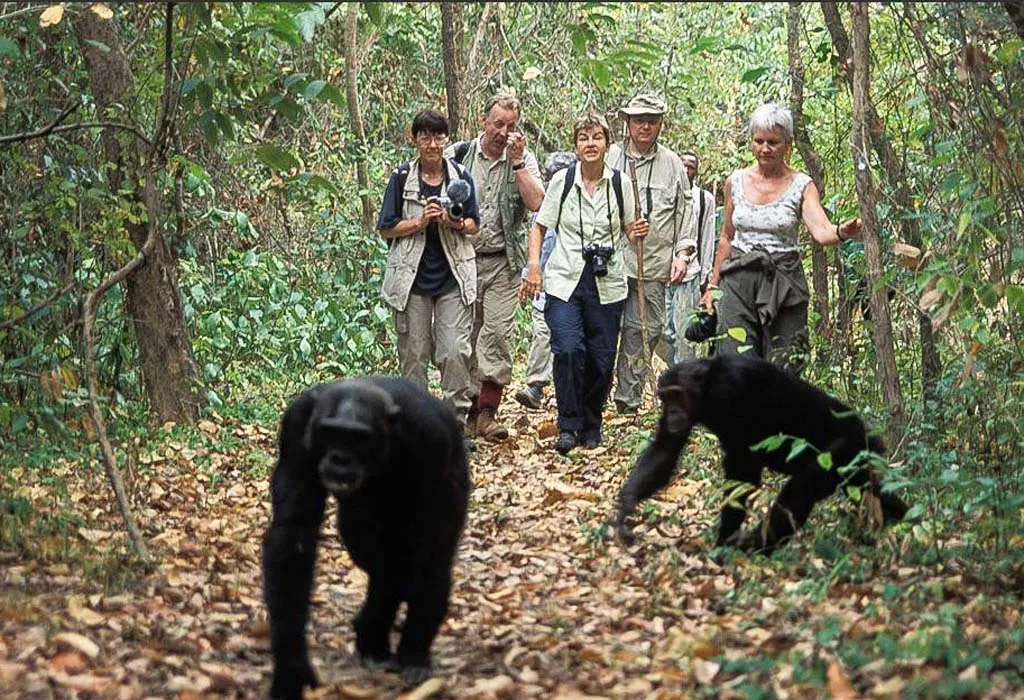
Yes. Many active older travelers successfully participate in chimpanzee trekking. Fitness, balance, mobility,ity and general health are more important than age alone. Travelers with physical concerns should discuss them before booking so the most appropriate chimpanzee destination can be selected.
What Happens If You Are Sick?
Visitors who are ill should not participate in chimpanzee trekking. Chimpanzees are genetically close to humans and can be vulnerable to infectious diseases transmitted by people. Travelers experiencing respiratory symptoms or other contagious illnesses should inform the ranger or safari operator rather than putting the chimpanzee community at risk.
Chimpanzee Trekking vs Chimpanzee Habituation
Standard chimpanzee trekking is the best choice for most first-time visitors because it is less expensive, requires less forest time, and fits easily into a wider Uganda safari. Chimpanzee habituation is designed for travelers wanting extended observation and a deeper understanding of chimpanzee behavior.
| Experience | Standard Chimpanzee Trekking | Chimpanzee Habituation Experience |
|---|---|---|
| Forest Time | Usually approximately 2–5 hours depending on where chimpanzees are located | Extended forest experience, usually beginning earlier and lasting much longer |
| Chimpanzee Observation | Up to one hour after the habituated chimpanzees are located | Up to approximately four hours with chimpanzees under the tourism experience |
| Group Experience | Regulated visitor group accompanied by ranger-guides | Smaller, more immersive and research-oriented forest experience |
| 2026 Kibale FNR Cost | US$250 | US$300 |
| Physical Demands | Moderate and generally suitable for most reasonably active travelers | Higher because substantially more time is spent walking and observing in the forest |
| Best Traveler Type | First-time visitors, couples, families with age-eligible children and general safari travelers | Photographers, primate enthusiasts, repeat visitors, tors and travelers interested in behavior. |
Is Chimpanzee Habituation Worth the Extra Cost?
For a 2026 Foreign Non-Resident, standard Kibale tracking costs US$250 while habituation costs US$300. The additional US$50 can represent excellent value for travelers who want substantially more time observing chimpanzees.
Photographers and serious primate enthusiasts are likely to appreciate the longer experience most. Travelers with limited safari time may prefer standard tracking and use the remainder of the day for Bigodi Wetland Sanctuary or another Kibale-area activity.
Chimpanzee Habituation vs Gorilla Habituation
Both experiences provide extended primate observation, but chimpanzees and gorillas behave very differently. Chimpanzees are highly mobile, vocal, and frequently move between the ground and canopy. Gorillas generally move more slowly and often remain easier to observe at ground level.
Travelers interested in both can combine chimpanzee habituation in Kibale with gorilla habituation in Bwindi for one of Uganda’s most intensive primate journeys.
Chimpanzee Trekking vs Gorilla Trekking

Chimpanzee trekking is generally less expensive than gorilla trekking and frequently involves lower-altitude forest. Chimpanzees, however, can move rapidly through the canopy, meaning the activity can involve more active pursuit once a community begins traveling.
Mountain gorilla trekking provides a different atmosphere, often involving a calmer observation period around a family group. Rather than choosing between them, travelers can combine Uganda chimpanzees with mountain gorilla trekking.
Photography Rules
Flash photography is prohibited during chimpanzee encounters. Travelers should prepare their cameras before reaching the chimpanzees because forest light can be surprisingly dark and chimpanzees may move rapidly between trees.
A camera capable of handling higher ISO settings and fast autofocus is useful. Photographers can prepare through Anthill Safaris’ chimpanzee photography safari guide.
Responsible Chimpanzee Tourism
Responsible chimpanzee tourism means respecting permit limits, maintaining the required distance, following health rules, avoiding flash photography, and never pressuring guides for unauthorized access. These regulations exist to reduce disturbance and protect chimpanzees from human disease.
Permit revenue contributes to conservation and protected-area management, while chimpanzee tourism creates employment for rangers, guides, drivers, lodge staff,ff and communities surrounding the forests. Travelers can strengthen this positive impact by combining Kibale trekking with community-based tourism at Bigodi.
Anthill Safaris can compare Kibale chimpanzee trekking, Budongo Forest, Kyambura Gorge and Kalinzu Forest Reserve before securing the option that fits your route and budget.
Travelers can also combine the Best Chimpanzee Trekking in Uganda with Queen Elizabeth National Park, gorilla trekking and wider Uganda primate safaris.
Book your Uganda chimpanzee trekking permits with Anthill Safaris and let our team confirm the correct visitor category, current permit rate, availability, accommodation and private safari transportation for your travel dates.
Best Time for Chimpanzee Trekking in Uganda, Weather, Difficulty and Packing
The Best Chimpanzee Trekking in Uganda can be experienced throughout the year, but the season you choose affects trail conditions, photography, visitor numbers, safari costs and the overall character of the forest. Uganda’s relatively drier periods generally provide easier walking conditions, while wetter months bring lush vegetation, dramatic rainforest scenery and fewer visitors. Travelers planning chimpanzee trekking in Uganda should therefore choose their travel dates according to personal priorities rather than assuming there is one perfect month for everyone.
Kibale National Park remains the benchmark for the Best Chimpanzee Trekking in Uganda, and its tropical rainforest climate means visitors should always be prepared for rain. Even during the drier months, a morning that begins with sunshine can change quickly. Proper footwear, lightweight waterproof clothing and a well-organized daypack are therefore important throughout the year.
Best Time for Chimpanzee Trekking in Uganda
For most travelers, the best time for chimpanzee trekking in Uganda is during the relatively drier periods from June through September and December through February. Trails tend to be firmer, forest walking can be easier, and road transfers between destinations are generally more straightforward. These months also work particularly well for travelers combining Kibale chimpanzee trekking with Queen Elizabeth National Park, Bwindi or other Uganda safari destinations.
The wetter periods from March to May and approximately October to November should not automatically be avoided. Travelers willing to accept rain and muddier conditions may enjoy greener landscapes, fewer visitors,s and excellent forest photography.
Is Chimpanzee Trekking Available Year-Round?
Yes. Chimpanzee trekking in Uganda generally operates throughout the year, subject to park operations and local conditions. Chimpanzees remain in their natural forests regardless of tourism season, so the difference between months relates more to rainfall, trail conditions and visitor comfort than whether chimpanzees are present.
This makes the best chimpanzee trekking destinations in Uganda suitable for both peak-season and lower-season travel.
Uganda’s Dry Seasons
Uganda generally experiences its main drier period from June through September and another shorter dry period from December through February. These periods are popular for primate trekking because less rainfall usually means firmer forest trails and easier road access.
However, “dry season” should never be interpreted as a guarantee of dry weather. Kibale is a rainforest, and showers can occur at almost any time. Travelers should still carry waterproof protection on every chimpanzee safari.
Uganda’s Rainy Seasons
The wetter periods generally occur from March through May and again around October and November. Rainfall can make trails muddy, increase humidity, ty and create more challenging walking conditions.
The advantages include deep green vegetation, atmospheric forest photography, and fewer tourists. Budget-conscious travelers may also find more attractive accommodation availability during some lower-demand periods.
January and February
January and February are excellent months for the Best Chimpanzee Trekking in Uganda. Conditions are often relatively dry, making forest trails easier to navigate. These months are especially suitable for travelers escaping the northern-hemisphere winter and combining primates with game drives.
Photographers can also benefit from easier equipment handling when rainfall is less frequent. Travelers planning a wider journey can combine chimpanzees with an Uganda gorilla safari.
March to May
March through May brings one of Uganda’s main rainy periods. Kibale becomes especially green, forest streams carry more water, and the entire landscape can appear intensely tropical. Walking conditions may become muddier,r and humidity can increase.
This period can nevertheless be rewarding for experienced travelers who value fewer visitors and rainforest atmosphere more than perfectly dry trails. Travelers should prioritize waterproof boots, quick-drying clothing,g and reliable rain protection.
June to September
June through September is generally the most popular period for Uganda primate safaris. Drier trails make forest walking more manageable, while the same months also provide excellent conditions for combining chimpanzees with wildlife parks and mountain gorilla trekking.
Demand can be high, so travelers should arrange chimpanzee trekking permits and accommodation well ahead of fixed travel dates.
October and November
October and November usually bring another wetter period. Forest conditions can become muddy, but the landscape is exceptionally green, and visitor numbers may be lower than during peak dry-season months.
November 2026 is particularly interesting for budget-conscious travelers because Uganda Wildlife Authority has introduced discounted low-season chimpanzee tracking rates for qualifying foreign non-residents and foreign residents. Travelers can review Anthill Safaris’ Uganda primate permit discounts before choosing dates.
December
December generally marks the beginning of another relatively dry period and is popular with travelers taking Christmas and New Year holidays. Forest trails may become easier, but demand for accommodation and permits can increase sharply around the festive season.
Couples and families traveling in December should therefore secure Kibale chimpanzee permits early.
Best Months for Chimpanzee Photography
June through September and December through February generally provide convenient conditions for chimpanzee photography because photographers spend less time protecting cameras from heavy rain. Anthill Safaris also identifies these drier periods as particularly favorable for classic Uganda photography.
However, rainy-season photography has its own advantages. Wet leaves, mist, rich forest colors, and soft light can create more atmospheric images. Photographers should therefore choose according to visual style rather than weather alone and can prepare through Anthill Safaris’ chimpanzee photography safari guide.
Best Time for Fewer Tourists
Travelers seeking fewer visitors should consider March through May and October through November. These periods tend to attract fewer international safari travelers than the major dry seasons.
A quieter forest does not mean private chimpanzee trekking, because visitor groups remain regulated, but lower overall tourism levels can make lodges and surrounding attractions feel more relaxed.
Best Time for Budget Travelers
April, May, and November 2026 are especially attractive for price-conscious travelers because Uganda Wildlife Authority has announced discounted low-season chimpanzee trekking permits for Kibale during these months.
Accommodation may also be easier to negotiate during lower-demand periods. Travelers prioritizing value can combine Kibale with Bigodi Wetland Sanctuary and other nearby activities rather than building an unnecessarily expensive itinerary.
Does Rain Affect Chimpanzee Trekking?
Rain normally does not automatically cancel chimpanzee trekking. Visitors should expect activities to continue unless rangers determine that conditions create a genuine safety or operational problem. Rain can make trails wetter, increase mud, and require slower walking.
Chimpanzees may also alter their movements according to weather and food availability. This unpredictability is part of the wild experience rather than a flaw in Kibale chimpanzee tracking.
How Difficult Is Chimpanzee Trekking?
Chimpanzee trekking is generally considered moderately demanding. The exact difficulty depends on where the chimpanzees have moved, trail conditions, rainfall, temperature,e and the traveler’s fitness.
Anthill Safaris notes that Kibale trekking can involve uneven terrain, mud, humidity, ty and variable walking distances, making preparation important even though the forest is generally less mountainous than Bwindi. :contentReference[oaicite:2]{index=2} Travelers can read more about chimpanzee trekking difficulty in Kibale.
Chimpanzee Trekking Terrain
Kibale includes established forest trails, roots, occasional slopes, muddy sections, ns and thick tropical vegetation. The terrain is generally less steep than mountain gorilla habitat, but high humidity can make the walk feel more demanding than the distance alone suggests.
Kyambura Gorge can be more physically challenging because trekkers descend into the forested gorge and later climb back toward the surrounding savannah. Travelers concerned about terrain should compare Kyambura chimpanzee trekking with Kibale before booking.
How Long Do You Walk?

Walking time varies because chimpanzees move freely through the forest. Some trekking groups may find them relatively quickly, while others walk for several hours. Published Anthill guidance notes that Kibale trek duration can vary substantially depending on chimpanzee location.
Travelers should therefore avoid assuming the trek will finish at an exact time and should not schedule an immediate long-distance transfer afterward.
Fitness Preparation
Most reasonably active travelers do not need specialized training. Walking three or four times per week before the safari, using stairs or hills,s and becoming comfortable spending several hours on your feet can improve the experience considerably.
Senior travelers should prepare according to personal health and mobility rather than age alone. Anthill Safaris provides additional guidance for senior chimpanzee trekkers.
What to Wear

Chimpanzee trekking clothing should be practical rather than fashionable. Long trousers protect the legs from vegetation and insects, while a lightweight long-sleeved shirt provides similar protection for the arms.
Neutral, breathable, quick-drying fabrics work particularly well. Anthill Safaris’ dedicated guide to what to wear for chimpanzee trekking also recommends preparing for sudden rain and humid forest conditions.
Best Shoes for Chimpanzee Trekking
Water-resistant or waterproof hiking shoes with strong tread are the safest general choice. Full heavy mountain boots are not essential for every Kibale trek, but footwear should provide enough grip for wet leaves, mud and exposed roots.
Travelers should wear their trekking footwear before the safari rather than arriving with completely new boots that may cause blisters.
Waterproof Clothing
A lightweight waterproof rain jacket should be carried regardless of the month. Breathable rain protection works better than a heavy jacket because tropical humidity can make insulated clothing uncomfortable.
During the rainy season, quick-drying trousers and waterproof footwear become particularly important. Similar wet-season preparation principles are discussed in Anthill Safaris’ rainforest weather preparation guide.
Daypack Essentials
A small comfortable daypack should hold drinking water, rain protection, camera equipment, insect repellent, sunscreen, personal medication, tissues, and any snacks permitted by park rules. A waterproof pack cover or internal dry bag helps protect electronics.
Do not carry an oversized backpack. Every unnecessary kilogram becomes noticeable after several hours of walking in humid forest.
Cameras and Photography Equipment
Chimpanzees move quickly and often remain beneath dark forest canopy. A camera with reliable autofocus and good high-ISO performance is extremely useful. A versatile zoom lens normally provides more flexibility than changing lenses repeatedly in humid conditions.
Flash photography is prohibited around chimpanzees. Travelers can prepare camera settings in advance using Anthill Safaris’ chimpanzee photography advice.
Binoculars
Binoculars are not essential for observing chimpanzees once they are close, but they can greatly improve the overall forest experience. Chimpanzees may initially remain high in the canopy, while other monkeys and birds can be difficult to identify without magnification.
Birdwatchers can combine chimpanzee trekking with birdwatching in Uganda or a guided walk around Bigodi.
Insect Protection
Tropical forests naturally contain mosquitoes and other insects. Apply suitable insect repellent, wear long clothing,g and avoid leaving large areas of skin exposed.
Travelers should also seek professional medical advice before visiting Uganda regarding malaria prevention and other travel-health considerations.
Should You Hire a Porter?
A porter is not essential for every chimpanzee trek, particularly in Kibale where many routes are manageable for reasonably fit visitors. However, hiring one can still be valuable for travelers carrying camera equipment, water, or a heavier daypack.
A porter also provides practical assistance on muddy or uneven sections while supporting local employment. Travelers concerned about physical demands can combine porter assistance with the preparation advice in Anthill Safaris’ Kibale trekking guide.
What Not to Bring
Avoid unnecessary heavy luggage, expensive accessories that serve no practical purpose, flash-dependent camera equipment, and food that cannot be carried or consumed according to ranger instructions. Bright or impractical clothing is less useful than neutral, quick-drying trekking wear.
Do not bring disposable items with the intention of leaving them in the forest. Everything carried into the protected area should be carried back out.
Complete Chimpanzee Trekking Packing List
A well-prepared traveler should have sturdy waterproof or water-resistant hiking shoes, comfortable long trousers, a long-sleeved breathable shirt, a lightweight waterproof jacket, a small daypack,k and adequate drinking water. Lightweight gloves can be useful when vegetation must be moved aside or used for balance, while gaiters provide extra protection in wet or muddy conditions. Anthill’s current clothing advice specifically recommends lightweight gloves for chimpanzee trekking.
Your daypack should also contain insect repellent, sunscreen, a hat, personal medication, tissues, a camera or smartphone, spare batteries, memory cards and waterproof protection for electronics. Photographers should carry only the lenses they genuinely expect to use rather than turning the trek into an equipment-carrying exercise.
Binoculars are worthwhile for chimpanzees high in the canopy and for Kibale’s other primates and birds. A reusable water bottle reduces unnecessary plastic waste and helps maintain hydration in humid forest conditions.
Travelers combining chimpanzees with Queen Elizabeth National Park should also carry lightweight safari clothing suitable for warmer savannah conditions. Those continuing to Bwindi for gorilla trekking should keep their waterproof boots, long trousers, gloves and rain jacket because the same core rainforest equipment remains useful.
The best packing strategy is therefore not to prepare for one perfect weather forecast but to prepare for change. Kibale’s tropical rainforest can move from cool morning conditions to warmth, humidity and sudden rain within the same trekking session.
Anthill Safaris can help travelers plan the Best Chimpanzee Trekking in Uganda according to season, preferred trekking session,n and wider safari route. Visitors can choose a Kibale chimpanzee safari, compare Kibale and Budongo, or add Kalinzu Forest to Queen Elizabeth National Park.
Travelers wanting a more intensive primate experience can choose chimpanzee habituation, while those planning a complete great-ape safari can combine Kibale with gorilla trekking in Bwindi.
Ultimately, June through September and December through February provide the easiest overall conditions for most travelers seeking the Best Chimpanzee Trekking in Uganda. March through May and October through November reward travelers who are comfortable with rain, prefer greener forest, a nd want fewer visitors. Regardless of the season, waterproof footwear, sensible clothing, and realistic fitness preparation matter more than trying to predict a perfectly dry trekking day.
Plan your chimpanzee trekking safari with Anthill Safaris and let our team match the best travel season, permits, accommodation, transportation and wider Uganda safari experiences to your preferred dates and budget.
Best Uganda Chimpanzee Safari Itineraries and Experiences to Combine
The Best Chimpanzee Trekking in Uganda becomes even more rewarding when the forest experience is built into a carefully planned safari rather than treated as an isolated activity. Kibale National Park works exceptionally well with Queen Elizabeth National Park, Bwindi Impenetrable National Park, Bigodi Wetland Sanctuary and Uganda’s crater-lake region, while Budongo Forest can be combined naturally with Murchison Falls National Park. Travelers with more time can add mountain gorillas, golden monkeys, birdwatching, community experiences and classic savannah wildlife to create a complete Uganda primate safari.
Anthill Safaris designs Uganda chimpanzee safaris around realistic driving times, permit availability and the traveler’s preferred pace. Short two- or three-day itineraries work well for visitors concentrating exclusively on Kibale, while five to eight days allow chimpanzees to be combined with gorillas and wildlife. Ten to fourteen days gives travelers enough time to explore Uganda’s major primate destinations without spending every afternoon transferring between parks.
Best Chimpanzee Trekking in Uganda Safari Itineraries
The strongest itinerary depends on how important chimpanzees are within the complete safari. Travelers visiting Uganda mainly for chimpanzees should give Kibale at least two nights, while those interested equally in chimpanzees and gorillas should connect Kibale with Bwindi through Queen Elizabeth National Park. Visitors wanting a broader national safari can incorporate Murchison Falls and Budongo before continuing south. Anthill Safaris’ Kibale and Bwindi safari demonstrates how western Uganda’s primate destinations can be connected efficiently.
2-Day Kibale Chimpanzee Trekking Safari
Safari Overview: The 2-Day Kibale Chimpanzee Trekking Safari is designed for travelers with very limited time who want the Best Chimpanzee Trekking in Uganda without adding several national parks. The journey normally begins in Entebbe or Kampala and travels west toward Fort Portal and Kibale National Park. The first day is primarily a scenic transfer and preparation day, while the second morning is dedicated to chimpanzee tracking before returning toward Entebbe. It is a fast-paced itinerary, so travelers who dislike long driving days should consider the three-day version instead.
Day 1 – Entebbe or Kampala to Kibale National Park: Meet your Anthill Safaris driver-guide after breakfast and begin the approximately five-to-six-hour drive toward Kibale, depending on traffic, stops and lodge location. Travel through central and western Uganda toward Fort Portal before continuing to the Kibale area. Check into your lodge, enjoy dinner and prepare your trekking clothing, permit documents and camera equipment for the following morning.
Day 2 – Chimpanzee Trekking and Return to Entebbe: After an early breakfast, transfer to the chimpanzee trekking briefing point. Enter Kibale Forest with an experienced ranger-guide and search for the habituated chimpanzee community. Once located, enjoy the regulated observation period before returning to headquarters. Have lunch and begin the drive back toward Entebbe or Kampala.
Recommended Accommodation: Turaco Treetops, Kibale Forest Camp, Chimpundu Lodge or another property matched to the traveler’s budget and trekking location.
Best For: Travelers with limited time, business visitors adding a short primate safari, and repeat Uganda travelers. Those wanting more time in the forest should consider Anthill Safaris’ 3-Day Kibale National Park Safari.
3-Day Kibale Chimpanzee Safari
Safari Overview: Three days is one of the best short itineraries for travelers whose priority is chimpanzee trekking. Unlike the two-day version, it gives visitors a complete day around Kibale and creates enough time to add Bigodi Wetland Sanctuary or the crater-lake region. This itinerary is ideal for first-time chimpanzee trekkers because the forest experience is not immediately followed by a long return drive. It also provides a better introduction to why Kibale is considered the benchmark for the Best Chimpanzee Trekking in Uganda.
Day 1 – Entebbe to Kibale: Depart Entebbe after breakfast and travel west for approximately five to six hours. Stop for lunch en route and continue through Fort Portal toward Kibale. Check into the lodge and spend the evening surrounded by western Uganda’s forest and crater-lake landscapes.
Day 2 – Chimpanzee Trekking and Bigodi Wetland: After breakfast, transfer to the chimpanzee trekking briefing point. Enter Kibale Forest in search of habituated chimpanzees and enjoy the permitted viewing period once the community is located. Return to the lodge for lunch before visiting Bigodi Wetland Sanctuary for a guided afternoon walk focusing on monkeys, birds, wetland vegetation and community conservation.
Day 3 – Kibale to Entebbe: Enjoy breakfast and begin the return drive toward Entebbe. Depending on flight timing, stops can be included around Fort Portal or along the route.
Recommended Accommodation: Chimpundu Lodge, Turaco Treetops, Primate Lodge Kibale or Kibale Forest Camp.
Best For: First-time chimpanzee trekkers, couples, photographers and travelers wanting a relaxed short primate safari. Anthill Safaris currently publishes a dedicated 3-day Kibale itinerary combining chimpanzees with surrounding nature experiences.
4-Day Chimpanzees and Queen Elizabeth Wildlife Safari
Safari Overview: This four-day journey provides one of Uganda’s strongest short combinations because it connects the Best Chimpanzee Trekking in Uganda with classic savannah wildlife. Kibale and Queen Elizabeth National Park are geographically close enough to combine without wasting entire days on transfers. Travelers can encounter chimpanzees beneath tropical forest canopy and then search for elephants, buffaloes, lions, antelopes and other wildlife across Queen Elizabeth National Park. A Kazinga Channel boat safari adds an entirely different wildlife perspective.
Day 1 – Entebbe to Kibale: Drive approximately five to six hours from Entebbe toward Kibale National Park. Check into your lodge and relax after the journey.
Day 2 – Kibale Chimpanzees and Bigodi: Trek chimpanzees in the morning before returning for lunch. Spend the afternoon exploring Bigodi Wetland Sanctuary or another Kibale-area nature experience.
Day 3 – Kibale to Queen Elizabeth National Park: Travel approximately two to three hours toward Queen Elizabeth National Park, depending on the lodge and route. Enjoy a game drive and later a boat safari along the Kazinga Channel. Anthill Safaris’ Queen Elizabeth safari activities can include game drives, boat cruises, birdwatching, and other wildlife experiences.
Day 4 – Morning Game Drive and Return to Entebbe: Begin with an early game drive before starting the approximately six-to-seven-hour journey toward Entebbe, depending on traffic and stops.
Recommended Accommodation: Turaco Treetops or Chimpundu Lodge near Kibale, followed by Elephant Plains, Buffalo Safari Lodge, Mweya Safari Lodge, or another Queen Elizabeth property.
Best For: First-time Uganda visitors who want primates and savannah wildlife within a short itinerary. Travelers wanting more time in Queen Elizabeth can consider a dedicated Queen Elizabeth National Park safari.
5-Day Uganda Chimpanzee and Gorilla Safari
Safari Overview: The 5-Day Uganda Chimpanzee and Gorilla Safari is one of the strongest great-ape itineraries for travelers with limited vacation time. It combines chimpanzees in Kibale National Park with mountain gorillas in Bwindi Impenetrable National Park. Because both activities involve regulated permits and specific start times, the itinerary should be confirmed around permit availability before non-refundable accommodation is booked. Travelers experience two very different primates: fast-moving, vocal chimpanzees in Kibale and family-oriented mountain gorillas in Bwindi’s highland rainforest.
Day 1 – Entebbe to Kibale: Depart after breakfast and drive approximately five to six hours to Kibale. Check into the lodge and prepare for chimpanzee trekking.
Day 2 – Chimpanzee Trekking: Enter Kibale Forest for morning chimpanzee tracking. After the trek, enjoy lunch and an optional Bigodi Wetland experience before returning to the lodge.
Day 3 – Kibale to Bwindi: Drive south through western Uganda toward Bwindi. Depending on the assigned gorilla trekking sector and road conditions, allow approximately six to eight hours. Check into a lodge close to the correct trekking headquarters.
Day 4 – Gorilla Trekking in Bwindi: Attend the morning briefing before entering the forest with UWA ranger-guides. After locating the assigned gorilla family, enjoy the regulated encounter before returning to the lodge.
Day 5 – Bwindi to Entebbe: Begin the approximately eight-to-ten-hour road journey back to Entebbe, or replace part of the road transfer with a domestic flight when the itinerary and budget allow.
Recommended Accommodation: Chimpundu Lodge or Turaco Treetops around Kibale followed by a lodge appropriate to the assigned Bwindi sector.
Best For: Great-ape enthusiasts, first-time Uganda visitors and travelers prioritizing primates over extensive game viewing. Anthill Safaris provides specialist planning for combining Kibale with gorilla trekking.
6-Day Uganda Primates and Wildlife Safari
Safari Overview: Six days allows travelers to add Queen Elizabeth National Park between Kibale and Bwindi, creating a compact but highly varied Uganda safari. Chimpanzees, savannah wildlife, a boat safari, and mountain gorillas can all be experienced within one route. The journey is active, but the geographical sequence makes sense and avoids unnecessary backtracking. It is an excellent option for travelers who want Uganda’s signature wildlife experiences but have less than one week on safari.
Day 1: Drive from Entebbe to Kibale National Park, approximately five to six hours.
Day 2: Complete morning chimpanzee trekking and spend the afternoon at Bigodi Wetland Sanctuary.
Day 3: Transfer approximately two to three hours to Queen Elizabeth National Park and enjoy an afternoon Kazinga Channel boat safari or game drive.
Day 4: Enjoy an early game drive before continuing south through the Ishasha region toward Bwindi. The day’s driving time depends on wildlife stops and the selected Bwindi sector.
Day 5: Complete mountain gorilla trekking in Bwindi and spend the remainder of the day relaxing at the lodge.
Day 6: Return to Entebbe by road or use a domestic flight when incorporated into the safari.
Recommended Accommodation: Midrange or luxury properties around Kibale, Queen Elizabeth and the correct Bwindi trekking sector.
Best For: Active travelers wanting chimpanzees, gorillas and classic wildlife within six days. Visitors particularly interested in game viewing can review Anthill Safaris’ gorilla and wildlife safari for additional routing ideas.
7-Day Uganda Gorilla and Chimpanzee Trekking Safari
Safari Overview: Seven days provides a much better pace than shorter great-ape itineraries. Travelers can dedicate full days to Kibale, Queen Elizabeth National Park and Bwindi without every activity being followed immediately by a long-distance transfer. The route delivers the Best Chimpanzee Trekking in Uganda alongside mountain gorillas, savannah wildlife and the Kazinga Channel. It can also be customized for photographers, couples or older travelers who prefer additional rest between activities.
Day 1: Travel from Entebbe to Kibale and check into the lodge.
Day 2: Complete chimpanzee tracking and enjoy Bigodi Wetland Sanctuary in the afternoon.
Day 3: Transfer to Queen Elizabeth National Park and enjoy an afternoon boat safari on the Kazinga Channel.
Day 4: Complete a morning game drive before traveling through Ishasha toward Bwindi.
Day 5: Trek mountain gorillas in Bwindi and return to the lodge for a relaxed afternoon.
Day 6: Enjoy a cultural experience, forest-edge activity or scenic relaxation around Bwindi or Lake Bunyonyi.
Day 7: Return toward Entebbe or take a domestic flight where appropriate.
Recommended Accommodation: Chimpundu Lodge, Turaco Treetops or similar near Kibale; Elephant Plains or comparable Queen Elizabeth accommodation; and a sector-matched Bwindi property.
Best For: Couples, photographers, first-time Uganda visitors and anyone wanting a comfortable great-ape itinerary. Anthill Safaris specializes in Uganda gorilla safaris that can be combined naturally with Kibale.
8-Day Uganda Primates Safari
Safari Overview: Eight days creates enough time for a deeper primate journey. Kibale chimpanzees, Bigodi Wetland, Queen Elizabeth wildlife and Bwindi gorillas can be combined with an additional primate or cultural experience. Travelers can also extend south toward Mgahinga for golden monkey tracking. This creates an exceptional three-primate journey featuring chimpanzees, mountain gorillas and golden monkeys within one country.
Day 1: Entebbe to Kibale.
Day 2: Chimpanzee trekking and Bigodi Wetland Sanctuary.
Day 3: Transfer to Queen Elizabeth National Park and complete an afternoon Kazinga Channel boat safari.
Day 4: Morning game drive and transfer through Ishasha toward Bwindi.
Day 5: Mountain gorilla trekking in Bwindi.
Day 6: Transfer toward Mgahinga or Kisoro with a scenic afternoon around Lake Mutanda or the Virunga foothills.
Day 7: Complete golden monkey tracking in Mgahinga before returning to your lodge.
Day 8: Return to Entebbe by road or domestic flight.
Recommended Accommodation: Appropriate midrange or luxury properties around Kibale, Queen Elizabeth, Bwindi and Kisoro/Mgahinga.
Best For: Dedicated primate enthusiasts. Travelers wanting inspiration for combining three major primate encounters can explore Anthill Safaris’ golden monkey tracking experiences.
10-Day Uganda Gorilla, Chimpanzee and Wildlife Safari
Safari Overview: Ten days is an excellent duration for travelers wanting the Best Chimpanzee Trekking in Uganda without sacrificing classic wildlife. The safari can begin with Murchison Falls or concentrate entirely on western Uganda. A particularly strong route includes Murchison Falls, Kibale, Queen Elizabeth National Park and Bwindi. The traveler experiences Nile wildlife, chimpanzees, game drives, boat safaris and mountain gorillas while moving gradually south across the country.
Day 1: Depart Entebbe and travel toward Murchison Falls National Park, optionally incorporating an appropriate stop along the northern route.
Day 2: Enjoy a morning game drive and Nile boat safari in Murchison Falls National Park.
Day 3: Explore another Murchison activity before continuing toward the Kibale region. This is a long transfer day and should begin early.
Day 4: Complete chimpanzee trekking in Kibale and visit Bigodi Wetland Sanctuary.
Day 5: Explore crater lakes or another Kibale-area activity before transferring to Queen Elizabeth National Park.
Day 6: Enjoy a morning game drive and afternoon Kazinga Channel boat safari.
Day 7: Drive through the Ishasha region toward Bwindi while looking for wildlife along the southern Queen Elizabeth route.
Day 8: Mountain gorilla trekking in Bwindi.
Day 9: Enjoy a relaxed cultural, scenic, or nature experience around southwestern Uganda.
Day 10: Return toward Entebbe or use a domestic flight.
Recommended Accommodation: A combination of quality properties in Murchison Falls, Kibale, Queen Elizabeth and Bwindi.
Best For: First-time Uganda visitors who want the country’s major primate and wildlife experiences in one journey. Anthill Safaris’ 10-day Uganda safari provides another strong long-form wildlife framework.
12-Day Complete Uganda Primate Safari
Safari Overview: Twelve days allow travelers to explore Uganda as a genuine primate destination rather than simply ticking off chimpanzees and gorillas. Kibale can receive several nights, providing time for either standard chimpanzee trekking or habituation, Bigodi Wetland Sanctuary, birdwatching, and crater lakes. Bwindi adds mountain gorillas, while Mgahinga can provide golden monkeys. Queen Elizabeth National Park adds wildlife between the forests, making the route both biologically diverse and geographically logical.
Day 1: Arrive in Entebbe and overnight.
Day 2: Drive toward Kibale National Park.
Day 3: Chimpanzee trekking and Bigodi Wetland.
Day 4: Add chimpanzee habituation, birdwatching, cratelakesss,s or a slower Kibale forest experience.
Day 5: Transfer to Queen Elizabeth National Park.
Day 6: Game drive and Kazinga Channel boat safari.
Day 7: Continue through Ishasha toward Bwindi.
Day 8: Gorilla trekking in Bwindi.
Day 9: Second gorilla trek, cultural experience or relaxation depending on interests and budget.
Day 10: Transfer toward Mgahinga or Lake Mutanda.
Day 11: Golden monkey tracking and Virunga scenery.
Day 12: Return toward Entebbe by road or air.
Recommended Accommodation: Carefully selected properties around Entebbe, Kibale, Queen Elizabeth, Bwindi and Mgahinga matched to the safari category.
Best For: Serious primate enthusiasts, photographers and repeat African travelers who want time to observe behavior rather than rush between destinations.
14-Day Uganda Primates and Wildlife Safari
Safari Overview: Two weeks allows the Best Chimpanzee Trekking in Uganda to form part of a complete national safari. The journey can include Murchison Falls, Kibale, Queen Elizabeth, Bwindi and Mgahinga while still allowing meaningful time in each destination. This itinerary is particularly suitable for travelers making a once-in-a-lifetime Uganda journey because it combines chimpanzees, mountain gorillas, golden monkeys, savannah wildlife, boat safaris, community activities and birdwatching.
Day 1: Arrival at Entebbe and overnight.
Day 2: Travel toward Murchison Falls National Park.
Day 3: Morning wildlife viewing and afternoon Nile boat experience.
Day 4: Additional Murchison exploration or optional chimpanzee experience in the Budongo landscape.
Day 5: Transfer toward Kibale National Park.
Day 6: Chimpanzee trekking and Bigodi Wetland.
Day 7: Crater lakes, birdwatching, community experience or additional primate activity around Kibale.
Day 8: Transfer to Queen Elizabeth National Park and enjoy an afternoon wildlife activity.
Day 9: Morning game drive and Kazinga Channel boat safari.
Day 10: Travel through Ishasha toward Bwindi.
Day 11: Mountain gorilla trekking.
Day 12: Cultural experience, second gorilla trek or transfer toward Mgahinga.
Day 13: Golden monkey tracking in Mgahinga.
Day 14: Return toward Entebbe by road or domestic flight.
Recommended Accommodation: A carefully balanced selection of midrange or luxury properties in each destination, chosen primarily for location, service quality and efficient access to activities.
Best For: Travelers who want Uganda’s most complete mixture of primates and wildlife. A route of this scale can draw inspiration from Anthill Safaris’ Uganda primates and Murchison Falls safari while adding additional days for a more relaxed pace.
Combining Chimpanzee Trekking with Gorilla Trekking
Combining chimpanzee and gorilla trekking is one of the strongest reasons to choose Uganda for a primate safari. Kibale and Bwindi protect two of Africa’s most sought-after great apes within the same country. Chimpanzees are energetic, vocal and highly mobile, while mountain gorillas are generally encountered within more stable family groups.
The contrast makes a Kibale and gorilla trekking safari more rewarding than simply completing two similar activities.
Kibale and Bwindi Impenetrable National Park
Kibale and Bwindi form the core of Uganda’s classic great-ape route. Travelers usually connect the forests through Queen Elizabeth National Park rather than driving directly without sightseeing. This breaks up the journey and introduces savannah wildlife between the two rainforest experiences.
Bwindi should always be booked according to the correct gorilla trekking sector because lodge location can dramatically affect morning logistics. Anthill Safaris’ Uganda gorilla safari planning can coordinate the gorilla permit, trekking sector, and accommodation with the earlier Kibale itinerary.
Chimpanzees and Queen Elizabeth National Park
Queen Elizabeth National Park is the easiest major wildlife destination to combine with Kibale because the two parks are relatively close. Travelers can leave Kibale after breakfast or another activity and reach Queen Elizabeth in time for an afternoon game drive or boat safari, depending on the route.
This combination creates one of the most efficient short Uganda safaris: chimpanzees in tropical forest followed by elephants, buffaloes, antelopes, lions and abundant birdlife in Queen Elizabeth National Park.
Chimpanzees and Murchison Falls National Park

Travelers wanting Murchison Falls have two choices. They can trek chimpanzees in Kibale and accept the longer transfer between western and northern Uganda, or they can use Budongo Forest as the chimpanzee component of the Murchison itinerary.
Budongo is especially attractive when safari time is limited because it allows primate trekking and Murchison wildlife to be combined without traveling to Kibale. Travelers can explore Murchison Falls safari logistics before deciding which route works best.
Chimpanzees and Golden Monkey Tracking
Golden monkey tracking provides an excellent third primate experience after Kibale chimpanzees and Bwindi gorillas. Mgahinga Gorilla National Park protects golden monkeys within the Virunga mountain landscape, creating a very different setting from Kibale’s lowland and mid-altitude tropical forest.
Travelers can include golden monkey trekking after Bwindi, particularly when trekking gorillas in the southern sectors or spending time around Kisoro and Lake Mutanda.
Bigodi Wetland Sanctuary
Bigodi Wetland Sanctuary is one of the most natural additions to Kibale chimpanzee trekking. The community-managed sanctuary provides guided walks through wetland and forest-edge habitat where visitors can search for monkeys, birds and other wildlife while supporting local conservation and livelihoods. Anthill Safaris’ current Kibale itineraries regularly combine chimpanzee trekking with Bigodi Wetland Sanctuary.
Community and Cultural Experiences
Community experiences help travelers understand the human landscapes surrounding Uganda’s forests. Around Kibale, visitors can learn about local agriculture, food, crafts, and conservation initiatives. Cultural activities should be community-led and designed so residents participate voluntarily and benefit economically from tourism.
Birdwatching Around Kibale
Kibale and Bigodi are exceptionally attractive for travelers combining primates with birdwatching. Forest canopy, wetlands, farmland and forest-edge habitats support very different bird communities. Slow birdwatching also increases the chance of detecting monkeys that general safari visitors may overlook.
Nature Walks

Guided nature walks provide a slower alternative to chimpanzee trekking. Instead of concentrating on one primate community, travelers can learn about forest vegetation, butterflies, birds, smaller primates and the ecological relationships that maintain Kibale’s biodiversity. Anthill Safaris outlines several possibilities in its guide to activities in Kibale National Park.
Crater Lakes
The Fort Portal and Kibale region contains beautiful crater-lake landscapes that work particularly well on arrival days, rest afternoons or days between demanding primate activities. Viewpoints, short walks and scenic drives add landscape variety without requiring another wildlife permit.
Uganda Chimpanzee and Gorilla Safari from Kigali
Kigali can be a practical gateway for travelers whose main Uganda objective is Bwindi, especially southern sectors. A regional itinerary can begin in Kigali, cross into southwestern Uganda for mountain gorillas and then continue north through Queen Elizabeth National Park toward Kibale. The journey can finish in Entebbe rather than returning to Rwanda.
This one-way approach can reduce unnecessary backtracking and works particularly well for travelers combining gorillas, wildlife and chimpanzees. Anthill Safaris already uses similar route logic in its Kigali to Bwindi and Entebbe itinerary.
Uganda Chimpanzee Safari from Entebbe
Entebbe remains the simplest gateway for a dedicated Kibale safari. Kibale lies roughly 300 kilometers west of Kampala, and Anthill Safaris’ current access guide describes road and air options for reaching the park. Getting to Kibale National Park by private safari vehicle also allows travelers to experience Fort Portal and western Uganda scenery along the way.
Luxury Chimpanzee Safaris
A luxury chimpanzee safari combines the Best Chimpanzee Trekking in Uganda with premium accommodation, private transportation, excellent guiding and a more relaxed pace. Luxury travelers may choose to stay several nights around Kibale, add the Chimpanzee Habituation Experience and incorporate domestic flights where they meaningfully reduce long road transfers.
The emphasis should be on privacy, location and quality of experience rather than simply choosing the most expensive room. A lodge close to Kibale’s trekking area can provide greater practical luxury than a more elaborate property requiring a long early-morning drive.
Midrange Chimpanzee Safaris
Midrange safaris provide one of the strongest balances between comfort and cost. Travelers can use quality lodges, private 4×4 transportation, and professional guides while directing more of the budget toward permits and additional activities. A Kibale chimpanzee safari can be structured comfortably at this level and extended toward Queen Elizabeth or Bwindi.
Budget Chimpanzee Safaris
Budget travel does not have to mean compromising the quality of the wildlife encounter. Travelers can select simpler accommodation, travel during lower-demand periods, and keep the itinerary geographically efficient. Kalinzu can be considered instead of Kibale when the safari is already passing through Queen Elizabeth National Park, while Budongo can provide an efficient alternative on a Murchison Falls route.
The most important cost-saving strategy is avoiding unnecessary mileage and accommodation nights rather than choosing unreliable services. A well-planned route can provide stronger value than an apparently cheap safari that spends most of the journey driving between poorly connected destinations.
Anthill Safaris can combine the Best Chimpanzee Trekking in Uganda with Kibale National Park, Queen Elizabeth and gorilla safaris, Murchison Falls National Park, Bwindi gorilla trekking and longer Uganda primate itineraries.
For travelers focused on great apes, the strongest route is usually Kibale, Queen Elizabeth and Bwindi. For travelers who want a broader national safari, Murchison Falls can be added before Kibale. For dedicated primate enthusiasts, Mgahinga and golden monkeys can extend the journey after Bwindi. Each version preserves chimpanzee trekking as a major experience rather than burying it inside an overcrowded itinerary.
The Best Chimpanzee Trekking in Uganda therefore becomes more valuable when the surrounding safari is intelligently designed. Two or three days is enough for Kibale alone; five to seven days can connect chimpanzees with gorillas and wildlife, while ten to fourteen days provides enough time for a complete Uganda primate and wildlife journey.
Plan your Uganda chimpanzee safari with Anthill Safaris and let our team coordinate chimpanzee permits, gorilla permits, private transportation, carefully selected accommodation, and the Uganda wildlife experiences that best fit your travel dates, budget, and preferred pace.
Planning Your Chimpanzee Trek, Accommodation, FAQs and Why Anthill Safaris
Planning the Best Chimpanzee Trekking in Uganda requires more than simply buying a chimpanzee permit. Travelers need to consider the trekking destination, transportation, accommodation location, safari duration, fitness, season, budget,ge,t and the other Uganda experiences they want to combine with chimpanzees. For most first-time visitors, Kibale National Park remains the strongest choice because it combines established chimpanzee trekking with excellent accommodation, other primates, birdlife and convenient access to Queen Elizabeth National Park.
Anthill Safaris can organize the entire journey from airport arrival to chimpanzee permit booking, private transportation, accommodation and onward safari arrangements. Travelers can book a short Kibale chimpanzee safari or incorporate chimpanzees into a longer Uganda itinerary featuring gorillas, game drives, boat safaris and cultural experiences.
How to Plan the Best Chimpanzee Trekking in Uganda
The first step is deciding how important chimpanzees are to your safari. If chimpanzee trekking is one of the main reasons for visiting Uganda, Kibale generally deserves at least two or three nights. This creates enough time for trekking, Bigodi Wetland Sanctuary, and surrounding nature experiences without arriving late one evening and departing immediately after the trek.
Travelers should then secure the appropriate chimpanzee trekking permit. Permit availability should ideally be confirmed before non-refundable accommodation is booked. Once the trekking date is secured, transportation and lodge selection can be built around it.
Getting to Kibale National Park
Kibale National Park lies in western Uganda near Fort Portal and can be reached by road or domestic aviation combined with a road transfer. Private road transportation remains the most common option because it allows travelers to stop along the journey and continue easily to other safari destinations afterward.
Anthill Safaris provides more detailed routing in its guide to getting to Kibale National Park.
Entebbe to Kibale
Most international chimpanzee safaris begin at Entebbe International Airport. Travelers normally drive through Kampala or use the most suitable western route toward Fort Portal before continuing to Kibale. Depending on traffic, stops and lodge location, the journey generally requires most of a travel day.
A private vehicle makes the transfer considerably more comfortable because departure time, lunch stops and scenic breaks can be adjusted to the traveler rather than a fixed public-transport schedule.
Kampala to Kibale
Kampala to Kibale is approximately 300 kilometers depending on the exact route and lodge, with road journeys commonly taking around five to six hours before allowing for longer sightseeing or meal stops. Travelers should leave reasonably early rather than planning to arrive after dark.
The route passes through western Uganda toward Fort Portal, one of the country’s most attractive highland towns and an excellent gateway to Kibale safari activities.
Bwindi to Kibale
Bwindi and Kibale are frequently combined because they provide Uganda’s two headline great-ape experiences: mountain gorillas and chimpanzees. Driving time varies substantially according to the Bwindi trekking sector, road conditions, and whether the route passes through Queen Elizabeth National Park.
Rather than treating the journey as a simple transfer, many travelers divide the route with wildlife experiences in Queen Elizabeth. Anthill Safaris specializes in combining Kibale with gorilla trekking, creating a logical western Uganda primate circuit.
Queen Elizabeth National Park to Kibale
Queen Elizabeth National Park is one of the easiest major safari destinations to combine with Kibale. Depending on the lodge locations, travelers can normally move between the two regions within part of a day, leaving enough time for another activity when departure is early.
This proximity makes a Queen Elizabeth wildlife safari one of the strongest additions to chimpanzee trekking. Travelers can experience chimpanzees in tropical forest before continuing to elephants, buffaloes, antelopes, lions and the Kazinga Channel.
Flying to Western Uganda
Travelers wanting to reduce road time can consider domestic flights from Entebbe toward western Uganda. Kasese Airstrip is one of the useful aviation gateways for the broader Kibale and Queen Elizabeth region, followed by a private road transfer to the selected lodge.
Flying is particularly attractive for luxury travelers, older visitors who prefer shorter driving days,s and travelers with limited vacation time. Anthill Safaris can also incorporate aviation into broader private flying safaris in Uganda.
Where to Stay for Chimpanzee Trekking

The best accommodation is not necessarily the most expensive lodge. Location matters enormously. Travelers participating in a morning chimpanzee trek should stay within a practical transfer of the briefing point rather than choosing a beautiful hotel that requires an unnecessarily early departure and long drive before trekking.
Kibale offers accommodation ranging from simple guesthouses and forest camps to comfortable midrange lodges and high-end properties. Anthill Safaris can match the lodge to the trekking session, overall route and budget.
Luxury Lodges
Luxury chimpanzee safaris prioritize privacy, excellent service, spacious rooms, quality meals and convenient access to the forest. High-end travelers may also add private transfers, longer stays around Kibale and the Chimpanzee Habituation Experience.
The real advantage of luxury is time and comfort rather than decoration alone. Spending three nights around Kibale can be more rewarding than staying at an expensive property for one rushed night before immediately transferring elsewhere.
Midrange Lodges
Midrange accommodation provides an excellent balance for most travelers. Comfortable rooms, private bathrooms, good meals and convenient forest access can be combined with a private safari vehicle without the cost of Uganda’s highest-end lodges.
Travelers wanting a wider midrange safari can review Anthill Safaris’ midrange Uganda safari options when budgeting for Kibale, Queen Elizabeth and Bwindi.
Budget Accommodation
Budget travelers can stay in simpler lodges, guesthouses and camps without compromising the actual chimpanzee encounter. The chimpanzees and ranger-guided forest activity remain the same regardless of whether the traveler sleeps in a luxury suite or a modest room.
The most effective budget strategy is to choose accommodation close to activities and keep the route geographically efficient rather than wasting money on unnecessary fuel and extra travel days.
How Many Days Do You Need?
Two days is possible for travelers with extremely limited time, but three days is a much better minimum for a dedicated Kibale safari. Three days generally allows one travel day to Kibale, one full chimpanzee and nature day, and one return day.
Travelers combining chimpanzees with Queen Elizabeth should allow around four days or more. Those adding mountain gorillas should consider five to seven days, while ten to fourteen days provides enough time for a fuller Uganda primate and wildlife safari.
How Much Should You Budget?
The budget depends on permit category, accommodation level, trip duration, group size,e and transportation. A short chimpanzee safari requires a chimpanzee permit, vehicle, fuel, accommodation, meals and guide services. Longer safaris add park fees and other activities.
Travelers should compare complete package prices rather than chimpanzee permits alone. A low permit price can still lead to an expensive safari if the chosen forest requires major detours or additional hotel nights.
Private vs Group Chimpanzee Safaris
Private safaris provide flexibility over departure times, photo stops, accommodation and the overall route. They work especially well for couples, families, photographers and travelers combining several national parks.
Group safaris can reduce the cost per person because vehicle and guide expenses are shared. However, participants must normally follow a fixed departure date and itinerary. Anthill Safaris can explain the differences between private and group safari travel before booking.
Chimpanzee Trekking for Couples

Chimpanzee trekking works exceptionally well for couples because the activity can be combined with private lodges, crater-lake scenery, Queen Elizabeth National Park and mountain gorillas. Couples can travel in a private 4×4 and adjust the itinerary around preferred accommodation and pace.
A longer great-ape journey can combine Kibale with an Uganda gorilla safari, creating two completely different primate encounters within the same holiday.
Chimpanzee Trekking for Families
Families should first confirm the minimum trekking age applicable to the chosen forest. Age requirements can differ between UWA-managed destinations and forests operating under other management arrangements.
For age-eligible children who enjoy wildlife and walking, chimpanzee trekking can be an exceptional educational experience. Families should select an appropriate lodge, avoid excessively long itineraries,s and allow enough rest between major activities.
Chimpanzee Trekking for Solo Travelers
Solo travelers can join a scheduled chimpanzee tracking group while still having a private driver-guide for the rest of the Uganda safari. This provides independence without requiring the traveler to organize transportation and accommodation alone.
Solo visitors who want a deeper wildlife journey can combine Kibale with Queen Elizabeth, Bwindi or a longer Best of Uganda safari.
Chimpanzee Trekking for Seniors
Many active seniors can successfully trek chimpanzees. Fitness, balance and mobility matter more than age alone. Kibale is generally a good choice because many trails are less steep than mountain gorilla trekking terrain, although chimpanzees can still move considerable distances.
Older travelers can prepare using Anthill Safaris’ chimpanzee trekking guide for seniors and can discuss private transfers or domestic flights when long road journeys are a concern.
Chimpanzee Trekking Photography Safaris
Chimpanzee photography is challenging because the animals move rapidly through dark forest environments. Photographers should use cameras capable of handling higher ISO settings, reliable autofocus, and sufficiently fast shutter speeds. Flash photography is prohibited.
A standard one-hour encounter can produce excellent photographs, but serious photographers may prefer the longer Chimpanzee Habituation Experience. Anthill Safaris can customize a chimpanzee photography safari with additional forest time and fewer rushed transfers.
Uganda Chimpanzee Trekking FAQs
1. Is Chimpanzee Trekking Safe?
Chimpanzee trekking is conducted with trained ranger-guides and habituated chimpanzee communities. Visitors should remain with the guide, maintain the instructed distance,nce and follow all forest rules. Chimpanzees are powerful wild animals, so responsible behavior is essential even though organized trekking is carefully managed. Travelers can review Anthill Safaris’ guide to chimpanzee trekking safety.
2. Are Chimpanzee Sightings Guaranteed?
No ethical operator can guarantee a wild chimpanzee sighting. Kibale nevertheless offers excellent probabilities because of long-term habituation and regular monitoring. This strong reliability is one reason Kibale is widely considered the benchmark for the Best Chimpanzee Trekking in Uganda.
3. Can Chimpanzees Attack Tourists?
Chimpanzees are extremely strong wild primates and should never be approached casually. Habituated tourism groups are accustomed to controlled human presence, but visitors must follow ranger instructions, keep the required distance, and avoid behavior that could disturb the animals.
4. What Happens If It Rains?
Chimpanzee trekking usually continues during rain unless rangers determine that conditions create a genuine safety or operational concern. Travelers should expect muddy trails and carry waterproof clothing. Rain is normal in tropical rainforest even during relatively drier months.
5. What Should I Wear for Chimpanzee Trekking?
Wear long trousers, a lightweight long-sleeved shirt, sturdy walking or hiking shoes, and d a waterproof jacket. Neutral, breathable, quick-drying fabrics work particularly well. Anthill Safaris provides additional advice on what to wear for chimpanzee trekking.
6. Can Children Trek Chimpanzees?
Children can participate once they meet the minimum age required by the authority managing the selected chimpanzee destination. Families should verify the current age requirement before purchasing permits because it can differ between forests.
7. How Close Can Tourists Get to Chimpanzees?
Visitors should maintain the separation instructed by ranger-guides and should never deliberately move closer for photographs. If chimpanzees approach, remain calm and follow the guide’s instructions rather than attempting to touch or follow them.
8. Can I Use Flash Photography?
No. Flash photography is prohibited around chimpanzees. Forest light can be dark, so photographers should prepare their camera settings before the encounter and use higher ISO, appropriate aperture, and a sufficiently fast shutter speed when necessary.
9. How Long Does Chimpanzee Trekking Take?
The entire activity can take several hours because the chimpanzees must first be located. Walking duration varies from day to day depending on chimpanzee movement, weather, and forest conditions. Travelers should avoid planning another tightly timed activity immediately afterward.
10. Is Kibale National Park Worth Visiting?
Yes. Kibale is worth visiting even beyond chimpanzee trekking because the park has exceptional primate diversity, birdlife and tropical forest scenery. Nearby Bigodi Wetland Sanctuary, Fort Portal and crater lakes add further reasons to spend several nights in the region. Anthill Safaris’ Kibale National Park guide covers the wider destination.
11. Is Kibale Better Than Budongo?
Kibale is generally the stronger choice when chimpanzees are a primary safari objective. Budongo becomes extremely attractive when the traveler is already visiting Murchison Falls National Park because it avoids the need for a major detour. Anthill Safaris provides a detailed Kibale versus Budongo comparison.
12. Is Chimpanzee Trekking Harder Than Gorilla Trekking?
Not generally, although individual treks vary. Mountain gorilla trekking can involve steeper highland terrain, while chimpanzees can move quickly through the forest and require travelers to keep walking once a community begins traveling. Fitness requirements therefore differ rather than one activity always being harder.
13. Can Gorillas and Chimpanzees Be Seen on One Safari?
Yes, and Uganda is one of the best countries in Africa for doing so. Travelers can trek chimpanzees in Kibale and continue through Queen Elizabeth National Park toward Bwindi for mountain gorillas. Anthill Safaris can arrange a Kibale and Bwindi safari combining both great apes.
14. How Many Days Should I Spend in Kibale?
Two nights is a useful minimum, while three nights is better for travelers who want chimpanzee trekking, Bigodi, crater lakes,s or another nature activity without rushing. Photographers and habituation participants may benefit from an additional night.
15. Do I Need a Porter for Chimpanzee Trekking?
A porter is optional for most travelers. Hiring one can nevertheless help carry water, rain gear, and camera equipment, particularly during wet conditions. Using local porter services also creates direct employment around tourism destinations.
16. Can Chimpanzee Permits Sell Out?
Yes. Permit availability can become limited during popular travel months and on dates needed by larger groups. Travelers with fixed itineraries should arrange permits before confirming non-refundable safari services. Anthill Safaris can assist with chimpanzee permit reservations.
17. What Other Primates Can I See in Kibale?
Kibale supports numerous primates in addition to chimpanzees, including black-and-white colobus, red colobus, red-tailed monkeys, blue monkeys and L’Hoest’s monkeys. The exact species seen varies by trail and day, but the diversity makes Kibale one of Africa’s great primate destinations.
18. Where Should I Fly Into for a Uganda Chimpanzee Safari?
Entebbe International Airport is the main international gateway for most Uganda chimpanzee safaris. Travelers can then continue by private road transfer or use a domestic flight toward western Uganda before completing the final transfer to Kibale.
19. How Far Is Kibale from Bwindi?
The road journey varies according to the Bwindi trekking sector, lodge location, and route. Travelers should generally treat Kibale–Bwindi as a substantial transfer rather than a short drive. Many itineraries break the journey with Queen Elizabeth National Park, creating a more enjoyable progression from chimpanzees to wildlife and finally mountain gorillas.
20. Is Chimpanzee Trekking Worth the Money?
For travelers interested in primates, animal behavior and natural forests, chimpanzee trekking offers exceptional value. Chimpanzees are intelligent, vocal and highly social, and the forest search itself is an important part of the experience. Combining the trek with Bigodi or another Kibale activity increases the value of spending several nights in the region.
Why Book Your Uganda Chimpanzee Safari with Anthill Safaris
Anthill Safaris can coordinate the practical details that determine whether a chimpanzee safari feels smooth or unnecessarily complicated. These include permit availability, appropriate accommodation, private transportation, airport transfers,s and realistic driving times between parks.
Travelers can focus on Kibale chimpanzee trekking, choose a longer Chimpanzee Habituation Experience, or incorporate chimpanzees into a complete Uganda safari itinerary.
Anthill Safaris can also compare Kibale with Budongo Forest, Kyambura Gorge and Kalinzu Forest Reserve. This allows travelers to choose the destination that fits the complete safari instead of automatically selecting a forest based only on permit price.
Great-ape enthusiasts can continue from Kibale to Bwindi gorilla trekking, while wildlife travelers can add Queen Elizabeth National Park, Murchison Falls or another established Uganda safari destination.
Plan the Best Chimpanzee Trekking in Uganda with Anthill Safaris
The Best Chimpanzee Trekking in Uganda begins with selecting the correct forest and then designing the safari around that decision. Kibale National Park remains the benchmark for most first-time visitors, but Budongo can be ideal for Murchison Falls itineraries, while Kyambura and Kalinzu work extremely well for travelers already visiting Queen Elizabeth National Park.
Two or three days is enough for a focused Kibale safari, while five to seven days allows travelers to combine chimpanzees with gorillas and wildlife. Ten days or longer creates enough time for a comprehensive Uganda journey featuring multiple forests, national parks and primate encounters.
Whether you are planning standard chimpanzee trekking, the Chimpanzee Habituation Experience, a photography-focused safari or a combined gorilla and chimpanzee journey, careful logistics make a major difference to the experience.
Plan the Best Chimpanzee Trekking in Uganda with Anthill Safaris and let our team customize your chimpanzee permits, habituation experience, accommodation, private transportation, gorilla trekking, ng and complete Uganda safari around your preferred travel dates and budget.